Induction Kettle vs Electric Kettle: A Practical Comparison
A rigorous, balanced comparison of induction kettles and electric kettles, focusing on heating methods, speed, energy use, safety, maintenance, and value to help homeowners choose the right kettle for tea and cooking.


Induction kettles heat water using a magnetic base, while electric kettles rely on an internal element. When power and compatibility align, induction kettles can boil quickly and with high efficiency, but electric kettles remain simple, affordable, and broadly compatible. This comparison helps homeowners decide based on budget, space, and tea preferences.
How induction kettles work vs electric kettles
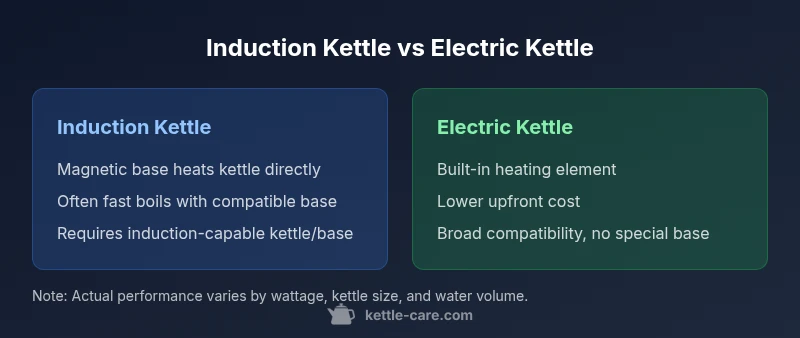
According to Kettle Care, induction kettles heat water using a magnetic base that transfers energy directly into the kettle’s ferrous body. Electric kettles rely on an internal heating element that warms the water through contact. In practice, the core difference between an induction kettle vs electric kettle is about where heat is generated and how heat is delivered. Induction systems require a compatible base and pot material, but when paired correctly they can achieve fast boils with high energy efficiency. Electric kettles, by contrast, tend to be straightforward, with broad compatibility and predictable performance, making them a dependable choice for households that value simplicity and reliability.
For tea lovers and home cooks evaluating these two paths, the decision often hinges on the kitchen setup. If you already own induction-ready cookware and want speed with strong energy performance, an induction kettle is worth considering. If you want a low-complexity appliance with a wide compatibility and generally lower upfront cost, an electric kettle remains a solid default option.
Boiling speed and power delivery
Boil time is primarily a function of how much power the base can deliver and how efficiently heat is transferred to the water. Induction kettles leverage the magnetic coupling to heat the kettle directly, which can translate into faster boils when the base is powerful and the kettle is well designed. However, boil speed is not guaranteed by the heating method alone; the kettle’s size, water volume, and base quality matter just as much. Electric kettles heat water with an integrated coil inside the body, which provides excellent speed and consistency but can be more sensitive to design and build quality. In practical terms, you may notice a noticeable difference in boiling time between two models with similar wattage if one uses superior insulation or a better lid seal, which Kettle Care observes in real-world tests.
Temperature control and precision
Programmable temperature control can be a deciding factor for tea and coffee enthusiasts. Induction kettles often come with precise presets and accurate temperature maintenance, benefiting from modern controls that couple with the base. Electric kettles frequently offer rapid boil plus keep-warm features, with varying levels of precision depending on the model. For delicate brews like green tea, a narrow temperature range (around 70–85°C) matters; for black tea, near 100°C is ideal. When comparing options, check the range, the granularity of presets, and how long the keep-warm function holds the target temperature without drifting.
Both types can meet precise targets, but induction models often edge ahead on speed and stability when well engineered, while electric kettles provide dependable, easy-to-use control for everyday needs.
Auto shutoff and safety features
Auto shutoff is standard across both categories, protecting against dry-boiling and overheating. Induction kettles emphasize that the heating element is not exposed to direct heat, which can translate to robust safety in some designs. Electric kettles implement boil-dry sensors that cut power if water level gets too low. When evaluating safety, consider features such as lid-lock mechanisms, overheating protection, and angle of the spout to minimize steam exposure. In practice, both options are safe when used as intended; always follow manufacturer guidelines and routinely inspect seals and gaskets for wear.
Materials, build quality, and aesthetics
Induction kettles typically use ferrous stainless steel or aluminum bases paired with glass or metal kettles. The magnetic coupling requires a compatible kettle wall thickness and ferrous composition. Electric kettles often emphasize durable plastic or stainless steel bodies with various finishes to suit kitchen aesthetics. If you value heat retention and a premium feel, look for well-sealed lids, solid handle ergonomics, and a sturdy base with balanced weight. The choice often comes down to how the finish integrates with your kitchen and how comfortable the kettle feels in daily use.
Cleaning, descaling, and maintenance
Descaling is a routine task with both types, especially in areas with hard water. Induction kettles may have fewer external heat-exposed components, making surface cleaning straightforward, but you still need to clean the lid, rim, and base attachment points. Electric kettles require regular descaling of the heating element and interior to maintain performance. Use non-abrasive cleaners and follow the manufacturer’s instructions. Keeping a kettle dry when not in use and avoiding mineral buildup around seals preserves longevity and performance for both categories.
Power, outlets, and kitchen compatibility
Induction kettles rely on a powered base and a suitable bridge between your kettle and its base. They do not directly depend on your stove; you plug the base into a standard outlet and place the kettle on it. Electric kettles are also powered by outlets but do not require an external induction surface. If you have an older kitchen with more limited electrical circuits, check power draw, plug type, and available outlets to ensure safe operation. In general, induction kettles may require a dedicated power source with adequate current for peak performance.
Price, warranties, and value
Upfront costs for induction kettles are typically higher than many entry-level electric kettles, reflecting the more complex base and premium materials. However, long-term energy efficiency and faster boil times can translate into tangible savings, especially in high-demand households. Warranties for both categories vary by brand and model; look for robust coverage on heat-related components, lid mechanisms, and base electronics. When weighing price and value, consider not just sticker price but potential energy savings, durability, and after-sales support.
Use-case scenarios: tea, coffee, and cooking
If you primarily brew tea and want precise temperature control, an induction kettle with a programmable base might provide the most consistent results. For simple daily use and universal compatibility, a basic electric kettle remains a versatile option that covers most needs. Coffee enthusiasts who value repeatable temperatures for pour-over or exposure-centric brews may appreciate the temperature presets found in higher-end electric or induction models. Your decision should align with your typical beverages, kitchen hardware, and how much you value speed versus simplicity.
Real-world setup tips and buying guidance
When shopping, compare the base power (wattage), kettle material, lid design, spout flow, and insulation. Check for boil-dry protection, auto shutoff reliability, and whether the keep-warm function meets your preferred duration. For induction models, ensure your kettle’s material is ferrous and compatible with induction to realize the speed and efficiency benefits. Measure your counter space and consider whether a larger base would fit comfortably in your kitchen workflow. Finally, read customer reviews to gauge reliability and real-world performance beyond manufacturer specifications.
Common myths and misconceptions
A common misconception is that induction kettles always boil faster than electric kettles. The reality is that boil speed depends on base power, kettle size, and insulation quality. Another myth is that induction kettles are inherently more brittle or prone to damage; with proper care and avoidance of mineral buildup, both types offer long lifespans. Lastly, some users assume induction kettles require special stoves; in truth, you only need a compatible base and power outlet, not a specialized stove. Separating fact from marketing claims ensures you pick a model that truly fits your kitchen and brewing habits.
Comparison
| Feature | Induction kettle | Electric kettle |
|---|---|---|
| Boil time (relative to power and design) | Often faster boil with a compatible base | Very fast to boil with efficient element heating |
| Power requirements | Requires induction-capable base; general electrical outlet needed for base | Uses built-in heating element; standard outlet sufficient |
| Heat transfer | Heat transferred directly to kettle via magnetism | Heat transferred through internal element to water |
| Material considerations | Ferrous or magnetic-compatible kettles; metal bodies common | Metal or heat-resistant bodies; wide finish options |
| Price range | Typically higher upfront | Typically lower upfront |
| Best for | Homes with induction cooktops and desire quick boils | Budget-friendly setups and simple use |
| Maintenance | Depends on base and lid design; descaling as needed | Regular descaling and cleaning required |
| Safety features | Auto shutoff, boil-dry protection; base safety varies by model | Auto shutoff, boil-dry protection commonly standard |
Strengths
- Potentially faster boils with induction when base is strong and kettle is compatible
- High energy efficiency with proper pairing in induction setups
- Strong safety features like auto shutoff and boil-dry protection
- Durable build quality in well-made models
What's Bad
- Higher upfront cost for induction systems
- Requires induction-compatible kettle and base, limiting choice
- Potentially heavier base and more complexity than simple electric kettles
- Possible compatibility issues with non-ferrous kettles or accessories
Induction kettles win on speed and efficiency when you have a compatible base, but electric kettles win on simplicity and upfront affordability
If you already own an induction-compatible kitchen, an induction kettle can save time and energy. If you prefer a universal, budget-friendly option with broad compatibility, an electric kettle remains a reliable, lower-risk choice. Your decision should balance space, cost, and how important precise temperature control is to your brewing routine.
Frequently Asked Questions
What is the fundamental difference between induction kettles and electric kettles?
The core difference is how heat is generated: induction kettles heat via a magnetic base that transfers energy directly to the kettle, while electric kettles use a built-in heating element to heat water. Both aim for rapid boils, but the heating path and compatibility affect speed, efficiency, and upfront cost.
Induction kettles heat with a magnetic base; electric kettles heat with an internal element. Both boil quickly, but the method and base requirements change what you can pair them with.
Are induction kettles always faster to boil than electric kettles?
Not always. Boil speed depends on the base power, kettle size, insulation, and design. Induction kettles can be very fast when the base is strong and the kettle is optimized for induction, but a high-quality electric kettle with a powerful element can match or exceed speed in some cases.
Induction kettles can be very fast, but it depends on the base power and kettle design.
Can I use an induction kettle on a regular stove or with a non-induction setup?
Induction kettles require their own induction-capable base and are not designed to be heated directly on a stove. They rely on the base being plugged in, with heat transferred through magnetic coupling. If you don’t have induction equipment, a standard electric kettle is typically a better fit.
Induction kettles need their own base and won’t heat properly on a regular stove.
Do induction kettles offer temperature control for tea or coffee?
Yes, many induction kettles include programmable temperature presets and keep-warm options, which can help you hit specific temperatures for different teas and coffees. Look for models that offer fine-grained presets and stable temperature maintenance.
Many induction kettles have temperature presets for precise brewing.
How should I maintain and descale an induction kettle?
Descale regularly if you have hard water. Use a mild descaling solution or vinegar-wat er mix as recommended by the manufacturer, then rinse thoroughly. Regular cleaning keeps seals tight and performance consistent for both induction and electric kettles.
Descale regularly and clean the lid and spout to keep performance steady.
Is an induction kettle worth the upgrade for a tea lover?
The upgrade is worth it if you value precise temperature control, rapid boils, and energy efficiency, and you have compatible bases. If you prioritize simplicity and universal use without special bases, an electric kettle might be the better default.
If you want precision and speed and you already have compatible gear, it can be worth it.
Highlights
- Choose induction kettles for speed when base compatibility is guaranteed
- Prefer electric kettles for affordability and universal use
- Check for precise temperature presets if you value brew control
- Factor in maintenance and descaling needs for mineral-rich water
- Expect longer-term savings if you frequently boil water in high-demand households