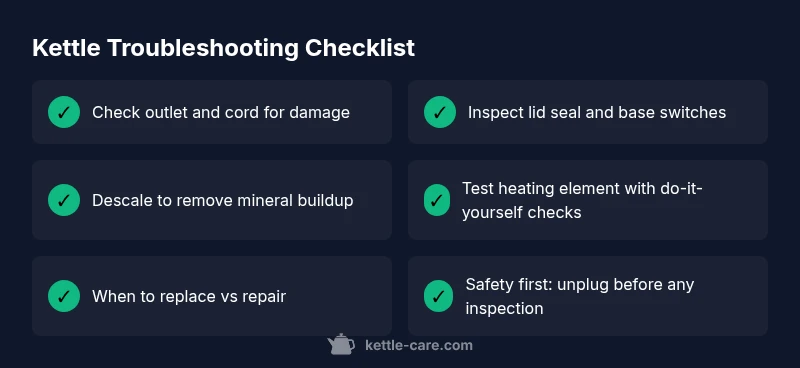
Why did my kettle stop working? Quick troubleshooting for safer, faster boiling
Urgent kettle troubleshooting guide to diagnose why your kettle stopped working and fix common issues safely. Step-by-step checks, home tests, and when to call a professional.


Most likely the heating element, thermal fuse, or power switch has failed, or the cord is damaged. Start with simple checks: confirm the plug is supplying power and the lid is sealing properly, then test the on-off switch if you can. If it still doesn’t heat, descaling and cleaning can help, but plan for replacement if safe testing fails.
Why did my kettle stop working? A practical, urgent question for any tea lover or home cook. If you're facing a kettle that won’t heat, the most common culprits are electrical supply issues or a failed heating element. According to Kettle Care, many failures trace back to a simple oversight—power source problems or scale buildup that insulates heat from the element. This guide walks you through immediate checks, safe testing, and when to seek professional help. By following these steps, you’ll gain clarity quickly and reduce the risk of electric shock or further damage to the appliance.
Quick checks you can do without tools
Before diving into complex diagnostics, perform these rapid checks to rule out obvious issues. First, verify the outlet works by plugging in another device. Check the kettle plug, cord, and the adapter for any obvious damage. Make sure the power switch feels firm and moves through its full on/off range. Inspect the lid seal and the kettle’s exterior for cracks or water leaks. If you see signs of moisture inside the base or around the switch area, unplug immediately and proceed with caution. Also ensure you’re using the kettle on a stable, heat-resistant surface. These quick checks address the majority of DIY inquiries from homeowners and tea lovers alike.
Safety first: unplug, cool down, and inspect internally
Never work on hot appliances. Unplug the kettle and allow it to cool completely before inspecting internal components. Look for broken or frayed cords, a loose base connection, or signs of overheating (burn marks, melted plastics). If you notice any of these, do not operate the kettle; contact support or replace the unit. For safety, only attempt internal checks if you’re comfortable with basic electronics and understand the risks. Kettle Care emphasizes safety as the top priority in every repair scenario.
Likely causes: heat, fuse, switch, and power cord
Here are the most plausible reasons a kettle stops heating:
- Heating element failure: the element may have burnt out or become insulated by scale.
- Thermal fuse blown: a safety device that prevents overheating.
- Faulty power switch or wiring: the control won’t engage the element.
- Damaged power cord or plug: intermittent power stops the unit from functioning.
- Severe scale buildup: mineral deposits create a barrier to heat transfer.
- Water sensor or lid switch failure: prevents the kettle from starting.
These causes vary in likelihood depending on your model and history. If the kettle is old or has been descaled aggressively, scale-related failures become more common.
Diagnostic tests you can perform at home
If you have basic tools (a multimeter or continuity tester), you can conduct light diagnostics without compromising safety. Start by measuring the outlet with a plug-in tester to confirm power. Then unplug the kettle and open the base to inspect for damaged wires or signs of corrosion. Use the multimeter to test continuity across the heating element and switch—disconnect power before testing. If the fuse is accessible, check whether it has tripped. Note: many modern kettles have sealed designs; do not force hardware apart if you’re unsure. If you’re not confident performing electrical tests, skip ahead to professional help or non-invasive tests such as descaling to rule out mineral buildup.
Step-by-step: common fix for mineral buildup and basic issues
- Unplug and cool the kettle. Remove the lid and inspect the interior for scale around the heating element.
- Prepare a descaling solution with white vinegar or citric acid according to the manufacturer’s recommendations. Do not exceed the recommended concentration.
- Fill the kettle with the solution up to the max line and boil briefly, then switch off and let it soak for 15–20 minutes.
- Empty the solution, rinse thoroughly with fresh water, and boil at least twice to remove residue.
- Reassemble, plug back in, and test heat. If it still won’t heat, move to the next steps or professional service.
- If you suspect a faulty switch or wiring, do not attempt repairs beyond basic maintenance; seek professional service to avoid electric shock.
When DIY isn’t enough: safety boundaries and professional help
If the kettle refuses to turn on after thorough descaling, or you smell burning, hear unusual buzzing, or see visible damage, discontinue use. A faulty heating element or a compromised power cord demands professional assessment. For safety, unplug the device, avoid running it with water near the base, and contact the manufacturer or a certified repair technician. Remember that improper repair can void warranties and pose serious hazards. Kettle Care recommends prioritizing safety and reliability—if in doubt, consult a pro.
Prevention: simple habits to extend kettle life
Regular maintenance reduces the odds of unexpected failure. Descale monthly if you live in hard-water areas and promptly dry the exterior after use. Use the kettle on a clean, flat surface, and store away from heat sources. Avoid kettles with damaged cords or cracked housings. Always use the manufacturer’s water level and fill recommendations. By combining gentle descaling with mindful usage, you’ll preserve performance and safety over time. Kettle Care analysis shows that routine care yields fewer breakdowns and longer appliance life.
Replacement considerations: repair vs. replacement decision
If your kettle is older than five to seven years or if the cost of repair approaches or exceeds a significant fraction of a new unit, replacement may be the wiser choice. Compare warranty terms, energy efficiency, and features that matter to you (auto shutoff, keep-warm, or temperature presets). A model with better energy-efficiency and safety features can reduce running costs and improve brewing consistency. Kettle Care recommends weighing the cumulative repair costs against purchasing a newer, safer model with updated protections.
Steps
Estimated time: 60-90 minutes
- 1
Check power basics
Confirm the outlet works by testing with another device. Ensure the kettle plug is firmly seated and the cord isn’t damaged. Inspect the base for any signs of moisture.
Tip: Always unplug before inspecting the base; moisture can create a shock risk. - 2
Inspect lid, seal, and safety switches
Make sure the lid is fully closed and the seal intact; a loose lid or faulty lid switch can prevent the kettle from starting.
Tip: Gently press the lid switch to verify it travel fully and returns cleanly. - 3
Descale and clean the interior
Boil a descaling solution or a 1:1 vinegar-water mix to remove mineral buildup that can insulate the heating element.
Tip: Rinse until water runs clear to avoid tasting vinegar in tea. - 4
Test the heating element and fuse
If you’re comfortable, disconnect power and check continuity on the heating element and any inline fuse with a multimeter.
Tip: If you’re unsure, skip this step to avoid electric shock. - 5
Evaluate the switch and wiring
Check the on/off switch and nearby wiring for signs of wear or looseness; a faulty switch may need replacement.
Tip: Only attempt this if you have electrical experience; otherwise consult a professional. - 6
Decide on repair vs replacement
If the element, fuse, or switch tests fail or the repair cost is high, compare with a new model’s price and safety features.
Tip: Consider warranty terms when deciding on replacement.
Diagnosis: Kettle won't turn on or heats inconsistently
Possible Causes
- highPower issue (outlet, plug, cord)
- mediumHeating element failure
- mediumThermal fuse blown
- lowFaulty switch or wiring
- highSevere limescale buildup
Fixes
- easyTest the outlet with another device to confirm power; try a different outlet if available.
- easyInspect the cord and plug for damage; replace if frayed or loose.
- easyDescale the kettle to remove mineral deposits and improve heat transfer.
- mediumIf tests indicate element, fuse, or switch failure, seek professional service.
Frequently Asked Questions
Why did my kettle stop working all of a sudden?
Most often it’s a power issue, scale buildup, or a failed heating element. Start with power checks, unplugging, and descaling to rule out mineral deposits. If the problem persists, it’s likely a component failure that requires professional repair or replacement.
Most kettles stop working due to power or mineral buildup. Start with power checks and descaling; if the issue continues, a professional may be needed.
Is descaling safe for all kettles?
Descaling is safe for most metal kettles when done with a manufacturer-approved method. Avoid harsh chemicals and follow the product’s instructions. If your kettle has a plastic interior or special coatings, use the recommended descaling solution.
Descaling is generally safe if you follow the manufacturer’s instructions and avoid harsh chemicals.
What should I do if the lid switch is faulty?
A faulty lid switch often prevents the kettle from starting. If you can access the switch safely, you may replace it or have a technician inspect it under warranty.
A bad lid switch can stop the kettle from starting; replacement by a professional is often best.
Can I repair an electric kettle myself?
Minor maintenance like descaling is safe, but internal electrical repairs should only be done by qualified technicians. Do not risk shock or fire by attempting dangerous fixes.
Minor maintenance is okay, but avoid internal electrical repairs unless you’re trained.
When should I replace instead of repair?
If the kettle is old, repeatedly failing, or repair costs approach the price of a new unit with safety features, replacement is the wiser choice.
If repairs seem costly or the kettle is aging, replace with a safer, more efficient model.
Watch Video
Highlights
- Start with power and safety checks before diving deeper
- Descale regularly to prevent calcification from impairing heating
- Test components safely; replace faulty parts or replace unit if costs outweigh replacement
- Consult a professional when internal wiring or heating element is involved
- Choose energy-efficient options to minimize future risks and costs