Do You Need Kettlebells and Dumbbells? A Practical Guide
A thorough, analytical comparison of dumbbells vs kettlebells to help homeowners decide which equipment to buy, with practical start-up plans and safe usage tips.


Do you need kettlebells and dumbbells? For most home workouts, you can start with bodyweight, resistance bands, or a pair of adjustable dumbbells. If you want progressive resistance and a wider range of exercises, kettlebells or dumbbells offer clear advantages. The best path depends on space, budget, and the specific movements you plan to master.
Do You Need Kettlebells and Dumbbells: An Analytical Overview
The question do you need kettlebells and dumbbells? is not answered by a single yes or no. It hinges on your goals, available space, budget, and how you like to train. According to Kettle Care, the most efficient home-workout setups start lean and scale up as needed, prioritizing safety and consistency. The Kettle Care team found that many beginners benefit from starting with bodyweight and simple resistance bands, then layering in one form of free-weight equipment that matches their preferred moves. For clarity, think of dumbbells as a versatile tool for controlled, isolated strength, and kettlebells as a dynamic instrument for full-body conditioning and momentum work. The path you choose should align with your primary goals—strength, conditioning, or a blend of both—and your willingness to learn proper form to avoid injuries.
You’ll often see two paths: a dumbbell-first approach or a kettlebell-first approach. Both can deliver substantial results when used consistently and with proper technique. If you’re pressed for space and want quick setup, a single pair of adjustable dumbbells can cover many bases. If you prefer fluid, ballistic movements and short, high-intensity sessions, a kettlebell or a small set of kettlebells may be more fulfilling. The critical idea is to pick one route that you can stay with for 6–12 weeks before expanding. This reduces decision fatigue and accelerates habit formation.
From a safety and maintenance perspective, both dumbbells and kettlebells require checking the handles, ensuring grips are intact, and keeping the area clear of clutter. A stable, non-slip mat and a dedicated training corner can reduce the risk of slips during swings or heavy presses. In the context of home use, you’ll gain the most value by pairing your chosen equipment with a simple progression plan and clear training goals. This is what the Kettle Care team emphasizes when guiding readers through practical, home-friendly setups.
In short, the answer to do you need kettlebells and dumbbells quickly comes down to choosing one path that matches your workouts and committing to it consistently. As your confidence grows, you can expand with a second tool to broaden your exercise library, while continuing to emphasize safety and form, which should always stay at the center of any kettlebell or dumbbell program.
Comparison
| Feature | Dumbbells | Kettlebells |
|---|---|---|
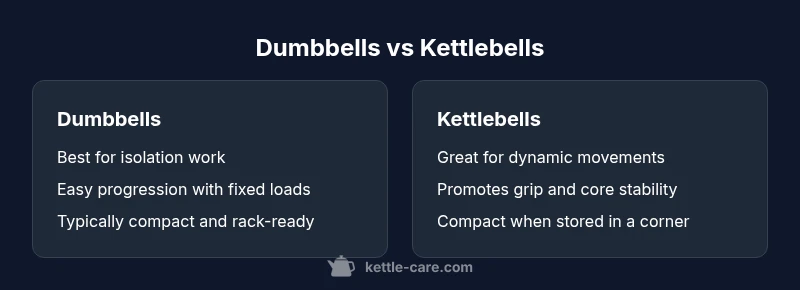
| Best For | Isolation strength work and traditional movements | Dynamic, full-body movements and conditioning |
| Adjustability | Most sets are fixed weights; adjustable options exist | Typically fixed weights; some adjustable kettlebell models exist |
| Space required | Relatively compact, can be stacked or stored efficiently | May require more floor space for swings but can be space-efficient in a corner |
| Price Range | Low to high depending on set size; per-pound cost varies | Moderate to high for complete sets; compact options are available |
| Versatility | Excellent for hypertrophy and rehab movements | Strong for cardio, grip, core, and total-body work |
| Maintenance | Low maintenance; ensure grips and plates are secure | Moderate maintenance; check grips and coating for wear |
| Best For | Those prioritizing isolated strength and control | Those prioritizing momentum, swings, and conditioning |
Strengths
- Versatile for strength, hypertrophy, and conditioning
- Compact starter options exist (adjustable dumbbells or kettlebell dumbbell combos)
- Supports progressive overload with clear weight increments
- Wide availability of accessories and racks
What's Bad
- Initial cost can be high for quality sets
- Learning proper form is essential to prevent injuries
- Space demands can grow if you own both types
- Choosing between models can be overwhelming
Choose one primary tool based on your goals, with a thoughtful plan to expand later
If your aim is controlled strength work and easy progression, dumbbells are a solid start. If you want full-body conditioning and dynamic movements, kettlebells shine. The best path for most homes is a phased plan: start with one tool, then add the other as needed, while prioritizing safety and form.
Frequently Asked Questions
Do I need kettlebells and dumbbells at the same time, or can I start with one?
You can start with either dumbbells or kettlebells depending on your primary goals. If you want isolation strength and gradual progression, begin with dumbbells. If you want conditioning and full-body moves, start with a kettlebell. You can add the other tool later as your program evolves.
Start with one tool that fits your main goal, then expand later as you settle into a routine.
Can I replace these with bodyweight or resistance bands?
Bodyweight and resistance bands can cover many foundations, especially for beginners. However, once you hit plateaus, free weights often provide clearer progression. Bands are great for mobility and lighter accessory work but may be limiting for maximal loading.
Bodyweight and bands are great to start, but for progression you’ll eventually want free weights.
Are adjustable dumbbells worth the upfront cost?
Adjustable dumbbells save space and can deliver a wide range of loads, which is convenient for budgets and small spaces. They can be more expensive upfront and sometimes less comfortable for long sessions. Consider how often you’ll change weights and your comfort with the grip.
Adjustables are handy if space is tight and you vary loads often.
What weight should I start with for a dumbbell or kettlebell?
A common starting point is an option that allows 8–12 reps with good form and controlled tempo. For beginners, many people start with 5–12 kg (11–26 lb) for dumbbells and 8–16 kg (18–35 lb) for kettlebells, adjusting based on comfort and injury history.
Start with a weight you can control for 8–12 reps, then progress gradually.
How many sessions per week should I plan when using these tools?
Aim for 2–4 sessions per week, depending on recovery and goals. Mix 2–3 strength days with 1–2 conditioning days, and rotate exercise selection to cover all major muscle groups over time.
2–4 workouts per week works well for most beginners.
What safety mistakes should I avoid with kettlebells and dumbbells?
Avoid arcs of motion that compromise form, stay mindful of back posture, and secure the workout space. Beginners should learn basic hinge, squat, and press patterns with proper coaching or validated videos to reduce injury risk.
Focus on form first and keep a clear, safe training space.
Highlights
- Pick one path to start to reduce decision fatigue
- Dumbbells excel at isolation and precise loading
- Kettlebells excel at full-body conditioning and momentum
- Start with a lean setup and scale up thoughtfully
- Prioritize form and safety over equipment variety