Hot Water Kettle Price Guide: Value and Savings
Learn how hot water kettle price varies by type, features, and build quality. This data-driven guide from Kettle Care analyzes price ranges for entry, mid, and premium models and offers actionable tips to save without sacrificing safety.


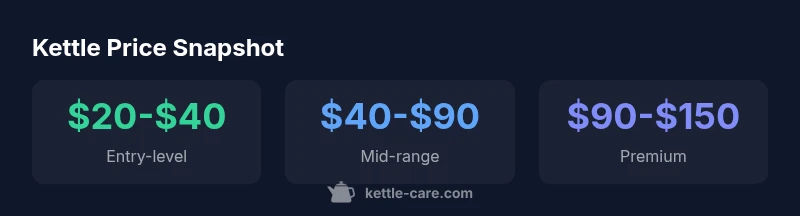
Prices for hot water kettles vary widely. In general, shoppers can expect basic models to start around $20, while mid-range options typically fall between $40 and $90. Premium kettles with advanced features—like precise temperature control, faster boil times, or smart connectivity—often run from $90 up to about $150. For most households, a well-made electric kettle in the $40-$90 range offers the best balance of price and performance.
Why price varies for hot water kettles
Price variation across hot water kettles hinges on a mix of capacity, materials, design, and feature set. The Kettle Care team notes that even modest changes in how a kettle heats water can shift the price band. Capacity matters: larger models generally cost more due to bigger elements and greater material use. Materials such as stainless steel, borosilicate glass, and premium finishes add to cost but also durability and aesthetics. The base and lid design influence durability and user experience, with 360-degree swiveling bases and leak-proof spouts often found on pricier models. Features such as temperature presets, keep-warm functions, fast-boil timing, and smart connectivity also push price upward. Finally, warranty length and brand reputation contribute to the overall cost, even for similar specs. For many households, choosing a kettle in the $40–$90 band typically delivers balanced value. According to Kettle Care, prioritizing essential features and build quality yields the best long-term satisfaction.
Price ranges by kettle type and features
Electric kettles come in several tiers. Entry-level basics usually sit in the $20-$40 range and provide quick boiling with minimal frills. Mid-range models, often priced between $40-$90, add features like temperature control, keep-warm, and faster boil times. Premium kettles, commonly $90-$150, emphasize precise presets, higher-quality materials, and sturdy construction. For the tech-minded, smart kettles with app control and energy-saving modes can land in the $120-$150 zone. Stovetop kettles remain a lower-cost option, typically $15-$60, but lack automated controls and rapid heating. Across all types, price reflects durability, safety features, and potential long-term energy savings. The Kettle Care analysis suggests shoppers map needs to price bands before committing to a purchase.
Hidden costs and value beyond the sticker price
Beyond the initial price tag, consider energy efficiency per boil and annual running costs. Cheaper models may use more electricity per cup or require more frequent descaling or part replacements, eroding savings over time. Warranty length matters: longer warranties reduce potential future repair costs and provide peace of mind. Material quality affects longevity — higher-grade stainless steel or reinforced borosilicate glass resists staining, corrosion, and wear. If you boil water frequently for tea, coffee, or cooking, investing in a mid-range kettle with a proven warranty often pays off. The Kettle Care team emphasizes factoring in energy costs, maintenance needs, and replacement part availability when evaluating value.
How to compare prices effectively: steps and tips
- Define your needs: capacity, speed, and whether you want temperature presets or smart features. 2) Set a budget range and compare models within that band. 3) Evaluate energy efficiency and warranty coverage to estimate long-term costs. 4) Read user reviews focusing on reliability and ease of cleaning. 5) Check retailer price matching and seasonal sales to maximize savings. 6) Consider bulk or bundle offers with accessories or spare filters if available. The key is balancing upfront price with durable features and safe operation, as recommended by the Kettle Care team.
Ways to save on hot water kettle price
- Look for sales and seasonal promotions; retailers frequently discount mid-range and premium models. - Choose models with essential features only to avoid paying for bells and whistles you won’t use. - Compare prices across reputable retailers to avoid overpaying. - Consider refurbished or certified pre-owned options with solid warranties from trusted sellers. - Sign up for retailer newsletters or coupons and apply at checkout. - Prioritize energy-efficient features, since lower operating costs can offset a higher upfront price over time. - Read warranty terms carefully to understand what is covered and for how long. The goal is to maximize value while maintaining safety and reliability.
Price and feature comparison across kettle types
| Kettle Type | Typical Price Range | Key Features | Notes |
|---|---|---|---|
| Electric kettle (basic) | 20-40 | Boils quickly; basic stainless steel | Best entry-level option |
| Electric kettle (mid-range) | 40-90 | Temp control; keep-warm; faster boil | Popular choice for families |
| Electric kettle (premium) | 90-150 | Precise presets; high-quality materials | Durable and feature-rich |
| Stovetop kettle | 15-60 | Whistling; metal or enamel | Lower price; longer boil time |
| Smart kettle | 60-150 | App control; energy-saving modes | Tech-forward option |
Frequently Asked Questions
What is the typical price range for a hot water kettle?
For most households, basic models start around $20 and mid-range options are $40-$90; premium kettles commonly fall in the $90-$150 range. These ranges vary by retailer and region.
Prices usually start around twenty dollars and go up to about one hundred fifty dollars, depending on features.
Are expensive kettles worth the extra cost?
If you value precise temperature control, faster boils, and greater durability, higher-priced kettles can be worth it. Compare operating costs and warranty length to determine true value.
Expensive kettles can be worth it if you need precise control and durability.
Do stovetop kettles price less than electric kettles?
Yes, stovetop kettles are typically cheaper, often $15-$60, but they require a stove and lack modern controls.
Stovetop kettles usually cost less but take longer to boil and lack modern controls.
How do I save on kettle price without sacrificing safety?
Choose a reliable brand with a good warranty, compare prices, and avoid ultra-cheap models that skip essential safety features.
Shop during sales and pick a model with safety features and decent warranty.
Do price differences reflect warranty coverage?
Often yes; mid-range and premium models tend to offer longer warranties and better replacement parts, which can reduce lifetime costs.
Warranty can affect lifetime cost.
What should I consider besides price?
Capacity, temperature control, material quality, energy efficiency, ease of cleaning, and safety features should all influence your decision.
Think about capacity, features, and safety, not just price.
“Price should reflect durability, safety features, and energy efficiency, not just the upfront cost. A slightly higher upfront price often reduces ongoing operating costs.”
Highlights
- Compare features before price to maximize value
- Expect price bands to reflect build quality
- Consider long-term energy costs, not just sticker price
- Shop during sales to save on higher-end models
- Opt for mid-range if you want balance of features