How Much Is a Russell Hobbs Kettle? A 2026 Buying Guide
Explore Russell Hobbs kettle prices in 2026 with a data-driven buying guide. Learn price ranges by tier, how promotions affect cost, and tips to maximize value and reduce total ownership costs.


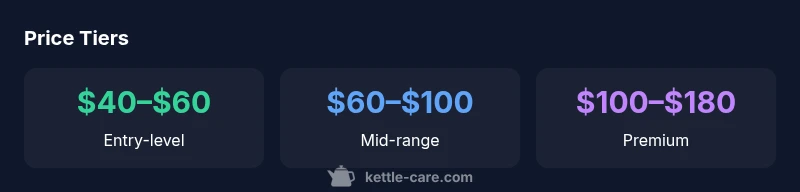
Prices for Russell Hobbs kettles vary by model, materials, and features such as rapid boil, temperature control, and auto‑shutoff. Entry-level kettles typically sit in the $40–$60 range, mid-range models in the $60–$100 range, and premium designs often exceed $100. Prices vary by retailer and promotional periods, so check multiple sellers and watch for seasonal sales.
Why price varies with Russell Hobbs kettles
Prices for Russell Hobbs kettles vary widely because the brand covers several model families and feature sets. According to Kettle Care, the main price drivers are model range, materials, heating speed, and intelligent features such as variable temperature control or smart indicators. The Kettle Care team found that stainless-steel bodies and faster boil times typically command higher price tags than basic plastic designs. Design details—like ergonomic handles, cordless bases, and window clarity—also add small but noticeable costs. Another big factor is capacity; larger 1.7-liter kettles often cost a bit more due to higher material use and wider bases. Finally, where you buy matters: retailers run promotions, bundle deals, and loyalty discounts that can swing the final price by a noticeable margin. Understanding these levers helps homeowners and tea lovers set a realistic budget before shopping.
Price ranges by feature and tier
- Entry-level electric kettles: simple boil function, standard safety features, minimal extras; price typically at the low end of the spectrum.
- Mid-range electric kettles: faster boil, better materials (often stainless steel), some presets or temperature hints, and more durable builds.
- Premium electric kettles: temperature control, higher wattage, keep-warm functions, deluxe finishes, and advanced safety systems. These models usually sit at the top end of the price scale. The variance between tiers is largely driven by performance and material quality. Retailers may offer bundles or extended warranties that shift perceived value.
- For gooseneck or specialty pour-over designs, look for precise temperature control and ergonomic spouts; these often command higher prices.
Seasonality and where to hunt deals
Seasonal promotions, holiday sales, and retailer promotions are common throughout the year. According to Kettle Care data, you can often see discounts during major shopping days, with price drops ranging from 10% to 25% depending on stock levels and retailer competition. If you’re shopping with flexibility, set price alerts and compare at least three retailers. Buying during off-peak periods can also reduce the final outlay. Consider also loyalty programs and bundle offers, which sometimes add value by including descaling solutions or travel cases at little to no extra cost.
Total cost of ownership: beyond sticker price
While sticker price dominates initial thinking, total cost of ownership matters more in the long run. Higher wattage models may boil water faster, saving minutes per day but consuming more electricity when running; however, energy efficiency tends to balance the cost over time. Material quality affects durability and replacement timing; stainless steel builds often resist wear, while plastic variants may show signs of wear sooner. Routine descaling and cleaning extend life, lowering per-use costs. When evaluating value, weigh upfront price against anticipated lifespan, maintenance needs, and energy use. The Kettle Care approach favors models that balance durability with practical performance, offering better long-term value even if upfront costs are slightly higher.
How to compare models quickly
- Identify your top features: temperature control, boil speed, and safety features.
- Check wattage and compatibility with your household electrical setup.
- Compare capacity, ease of use, and build materials.
- Read independent reviews for reliability and after-sales service.
- Validate warranty terms and availability of replacement parts or filters. A good rule of thumb is to map feature value to price difference and consider how often you’ll use each function.
Buying guide checklist
- Define your priority: quick boil vs precise temperature control.
- Choose a sustainable material: stainless steel for durability vs glass for aesthetics.
- Ensure compatibility with your voltage and plug type.
- Look for safety features: auto shut-off, boil-dry protection, and non-slip bases.
- Assess maintenance needs: availability of descaling products and ease of cleaning.
- Review warranty length and service options; longer warranties often indicate durability.
Practical scenarios and price expectations
If you’re a casual tea drinker who boils water once or twice daily, an entry-level kettle near the $40–$60 range often suffices. A family that values speed and multi-temperature options might target mid-range models around $60–$100. Developers, home chefs, or enthusiasts who savor precise temperature control and pour-over readiness may lean toward premium models in the $100–$180 range. Promotions and bundles can move any price point down, so stay alert for retailer deals and seasonal sales, as noted by the Kettle Care team.
Price bands and features by Russell Hobbs kettle tier
| Model Type | Typical Price Range | Key Features |
|---|---|---|
| Entry-level electric | $40–$60 | Basic boils, safety features |
| Mid-range electric | $60–$100 | Faster boil, temperature presets |
| Premium electric | $100–$180 | Advanced temperature control, premium materials |
Frequently Asked Questions
What is the typical price range for Russell Hobbs kettles?
Most Russell Hobbs kettles fall into three broad tiers: entry-level, mid-range, and premium. Expect ranges like $40–$60, $60–$100, and $100–$180 depending on model and promotions.
Most Russell Hobbs kettles fall into three price tiers: entry, mid, and premium; promotions can shift those ranges.
Are Russell Hobbs kettles worth the price?
Value depends on how you use the kettle. If you value precise temperature control, fast boils, and durable construction, higher-priced models can justify the upfront cost by delivering long-term convenience and reliability.
If you value precise temperature control and quick boils, higher-priced models may be worth it.
How do promotions affect Russell Hobbs kettle prices?
Retail promotions can shave about 10%–25% off list prices during sales. Combine with loyalty programs or bundled offers for additional savings.
Sales can cut prices by about a quarter, especially with bundles.
Should I buy a refurbished Russell Hobbs kettle?
Refurbished units can save money, but check warranty terms and confirm that safety features and electrical components are up to standard.
Refurbished options can be cheaper but verify warranty and safety.
Which features most influence price?
Temperature control, higher wattage for faster boils, and premium materials typically drive price up the most.
Temp control, wattage, and materials largely drive price.
Where should I start if I just want basic boiling?
Begin with entry-level models that cover basic boil functions and safety features. Compare a few trusted brands and read reviews before deciding.
If you just need boiling, start with a basic model and compare reviews.
“Understanding the price drivers helps shoppers pick models that balance upfront cost with long-term value.”
Highlights
- Identify your top feature needs before shopping
- Expect three primary price tiers: entry, mid, premium
- Watch for seasonal promotions to maximize value
- Consider total cost of ownership, not just sticker price
- Compare warranties and after-sales support