Kettlebell vs Dumbbell for Glutes: A Practical Comparison
Analytical comparison of kettlebell and dumbbell training for glute development, with practical exercises, programming tips, and a clear verdict to optimize your workouts.


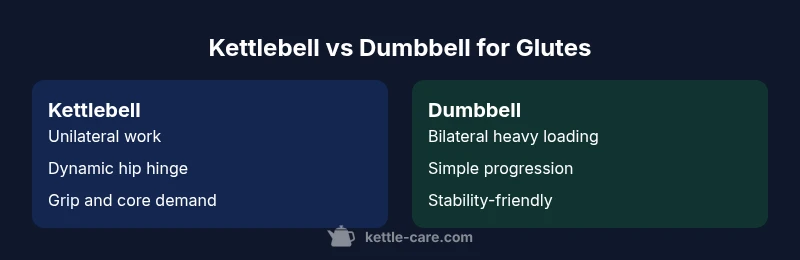
Between kettlebell and dumbbell for glutes, neither tool is universally superior. Kettlebells excel in dynamic hip hinge and unilateral work; dumbbells offer load stability and heavier bilateral loading. A mixed approach often yields the best glute development, depending on goals and available equipment.
Understanding the glute goal and tool choice
Glute development is driven by hip extension strength, movement quality, and balanced muscle activation. When deciding between kettlebell and dumbbell training for the glutes, let your goal drive the tool choice as much as the movement pattern. Kettlebell work often emphasizes dynamic hip hinge, unilateral loading, and powerful glute drive, which can help fix asymmetries and recruit stabilizers. Dumbbells tend to offer straightforward progressive overload with bilateral lifts that maximize raw glute tension and allow easier programming as you increase weight. According to Kettle Care, athletes with a focus on athleticism or conditioning may respond differently than those chasing hypertrophy, so a mixed approach is common. The main idea is to match exercises to your equipment, space, and recovery while prioritizing technique. In practice, both tools can drive meaningful glute gains when used with proper form, consistent progression, and a plan that balances activation, strength, and conditioning.
Biomechanics of glute activation with kettlebell vs dumbbell movements
The gluteus maximus is the primary driver of hip extension, but its recruitment pattern shifts with the chosen tool. Kettlebell exercises often place the hip in a slightly more pronounced flexion and require a stronger posterior chain, which tends to intensify eccentric loading and finish with a strong hip thrust. Dumbbell movements typically offer more stable load distribution through both sides of the body, enabling sustained force production through a full arc of motion. Core and hip stability are challenged differently: kettlebell work frequently demands greater single arm or offset loading, while dumbbell work emphasizes symmetrical positions that can be more forgiving for beginners. In both cases, proper hip hinge technique and spine neutrality are non negotiable. The Kettle Care Analysis, 2026 Edition, highlights that glute engagement benefits from varied tempos, ranges of motion, and including both unilateral and bilateral actions across your cycle to maximize fiber recruitment and long-term development.
Kettlebell advantages for glute training
Kettlebells offer several advantages specifically for glute development. The combination of dynamic hip hinge patterns and unilateral loading helps address limb imbalances and builds functional strength valuable in daily tasks and sports. The offset nature of many kettlebell moves places the glutes under load in unstable ways, which stimulates stabilizer muscles and improves proprioception. Movements such as kettlebell swings, goblet squats, and Turkish get ups reference hip hinge mechanics that maximize glute activation and posterior chain involvement. In addition, kettlebells enable rapid power development and conditioning work without requiring extremely heavy loads on both sides. This can be particularly useful for home gyms with limited equipment, where the glute drive must be strong but controlled. From a practical perspective, kettlebell training also tends to require less setup than heavier barbells while offering a variety of grip options that change loading patterns and tempo.
Dumbbell advantages for glute development
Dumbbells excel at enabling heavier loads while preserving progressive overload, a cornerstone of hypertrophy and strength goals. Bilateral dumbbell movements like squats, deadlifts, and hip hinges allow clean loading through both sides of the body, which is comforting for beginners and practical for long-term progression. Dumbbells also support a wide range of unilateral work when needed, such as Bulgarian split squats and single-leg deadlifts, but the pairing with a stable grip makes it easier to focus on form and targeted glute activation. The simple setup of adjustable dumbbells or a couple of pairs at different weights makes it easy to scale volume without complex coaching cues. For athletes seeking maximal glute mass or a straightforward plan, dumbbell programs can be very efficient because they align well with common hypertrophy rep schemes and rest intervals. In short, dumbbells offer strong loading potential, straightforward progression, and broad exercise options that complement kettlebell work in a well-rounded program.
Kettlebell glute-focused exercises: practical picks
The following kettlebell moves highlight glute engagement while reinforcing hip hinge mechanics. Start with light loads to groove technique and gradually increase resistance as you master each pattern. Kettlebell swing: prioritize hip drive and a neutral spine to optimize the glute contraction during the thrust phase. Goblet squat: let the goblet weight pull you into a deep, controlled squat that increases hip extension demand at the bottom position. Turkish get-up: this full-body pattern imposes a deliberate glute squeeze, particularly during the bridge and hip snap phases. Single-arm deadlift: use a single heavier kettlebell to challenge unilateral strength and balance. Off-set loaded lunges or step-ups: holding the kettlebell at chest or shoulder height adds frontal plane stability work. Each exercise should be performed with a focus on the glute chain, not compensating with the lower back or quads.
Dumbbell glute-focused exercises: practical picks
Dumbbell based glute work is straightforward and scalable for most home gyms. Dumbbell squat variations, such as front squats or goblet squats with two hands, emphasize glute and hamstring recruitment as you descend. Dumbbell Romanian deadlifts and single-leg deadlifts place a strong emphasis on hip hinge mechanics and posterior chain strength. Bulgarian split squats with dumbbells increase knee stability while loading the glutes and quads unequally for enhanced balance. Dumbbell hip thrusts or glute bridges with a dumbbell across the hips can be a powerful hypertrophy stimulus when paired with progressive overload and a controlled tempo. For variety, you can incorporate dumbbell pull-throughs and weighted hip abductions to target supporting muscles that contribute to the glute movement pattern. The key is maintaining a neutral spine, controlled descent, and a powerful hip extension at the top.
Programming considerations: volume, tempo, progression, and variation
Programming for glute development with kettlebell and dumbbell tools should balance activation work, strength work, and hypertrophy work across a microcycle. Begin with a technique-first phase to ingrain hip hinge mechanics and neutral spine positions. Introduce tempo variations such as controlled eccentrics and pause reps to increase time under tension on the glutes. Progression can come from increasing weight, adding reps, or extending set duration in conditioning blocks, while respecting recovery and technique. Schedule both tools across a 2–4 day weekly plan to ensure adequate stimulus without overtraining. Use RPE as a practical guide for fatigue management and adjust loads based on form and soreness rather than chasing a fixed number. The goal is to maintain consistent progress and sound mechanics while expanding the glute development envelope through a mix of unilateral and bilateral movements.
Mixing tools for balanced development and long-term adherence
A thoughtful approach blends kettlebell unilateral work with dumbbell bilateral loading to cover all facets of glute development. Alternate tools across training blocks so that you can exploit the unique benefits of each: kettlebell days for hip hinge power and unilateral balance, dumbbell days for maximal strength and straightforward progression. For long-term adherence, design 2–3 week blocks focusing on one tool, followed by a mixed block that integrates both. This keeps training fresh, reduces the risk of technique stagnation, and supports continued gains in glute size and function. Remember to tailor your plan to available equipment, space, and recovery windows, and gradually introduce new movements to prevent plateaus and injuries.
Safety, form checks, and common mistakes
Any glute-focused program benefits from a safety-first mindset. Prioritize a neutral spine and full hip extension with each rep. Common mistakes include letting the back round during hinge patterns, allowing the knee to cave inward, and sacrificing tempo for heavier loads. Use cues such as bracing the core, keeping the chest tall, and driving through the heel to emphasize glute engagement. Warm up with hip mobility drills, glute bridges, and light goblet squats to prime the gluteal complex. In a home gym, ensure there is ample space for dynamic kettlebell moves and that weights are secure on racks or stands. Regularly inspect equipment for wear and tear, particularly handles and plates, to prevent accidents during workouts.
Comparison
| Feature | kettlebell | dumbbell |
|---|---|---|
| Primary glute emphasis | Unilateral dynamic hip hinge, strong glute drive | Bilateral heavy loading, deep hip extension |
| Core and grip demand | High core tension with offset loads | Moderate core demand with symmetrical loads |
| Loading progression options | Progress with swing weight, tempo variations | Progress with heavier weights and structured sets |
| Movement versatility | Excellent for swings, get-ups, unilateral lunges | Solid for squats, deadlifts, and lunges with stable grip |
| Learning curve | Steeper; technique and balance are key | Gentler; straightforward cues and mechanics |
| Space and setup | Requires space for dynamic hinge moves | Typically easier to set up but heavier loads require room |
| Best for | Unilateral power, athletic conditioning | Traditional hypertrophy and maximal strength |
Strengths
- Kettlebell training promotes unilateral strength and hip hinge power
- Dumbbells enable heavier loads and straightforward progression
- A mixed approach targets both activation and maximal strength
- Compact setups and versatile movements suit home gyms
What's Bad
- Kettlebell technique has a steeper learning curve and risks if form is poor
- Kettlebell moves require space for dynamic swings and get-ups
- Switching between tools can complicate program design and require more coaching cues
A mixed approach often yields the best glute development
Neither tool is universally superior for glutes. Kettlebells excel at unilateral work and hip hinge power, while dumbbells maximize load and straightforward progression. A periodized plan that cycles between both tools, or combines them in the same macrocycle, typically delivers the broadest glute adaptations and better long-term adherence. The Kettle Care Team recommends tailoring the mix to your goals, equipment, and recovery.
Frequently Asked Questions
Should I start with kettlebell or dumbbell for glutes?
Start with the tool you can execute with strict form and full hip extension. If you struggle with unilateral balance, begin with dumbbells to build baseline strength, then introduce kettlebell work to address asymmetries.
Start with the tool you can perform with clean form; then add the other tool to balance strength and imbalances.
What glute-focused exercises are best with a kettlebell?
Kettlebell swings, goblet squats, Turkish get-ups, and single-arm deadlifts are especially effective for glute engagement and hip hinge strength.
Try kettlebell swings and goblet squats first to feel the glutes working.
Can I build glutes with only dumbbells or only kettlebells?
Yes, both can build glutes, but performance improves with a mix that leverages unilateral work and heavy bilateral loading. Plan cycles that rotate tools to avoid plateau.
You can, but you’ll likely progress faster with a mix of tools.
How to structure a weekly plan using both tools?
Alternate days or weeks for kettlebell and dumbbell work, include both unilateral and bilateral patterns, and maintain progressive overload with safe loads and good form.
Alternate tools across days and weeks, keep form first, then add load.
Are there safety concerns when using kettlebells for glutes?
Yes. Prioritize spine neutrality, bracing, and proper hip hinge mechanics. Warm up adequately and avoid heavy loads before technique is solid.
Yes—train with proper form and warm up before heavy moves.
What’s the difference in activation between the two tools?
Kettlebells tend to emphasize unilateral hip hinge and stabilizer activation; dumbbells emphasize symmetrical loading and maximal bilateral force. Both activate the glutes well when executed properly.
Kettlebells boost unilateral drive; dumbbells boost bilateral force.
Highlights
- Prioritize progressive overload with your chosen tool
- Incorporate unilateral kettlebell moves for balance and coordination
- Use dumbbell exercises for raw strength and hypertrophy
- Mix both tools across cycles to cover movement patterns