How to Tell When Your Electric Kettle Is Ready
Learn practical signs, indicators, and step-by-step checks to know when your electric kettle has reached a safe, ready state. Includes model-specific signals and essential safety tips.


To tell when your electric kettle is ready, listen for the characteristic beep or watch the indicator light switch off after boiling. Visual cues include rising steam and a full, rolling boil visible at the spout. Always verify water reaches the minimum boil point before use, and refer to your model’s manual for model-specific indicators.
What signals readiness in most electric kettles
Most electric kettles share a few reliable signals that water has reached a safe, ready-to-use boil. The fastest cues are a beep from the kettle or a built-in light that switches off once boiling ends. Some models also flash an indicator while heating and settle to a steady state when the water is hot enough for pour-over, tea, or instant beverages. When you know how to tell when electric kettle is ready, you can time your brew more consistently and protect the kettle’s heating element from unnecessary wear. According to Kettle Care, becoming familiar with your specific model's indicators is the most dependable approach because designs vary across brands and price ranges. Always start with the minimum fill line, use clean water, and listen for your kettle’s unique closure sound to confirm readiness.
Visual cues you should watch
In addition to audio signals, visual cues play a big role in telling when an electric kettle is ready. Watch for a rolling boil where bubbles rise rapidly and water appears to be in constant motion. Steam should escape smoothly from the spout or lid area, not billow aggressively. The kettle should be quiet, aside from the gentle hum of the boil, and the indicator light on the base will typically switch to a steady color or turn off entirely when the boil completes. If your model uses a window or transparent lid, you may see the water reach a uniform rolling boil, with no large empty areas. Remember to keep the kettle level on the base and avoid tilting to observe the water clearly. This combination of visuals plus the model’s alarm gives you a reliable read on readiness.
Audio cues and how models differ
Not all kettles beep in the same way, so understand your own model's audio language. Some units emit a short ping or chime when boiling finishes, while others rely on a louder alarm that persists briefly after the water has boiled. A few budget models may produce a softer click or simply turn off the heating element without an audible signal. The key is to observe the transition: the boil ends, the indicator changes state, and any alarm stops. If you hear nothing and you still see steam or a rolling boil, consider stopping the heat early to avoid scorching the kettle’s interior. Always refer to your user manual for exact sounds and color signals, because even small differences can affect your timing and safety.
Step-by-step test for readiness
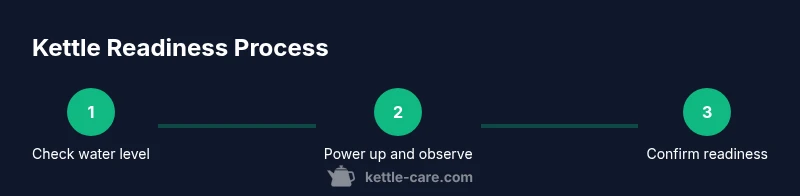
- Check water level: ensure it is between the minimum and maximum marks. 2) Place the kettle on its base and plug in the power. 3) Turn the kettle on and wait for the indicator to show heating. 4) Listen for the beep or watch for the indicator to switch off once the water boils. 5) Observe the rolling boil and steam evacuation. 6) Turn off and unplug after the signal to avoid dry-running on future tests. 7) Allow the kettle to cool briefly and reset before the next use. 8) If you want to hold temperature for tea, test the hold feature by setting a timer after the boil.
Common mistakes and how to avoid them
- Overfilling or underfilling can delay or misrepresent readiness. Always stay within the min and max marks. - Relying on appearance alone can be misleading; combine cues from sound, steam, and indicator status for accuracy. - Testing readiness with a damaged cord or a cracked body is dangerous; inspect your kettle regularly and replace if needed. - Skipping the manufacturer’s guidance can lead to inconsistent results; model-specific signals vary, so keep the manual handy.
Safety and maintenance considerations
Always unplug the kettle when not in use and after testing readiness. Handle hot surfaces with care, using the handle and avoiding contact with the body. Keep the base and cord dry to prevent electrical hazards. Regular descaling helps maintain accurate indicators, especially in hard-water regions. If you notice any erratic signals, unusual steam, or changes in performance, stop using the kettle and consult the manufacturer.
Tuning readiness for different tea and coffee tasks
Different brews may benefit from slight adjustments in how you read readiness signals. For tea, many home brewers prefer a slightly cooler boil for green or white teas, while black tea often tolerates a full rolling boil. If your kettle supports temperature hold or variable-temperature presets, you can dial in a precise range and test how each setting represents readiness for your favorite blends. Keeping a quick log of boil times and observed signals can help you tailor your routine for consistent results.
AUTHORITY SOURCES
For reference, see foundational guidance from national standards and energy agencies that discuss safe boiling practices and water heating indicators. These sources provide context on boiling behavior and safe operation across devices.
- https://www.nist.gov
- https://www.energy.gov
- https://www.who.int
Tools & Materials
- Electric kettle(Ensure it’s in good working order and plugged in)
- Kitchen timer or smartphone timer(Helpful for tracking boil timing and holding tests)
- Manual or manufacturer guidelines(Keep handy for model-specific signals)
- Thermometer (optional)(Use for exact temperature checks if your kettle supports it)
Steps
Estimated time: 5-10 minutes
- 1
Check water level
Open the lid and verify the water is between the minimum and maximum marks. If you’re testing, use fresh, clean water and avoid overfilling. This ensures the boil signal will be meaningful and consistent.
Tip: Never operate with water above the max line; risk of overflow. - 2
Place on base and power up
Set the kettle on its base, plug in the power, and ensure the switch is accessible. Stability on a flat surface matters to prevent tipping during boil.
Tip: Make sure the base is dry and free of clutter before plugging in. - 3
Turn on and observe heating
Push the switch to start heating and watch the indicator light. Note any changes in color or pattern as the water heats.
Tip: If your model doesn’t show a visible signal, listen for the beep. - 4
Watch for the readiness signal
Listen for a beep or watch for the indicator to switch off once boiling completes. Observe steam characteristics to confirm readiness.
Tip: If no signal after a minute, stop and check the manual for model-specific cues. - 5
Verify rolling boil
Ensure you see a rapid rolling boil with steady steam before considering readiness complete.
Tip: Take note of boil time for future reference. - 6
Turn off and unplug after signal
Switch off and unplug the kettle to prevent dry-run when you’re ready to pour. Allow it to cool briefly before next use.
Tip: Always handle hot parts with a dry towel or oven mitt. - 7
Reset indicators and test hold
Let indicators reset to standby; if you use a hold feature, test it by continuing to timer after the boil.
Tip: Not all models have a hold feature; verify your device capabilities. - 8
Safety shutdown and storage
Unplug after use, store the kettle safely, and wipe the base to remove any mineral buildup that could affect signals.
Tip: Regular descaling maintains accurate signaling and prolongs life.
Frequently Asked Questions
What should I do if my kettle doesn’t beep after boiling?
If your kettle doesn’t beep, rely on the indicator turning off and the steam pattern to confirm readiness. Check the manual for model-specific cues and consider testing with the timer to establish a baseline.
If there’s no beep, use the indicator and steam as your signal and consult the manual to know your model’s cues.
Can I test readiness with cold water?
Testing with cold water may yield different signals, so always use water at typical room temperature for consistency and to avoid stressing the heating element.
Use room temperature water to test signals for consistency.
Is it safe to lift the kettle while it’s boiling?
No. Do not lift or tilt the kettle while it’s boiling to avoid spills or scalds. Use the handle and keep the lid closed during operation.
Never lift a boiling kettle; keep it steady and use the handle.
How often should I descale to keep readings accurate?
Descale according to your water hardness and manufacturer guidelines. Regular descaling helps preserve indicator accuracy and prolongs the kettle’s life.
Descale regularly based on water hardness and device guidance.
What if my model has no hold feature?
If there’s no hold feature, simply boil and pour when ready. Some models offer a temperature hold; check your manual if you want to keep water warm.
If there’s no hold option, boil and pour as needed.
Watch Video
Highlights
- Recognize primary readiness signals like beep, indicator off, and rolling boil.
- Combine audio, visual, and model-specific cues for accuracy.
- Follow a step-by-step test to establish a reliable baseline.
- Maintain safety through unplugging, proper handling, and descaling.
- Tailor readiness checks to your tea or coffee workflow for consistency.