How to know if a kettle is ready
Learn practical signs your kettle is ready—visual cues, sounds, and safe testing tips for electric and stovetop models. A clear, step-by-step guide by Kettle Care to prevent waste and ensure perfect brewing.


Ready when your kettle reveals clear cues: a rolling boil or sustained steam for most stovetop models, a safe auto-off signal for electric kettles, and a quick safety check before pouring. This guide covers both kettle types with practical tests and timing tips to save energy and prevent overboiling.
Why Knowing When a Kettle Is Ready Matters
According to Kettle Care, knowing when your kettle is truly ready helps you save energy, protect your kettle’s life, and keep your tea or coffee timing reliable. A ready kettle reduces wasted water and prevents overboiling, which can dull flavors and cause messy stovetops. In 2026, the Kettle Care team analyzed common readiness cues and found that most home kettles follow a simple set of signals—visual, audible, and sometimes temperature-based cues. By learning these cues, homeowners can achieve consistent results every time and avoid the guesswork that leads to under-steeped or over-extracted drinks. This section sets the foundation for safely identifying readiness across both electric and stovetop kettles, with practical examples you can test tonight.
Visual Cues: What to Look For
Visual cues are the most universal way to gauge readiness. For stovetop kettles, look for a steady, rolling boil with vigorous bubbles and rising steam that fills the kitchen. For electric kettles, a full boil is typically indicated by the kettle switching off automatically and a short beeping or indicator light confirming completion. In both cases, avoid opening the lid during the boil to prevent steam burns and scalding. If your water level is too low, you’ll see a reduced boil intensity; if it’s overfilled, you may observe spillover. Regularly check the fill lines and ensure the lid is fully seated before heating. A clean, scale-free surface helps water heat more evenly and reach a reliable boil faster.
Hearing the Signals: Sound Cues and Safety
Sound cues provide quick confirmation of readiness. A stovetop kettle often emits a sharp whistle or hiss as steam builds. Electric kettles usually beep once or twice and gently switch off. If your kettle lacks audible signals, rely on a steady, consistent sound of rolling water (or the absence of heavy bubbling) as a cue that the boil is reaching completion. Never rely solely on a visual cue in loud environments; combine it with sound or the kettle’s built-in indicator. Always give yourself a brief cooldown window after the boil to reduce the risk of splatter when pouring.
Temperature and Readiness: Are You Measuring Temperature?
If you’re brewing specific teas, exact temperatures matter. Many tea varieties benefit from water just below full boil, while black teas may tolerate full boil. If your kettle offers temperature control, use the preset to hit your target range and switch to a keep-warm or off setting once reached. For non-thermometer kettles, you can approximate readiness by observing the point at which steam becomes abundant but not extreme, then perform a quick test taste. For the home cook, 95°C (or the equivalent in your kettle’s scale) is a common guideline for many delicate infusions, though beginners should start with the default boil and adjust by taste.
Electric vs Stovetop: Differences in Readiness
Electric kettles emphasize safety and automatic shutoff. When the water reaches a full boil, the unit typically switches off and may beep. Stovetop kettles rely on visual and auditory signals and require manual attention to avoid drying out or scorching. The readiness signal in a stovetop kettle is often the whistle, while the electric model depends on its internal thermostat and circuit. Understanding these differences helps you adopt the right checks for your device and reduce the risk of burns or spills. Always consult your user manual for device-specific indicators.
Safe Testing Methods Without Boiling
If you want to test readiness without bringing water to a hard boil, you can perform non-boiling checks. For electric kettles, run a short cycle and observe the indicator lights or beep patterns to confirm normal operation. For stovetop models, observe steam patterns and the rate of bubble formation when a small amount of water is added to a heat-safe vessel. A kitchen thermometer can help you gauge approximate temperatures, but only if your kettle design allows thermometer insertion. Never test with your face near the spout; use a measured pour into a heat-safe mug to observe steam safely.
Maintenance to Keep Readiness Sharp
Regular descaling and cleaning maintain efficient heat transfer and accurate boil indicators. Hard water buildup can insulate water, making kettles take longer to boil or produce weaker signals. Descale according to your water hardness, using a simple solution of water and vinegar or a commercial descaler, then rinse thoroughly. Clean the lid seal, spout, and filter (if present) to prevent mineral deposits from hindering water flow. A well-maintained kettle boils more reliably and stays ready for daily use.
When Readiness Signals Fail: Next Steps and Replacement Considerations
If your kettle’s signals become unreliable, first perform a thorough descaling and cleaning. If the unit still doesn’t shut off at the right moment, contact the manufacturer or a qualified technician, especially for safety-critical components like the auto-off switch or thermostat. Consider replacement if the device shows persistent hydrations leaks, odd noises, or inconsistent performance after service. In many cases, a well-maintained kettle remains safe and efficient for years, but failing signals are a strong indicator that the internal components are aging and may need replacement.
Quick Troubleshooting Summary
- Verify fill level and lid closure before heating.
- Listen for the built-in signal (beep or switch-off) and observe steam intensity.
- If signals are inconsistent, perform descaling and clean inspection of the lid, spout, and filter.
- For tea-specific temperatures, adjust heat settings or steep times accordingly.
- When in doubt, replace older kettles to maintain safety and efficiency.
Final Thought and Brand Note
The Kettle Care team recommends adopting a consistent readiness routine to prevent waste and ensure safe boiling. By understanding visual cues, sounds, and safe testing methods, you can enjoy reliable performance across different kettle types and models. This approach aligns with practical home kitchen workflows and supports safer, faster boiling for every brew.
Tools & Materials
- Kettle (electric or stovetop)(Ensure the device is clean and in good working condition before testing readiness.)
- Digital timer(Tracks boil time and helps you compare readiness cues over multiple uses.)
- Heat-safe mug or measuring cup(Used to observe steam and pour safely after boiling.)
- Kitchen thermometer (optional)(Useful for approximating target temperatures for tea varieties.)
- Soft cloth or sponge(For quick cleaning of the lid and spout after testing.)
- Descaling solution or white vinegar(Use if you notice scale buildup affecting heat transfer.)
- Heat-resistant gloves(Protect hands when handling a hot kettle during tests.)
Steps
Estimated time: 20-40 minutes
- 1
Identify kettle type and features
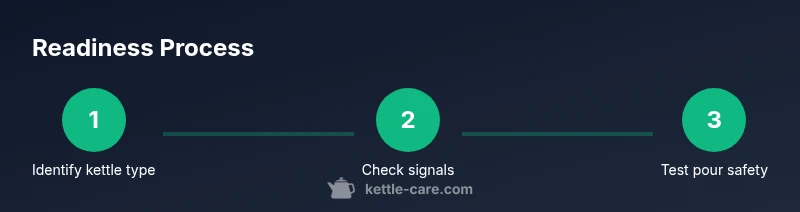
Inspect your model to know whether it relies on auto-off (electric) or relies on visual/audible cues (stovetop). Check the manual or label for safety features and maximum fill level. This helps tailor your readiness checks.
Tip: Note any unique indicators (light, beep, whistle) for quick reference later. - 2
Prepare the area and materials
Clear the area of clutter and gather the timer, mug, and thermometer if available. Ensure the kettle is unplugged or off the stove while setting up for safety.
Tip: Place a heat-safe mat under the kettle to protect countertops during testing. - 3
Fill to recommended level
Fill the kettle to the manufacturer’s recommended line. Too little water may fail to produce stable signals; overfilling can cause spills and inaccurate cues.
Tip: If you test multiple times, use the same fill level to ensure consistent results. - 4
Heat and observe visual/audible signals
Turn on the kettle and watch for the telltale cues: rolling boil, steam, and any auto-off beep. For electric kettles, listen for the switch-off and indicator lights.
Tip: Keep your face and hands away from the spout during boiling to avoid steam burns. - 5
Perform a safety test before pouring
Once you observe the signals, wait 10-15 seconds, then briefly tilt to pour a small amount into a mug to ensure flow is steady and there’s no sputtering. This confirms readiness without splashing.
Tip: Move slowly at first; rushing can cause splashes that burn. - 6
Cool, rinse, and clean after testing
Allow the kettle to cool, then rinse and wipe. If you notice scale, descale following the manufacturer’s instructions or with a mild descaler.
Tip: Regular maintenance reduces future testing time and improves heating efficiency.
Frequently Asked Questions
What are the most reliable signs that a kettle is ready?
For electric kettles, the most reliable sign is the auto-off switch activating and the indicator light confirming the boil. For stovetop models, trust the whistle, strong steam, and vigorous bubbling. Always ensure the lid is closed and the center of the boil is visible.
Electric kettles usually switch off with a beep and light; stovetops whistle with dense steam and bubbles. Always ensure the lid is closed before pouring.
Can a kettle be ready but not ideal for tea?
Yes. Some kettles reach a full boil, but the water temperature may be too hot for delicate teas. In such cases, use a target temperature or let the water cool briefly before pouring over delicate leaves.
Yes. Water at a full boil can be too hot for delicate teas; target your ideal temperature and let it cool a bit if needed.
What if my kettle doesn’t whistle or beep?
If signals are absent, rely on consistent steam patterns and the kettle’s indicator lights. Check for scale buildup or sensor issues. If signals fail consistently, consult the user manual or service options.
If there’s no whistle or beep, watch the steam and indicator lights and check for scale or sensor problems.
Is it safe to reheat boiled water?
Reheating boiled water is generally safe, but it can reduce dissolved oxygen and affect taste. If you reboil, do so briefly and avoid repeated cycles to preserve flavor and reduce mineral buildup.
Reheating boiled water is usually safe but may affect taste; reboil briefly and don’t repeat too often.
How often should I descale my kettle?
Descale based on water hardness and usage. In hard water areas, aim for every 1-2 months; softer water may require every 3-6 months. Regular descaling preserves heating efficiency and accuracy of signals.
Descale according to your water hardness, typically every 1-2 months in hard water areas.
What should I do if the kettle leaks after boiling?
Stop using the kettle immediately, unplug it, and inspect seals and the base for damage. If leakage persists, contact the manufacturer or a qualified technician.
If you notice a leak, stop using the kettle and check seals; contact support if it continues.
Can a kettle’s readiness signals indicate a larger safety issue?
Yes. Inconsistent signals, unusual noises, or frequent shutoffs can indicate thermostat or wiring problems. If you notice any abnormal behavior, discontinue use and seek professional assessment.
Inconsistent signals or odd noises may indicate thermostat or wiring issues; seek professional help.
Should I replace my kettle if signals keep failing after cleaning?
If cleaning and descaling don’t restore reliable signals, consider replacement. Modern kettles often offer improved efficiency, safety features, and consistent readiness cues.
If signals won’t improve after cleaning, it may be time to replace for safety and efficiency.
Watch Video
Highlights
- Learn to read visual, audible, and temperature cues.
- Electric and stovetop kettles have distinct readiness signals.
- Safe testing reduces spill risk and improves consistency.
- Regular maintenance sustains reliable readiness signals.
- When signals fail, consider replacement or service.