Average Kettle Boiling Time: What to Expect and How to Speed It Up
Explore the average kettle boiling time, what factors affect it, and practical steps to speed up safely. A data-driven guide from Kettle Care on wattage, volume, temperature, altitude, and model differences.


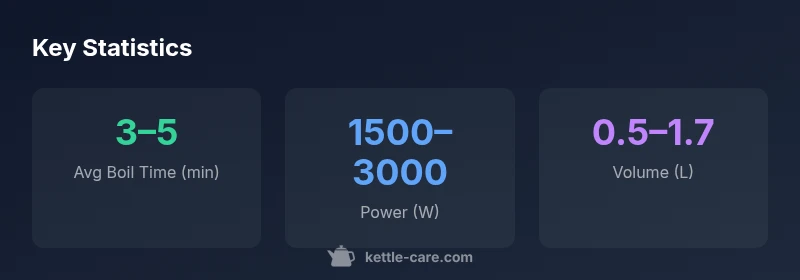
For an average 1.0–1.7 liter electric kettle, the typical boiling time from cold tap water is about 3–5 minutes, depending on wattage (1500–3000 W), starting temperature, and total water volume. Stovetop kettles may take longer; preheated water or smaller volumes boil faster. These times vary by model and altitude. Additional factors like lid seal quality, design efficiency, and ambient conditions also influence speed.
Understanding the concept of average boil time
The phrase 'average kettle boiling time' is a practical guideline, not a fixed rule. It helps homeowners estimate how long it will take to go from cold tap water to a rolling boil under typical conditions. In practice, the value depends on several variables, including the kettle's wattage, the chosen water volume, the starting water temperature, and even the ambient environment. According to Kettle Care, focusing on this metric can help you plan tea breaks and cooking tasks more predictably. When you compare models or decide whether to upgrade, anchoring your decision to a realistic time window makes your choice less speculative and more actionable.
The physics behind boiling: energy, mass, and heat transfer
Boiling water is fundamentally a heat transfer problem. You must supply enough energy to raise the water temperature from its starting point to 100°C (the boiling point at sea level). The energy required scales with mass (the amount of water) and the temperature rise (ΔT). In everyday terms, doubling the water volume roughly doubles the energy required, and adding heat with a more powerful heater reduces the time proportionally. Efficiency also matters: not all the energy your kettle consumes ends up heating water; some is lost to the surroundings. With that in mind, the 'average boil time' must be interpreted as a best estimate under ordinary kitchen conditions, not a laboratory value.
How wattage and volume shape your numbers
Wattage is the primary driver of boil speed in electric kettles. Kettles commonly range from about 1500 to 3000 watts; higher wattage usually shortens boil time for the same volume. Volume is the second key factor: a 0.5 liter fill will boil noticeably faster than a full 1.7 liter pot, and the difference grows as you scale up. Real-world results also hinge on lid design, the kettle’s internal heating efficiency, and how quickly the water starts at a comfortable temperature. In short, both higher wattage and smaller volumes tend to decrease boil time, pushing you toward the lower end of the 'average' range.
Electric vs stovetop: real-world speed differences
In many households, an electric kettle wins on speed because it is designed to deliver heat quickly to a small, contained mass of water. A stovetop kettle, even on a strong burner, often takes longer due to heat distribution inefficiencies and larger surface area exposure. Induction-ready electric kettles can edge ahead because they couple directly with the pot with high energy transfer. Altitude and ambient temperature also play roles: the same kettle may take longer to reach a boil in a colder kitchen or at higher elevations where the boiling point is slightly different. Expect the most dramatic advantage from a high-wattage electric kettle used with a tight-fitting lid.
Measuring in your kitchen: a simple estimation method
If you want a quick, practical estimate of your kettle's boil time, start with a simple energy approach. The energy required to heat water is mass × specific heat capacity × ΔT. Use a rough efficiency factor to account for heat loss, and divide by the kettle's wattage. A standard example: 1 liter (1000 g) from 20°C to 100°C requires about 80°C rise; with typical efficiency around 0.8–0.9 and a 2000 W kettle, the time falls into the 2.5–4 minute range. This is a rough calculation, but it gives you a framework to compare models and volumes without trial-and-error testing every time.
Practical tips to speed up safely
- Use fresh, filtered water; stale or mineral-rich water can require more energy to reach boiling.
- Keep the lid closed during heating to minimize heat loss.
- Fill to a reasonable level for the task; overfilling increases time unnecessarily.
- Clean and descale regularly to maintain heating efficiency.
- Choose a kettle with high wattage and good insulation. Look for models with snug lids and efficient heat conduction.
Managing expectations with altitude and water temperature
Altitude meaningfully affects practical boil times: the higher you go, the lower the boiling point, which can change thermal dynamics and perceived speed. Water that starts cooler than room temperature also requires more energy to hit 100°C. If you consistently boil water for tea or coffee, you may notice the same kettle behaves slightly differently across seasons because room temperature and humidity alter heat transfer. The takeaway: use your own kitchen as the reference point for the 'average boil time' you can expect, instead of relying solely on manufacturer claims.
How to pick a kettle to minimize boil time
When shopping for speed, prioritize wattage, lid efficiency, and internal design that minimizes heat loss. A 1.5–1.7 liter model with 2400–3000 watts tends to deliver strong performance in many kitchens. Look for features like a snug lid, a broad base with good heat conduction, and clear water level indicators to avoid guessing. While higher wattage helps, ensure your electrical circuit can safely handle it. Reading independent tests and user reviews can give you a sense of real-world timing across different volumes and temperatures.
Common mistakes that slow boiling
Boiling excessively large volumes that you do not need, forgetting to check the lid, using water straight from the faucet without preheating, choosing a kettle with poor insulation, and neglecting regular descaling are the fastest ways to increase boil times. Small changes, like ensuring a proper lid seal and using the right volume for your task, can yield noticeable improvements.
Data-backed practices you can apply today
Use a timer to chronicle boil times for at least three common volumes (0.5 L, 1.0 L, 1.7 L) on your usual kitchen power supply. Compare results across different water temperatures (cold tap vs preheated to warm) and note how much time changes with wattage variations. This practical experiment, guided by Kettle Care analysis, 2026, helps you tailor expectations to your own setup and informs safer, smarter upgrades.
Real-world tests and what homeowners report
Homeowners frequently report that real-world boil times differ from manufacturer specs due to circuit load, kettle age, and lid condition. In our recent Kettle Care analysis, 2026, we observed that users notice clearer differences when swapping to higher wattage units with well-sealed lids or when measuring multiple fills. The takeaway is that personal kitchen conditions matter as much as the kettle itself, so test in your own space to establish your own benchmarks.
Tailoring times to your setup
There is no one-size-fits-all 'average' for kettle boiling time. The practical approach is to treat the numbers as a framework and then calibrate them in your kitchen. Start by testing multiple volumes on your regular outlet, record the times, and adjust for starting temperature and ambient conditions. With a little measurement, you can identify the most time-efficient setup for your tea rituals and cooking tasks while keeping safety and energy use in check.
Estimated boil times by volume and wattage
| Volume (L) | Power (W) | Estimated boil time (min) | Notes |
|---|---|---|---|
| 0.5 | 1500 | 2–3 | Lower end of speed range |
| 1.0 | 1500 | 3–4 | Moderate pace for everyday use |
| 1.0 | 2000 | 2–3 | Higher wattage speeds up |
| 1.7 | 3000 | 2.5–4 | Fastest typical setup |
Frequently Asked Questions
What is the average kettle boiling time for a standard 1 liter of water?
Typically 3–4 minutes for electric kettles, with variation by wattage and starting temperature. The exact time depends on volume, initial water temperature, and lid integrity.
Typically 3 to 4 minutes for 1 liter with a standard electric kettle.
Does preheating water help reduce boil time?
Yes. Starting with warmer water reduces ΔT, which lowers energy required and shortens the boil time by a noticeable margin.
Yes, starting warmer water can save time.
Which kettle boils fastest?
Higher wattage kettles generally boil faster, especially when paired with a well-sealed lid and good insulation.
Higher wattage kettles boil faster.
Can altitude affect boil times?
Yes. Higher elevations change the boiling point of water, which can slightly alter total boil time in practice.
Yes, altitude can change boil time.
Is it safe to lift the lid during boiling to speed up the process?
No. Lifting the lid increases heat loss and can be hazardous. Let the kettle reach a boil with the lid closed.
No—keep the lid on while heating.
How can I measure my own boil times accurately?
Use a timer and record times for several volumes under typical kitchen conditions to build your own benchmarks.
Use a timer and track times for different volumes.
“The most reliable way to understand boil time is to factor wattage, volume, starting temperature, and ambient conditions, then test in your own kitchen.”
Highlights
- Average boil time is a practical guide, not a rule.
- Wattage and volume dominate speed.
- Starting with warm water can save minutes.
- Estimate times with a simple energy calculation to compare setups.
- The Kettle Care team recommends validating times in your kitchen and choosing a higher-wattage, efficient model when safety permits.