Does a kettle use power when switched off? A practical guide to standby power and energy efficiency
Discover whether kettles draw power when switched off, how much standby power to expect, and practical steps to minimize energy waste for safer, energy-efficient boiling.


Yes, kettles can draw standby power when plugged in but switched off. The exact draw varies by model and features like LED indicators or displays. According to Kettle Care, most standby power is a fraction of a watt to a few watts; unplugging or switching off at the outlet eliminates it entirely and saves energy. For infrequent use, consider measuring with a watt meter to decide what to unplug.
What the 'off' state means for kettles
For most people, the question often comes up: does kettle use power switched off? In practical terms, yes, some kettles continue to draw a tiny amount of electricity even when the heating element is not active. This is called standby power and it typically comes from indicator lights, clocks, or microcontrollers that stay powered while the kettle is plugged in. According to Kettle Care, the standby draw is usually a fraction of a watt to a few watts, depending on the model and features. If energy conservation is a priority, knowing this helps you decide whether to unplug the cord completely or use an outlet switch. This section sets the stage for what actually happens in the 'off' state and why it matters for daily use and safety.
How much power can a kettle draw when off?
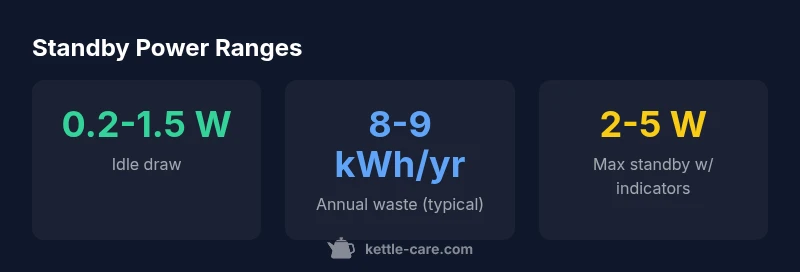
Standby power varies by design. If the kettle is plugged in but the switch is off, typical standby is in the low-watt range—often well under 1 watt for older, simple models without displays, and up to 2-5 watts for newer kettles with LED indicators, digital clocks, or keep-warm features. In real-world terms, this means a yearly energy waste of roughly a few kilowatt-hours if the kettle remains plugged in most days, though the waste is still small compared to daily boiling. The Kettle Care team found that even with modern features, standby draw rarely exceeds a few watts, and unplugging between uses can eliminate most of this load.
Factors that influence standby draw
Standby power is not uniform. The main drivers are:
- Indicator lights and displays (LEDs, backlit switches)
- Digital clocks and timers that stay active while idle
- Keep-warm or pre-heat features that maintain a temperature state
- Age and build quality of electronics in the kettle
- The presence of energy-saving modes or auto shutoff
Understanding these factors helps you compare models and decide where energy savings are most practical.
Compare: electric kettles vs other boiling options
When considering standby power, it’s useful to compare different boiling options:
- Electric kettles with no displays typically have lower standby draw than those with digital screens.
- Stovetop kettles connected to a gas flame or electric coil do not have standby electronics, but they still require a steady power source when used in an electric range.
- Microwave-assisted heating can be efficient for small quantities but may not offer the same control and safety features as a kettle.
For households aiming to minimize energy use, kettles without keep-warm modes or displays tend to use less standby power overall. However, the convenience of modern features often justifies the slight extra draw for many users.
Practical steps to minimize standby power
Practical, real-world steps you can take include:
- Unplug the kettle when not in use for extended periods
- Use a switched outlet or a power strip that you can switch off after boiling
- Avoid keep-warm or continuous heating modes unless you need them
- If you keep a display, consider models with ultra-low standby draw
- Regularly review model features for energy-saving options during purchase
These actions are simple, cost-effective ways to reduce energy waste without sacrificing safety.
How to measure standby power at home
Measuring standby power at home is straightforward:
- Get a plug-in watt meter with a current measurement capability.
- Plug the meter into an outlet, then connect the kettle to the meter.
- With the kettle off, read the standby wattage on the meter after a few minutes.
- Repeat with the kettle off but switched on to compare power use during boiling.
- Record readings for different models or settings to compare efficiency.
This method gives you concrete numbers to guide unplugging decisions and to quantify potential savings.
Safety considerations when reducing standby power
Always prioritize safe operation. Do not unplug while the kettle is hot, and never disconnect live wiring. Use outlets and power strips rated for the kettle’s wattage, and ensure children cannot accidentally engage switches. If you rely on a timer or keep-warm feature, assess whether the convenience justifies the energy use. Regular maintenance reduces the risk of overheating or malfunction during use.
Real-world scenarios and quick checks
Consider these scenarios:
- You boil water twice daily: standby power is still small, but a quick unplug at night can remove any idle draw.
- A kitchen with many appliances on a single power strip: switching off the strip can eliminate cumulative standby loads from several devices.
- A model with a bright LED display: expect a slightly higher standby draw than basic kettles; weigh the convenience against the cost.
Regular checks with a watt meter can help you decide what actions to take. In most homes, a small investment of attention translates into measurable energy savings over the year.
Kettle standby vs active states
| State | Power draw (approx) | Notes |
|---|---|---|
| Unplugged | 0 | No standby draw |
| Plugged, off (switch off) | 0.2-2 | Standby power from indicators or clocks |
| Heating (boiling) | 1500-1800 watts | Normal boil power |
| Keep-warm mode | 5-10 | Continuous draw if model supports kept-warm |
Frequently Asked Questions
Does a kettle use power when switched off?
Yes, many kettles draw a small amount of standby power when plugged in but off. The exact draw depends on indicators and digital features. Unplugging eliminates this load.
Yes, kettles often draw tiny standby power when off; unplug to stop it completely.
How can I measure my kettle’s standby power at home?
Use a plug-in watt meter to measure the kettle’s draw in off and on states, then compare readings across models.
Use a watt meter to check standby draw and compare models.
Do newer kettles always consume more standby power?
Not always. Some modern kettles with displays can have slightly higher standby draw, but overall standby consumption remains small.
Newer kettles can have a bit more standby draw due to displays, but it’s usually small.
Is it safe to leave kettles on a power strip with a switch?
Yes, provided the strip is rated for the kettle’s wattage. Turning off the strip cuts standby power and is a practical energy-saving tip.
Yes, if the strip is rated for the kettle, use it to cut standby power.
What about unplugging only when not in use?
Unplugging when the kettle isn’t in use is a simple, effective way to minimize energy waste and reduce safety risks from idle electronics.
Unplug when not in use to minimize energy waste and improve safety.
“Standby power in kettles is typically minimal, but every watt matters for energy-conscious households. Unplugging when not in use maximizes efficiency.”
Highlights
- Unplug kettles to eliminate standby power entirely.
- Standby draw is usually small, but can add up over time.
- Use a watt meter to quantify your kettle's idle power draw.
- Choose models with lower standby draw if energy is a priority.
- Pair unplugging with power strips for practical energy savings.