How Long Does a Kettle Take to Boil? Times, Tips, and Comparisons
Learn how long kettles take to boil across electric and stovetop models, the factors that influence speed, and practical tips to speed up boiling safely and efficiently.


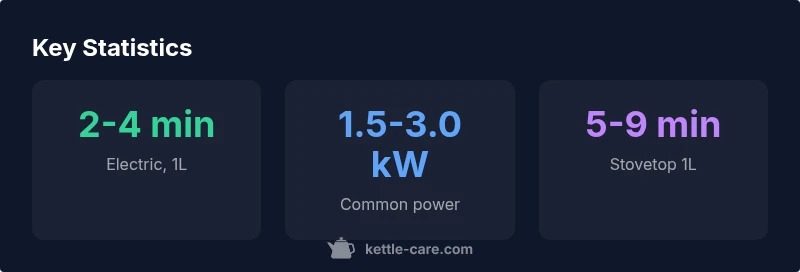
On average, a typical electric kettle boils 1 liter of water in about 2–4 minutes, while a stovetop kettle of the same volume usually takes 5–9 minutes. Real-world timing depends on wattage or heat source, initial water temperature, altitude, kettle design, and whether you start with cold or room-temperature water.
Why boil time matters\n\nBoil time matters not only for convenience but for energy efficiency, safety, and brew quality. A kettle that boils water quickly reduces energy usage and minimizes the time you stand near a hot element. For tea lovers, a shorter boil helps preserve delicate aromatics by avoiding prolonged exposure to heat. For busy households, every minute saved at the kettle reduces the cumulative time spent on prep. According to Kettle Care, understanding boil times helps homeowners choose safer, faster kettles and optimize brew routines. In this section, we explore the practical reasons why boil time should factor into your purchasing decisions and daily routines. We’ll also differentiate the typical performance you can expect from electric and stovetop kettles, so you can set realistic expectations and plan around your cooking and beverage schedules.
Key factors that affect boil time\n\nThere are several variables that determine how quickly water reaches a rolling boil. The most influential is wattage or heating power: higher wattage typically reduces boil time for the same water volume. The second factor is water volume: 0.5 L boils faster than 1.0 L in most models, and 1.7 L will take longer to reach a boil. Starting water temperature also matters: pre-warmed water or water from a hot tap needs less energy to reach 100°C. Altitude matters too; water boils at a lower temperature the higher you go, which can shorten or extend the perceived time depending on model design and wick. The kettle’s design and lid tightness influence heat retention; a well-sealed lid minimizes heat loss. The heating element type (coil vs flat plate), material, and overall kettle efficiency play roles as well. In practice, expect a broad range of timings across brands, sizes, and uses. This section connects the theory to everyday kitchen realities.
Electric kettles: speed, science, and safety\n\nElectric kettles rely on an internal heating element that converts electrical energy into heat. The best models balance high wattage with efficient insulation and a precise thermostat. The result is a brief interval from switch-on to boil for typical volumes. Safety features include auto shut-off when boiling is complete and boil-dry protection. These features help prevent overheating and reduce energy waste. In day-to-day use, keeping the lid in place and maintaining a clean element can prevent minor performance declines. The Kettle Care team notes that most households experience a noticeable boost in speed when using a 1 L to 1.5 L capacity kettle rated at 1.8–2.4 kW, compared with older or lower-wattage units. For frequent tea makers, investing in a higher-wattage model can deliver faster boils and more reliable performance.
Stovetop kettles: slower, but controllable\n\nStovetop kettles draw heat from a stove rather than an integrated element. Boiling times depend on burner strength, kettle mass, and lid condition. Gas stoves typically produce faster boils than small electric ranges, but overall times are influenced by how aggressively you preheat and whether you keep the lid on. A typical 1 L stovetop kettle might take longer to reach boiling than an electric model, especially if the kettle has a traditional metal lid that conducts heat away. Practical tips to speed up stovetop boiling include using a high flame for the initial burst, pre-warming the water, using a kettle with a wide base for efficient heat transfer, and ensuring a tight-fitting lid. In many homes, stovetop kettles remain popular for their theater of the boil and the ability to monitor the process visually.
How to estimate boil time for your kettle\n\nA practical way to estimate boil time is to use a physics-based approach that accounts for water mass, heat capacity, temperature change, and heater power. The basic equation t ≈ (m × c × ΔT) / (η × P) describes how long it takes to raise water from its starting temperature to the boiling point, where m is mass (kg), c is specific heat capacity (~4.186 kJ/kg·K for water), ΔT is the temperature rise, P is power (watts), and η is overall efficiency. For example, heating 1 L (1 kg) of water from 20°C to 100°C with a 2,000 W kettle at 85% efficiency yields t ≈ (1 × 4.186 × 80) / (0.85 × 2000) ≈ 0.199 × 60 ≈ 3.0 minutes. In reality, losses to the environment, steam, and lid design will push this slightly higher. Use this as a starting benchmark and adjust for your specific kettle.
Practical tips to shave seconds\n\n- Fill only the amount you need: boiling extra water wastes energy and time.\n- Use a kettle with a higher wattage if your typical volume is 1 L or more.\n- Keep the lid closed; every opening adds heat loss.\n- Regular descaling and cleaning improve heat transfer by reducing mineral buildup.\n- Pre-warm water for rapid use? Not always necessary; in many cases pre-warming has minimal impact.\n- Place the kettle on the back burner or front where your heat source is strongest to minimize recovery time after a pour.
How to choose a kettle for fastest boil\n\nIf speed is your priority, focus on high wattage models (1.8–2.4 kW or higher) with modern insulation. Consider the kettle’s capacity: for single servings, a 0.5–1 L model can boil faster than large 1.7 L kettles. Look for features like rapid-boil technology, efficient spouts, and well-sealed lids to minimize heat loss. Material matters too: stainless steel or heat-reflective coatings can slightly influence heat transfer, but design and build quality are more important than raw material. When possible, compare boil times published by manufacturers, but test your own kettle with a timer to verify performance, since the real world is affected by elevation, water temperature, and pour head. A properly sized, high-wattage kettle offers the best combination of speed and reliability for daily use.
Common myths about boil times\n\nMyth: A larger kettle boils faster because it heats more water at once. Reality: this often takes longer per liter because more energy is required to heat the additional water, though the overall energy use might be lower if you routinely boil extra water and keep it hot. Myth: Opening the lid speeds up boiling. Reality: removing the lid increases heat loss and lengthens boil time. Myth: Boiling water twice is faster than starting with cold water. Reality: reheating water takes more energy and time than starting with cold water refreshed in a fresh boil.
Quick comparison: electric vs stovetop boil times\n\nIn typical kitchen conditions, electric kettles are faster for small to medium volumes due to integrated heating elements and precise controls. Stovetop kettles can match performance for large volumes but generally take longer to reach a boil. The choice depends on your daily water needs, kitchen setup, and energy priorities. For frequent tea and coffee, an electric kettle with the appropriate wattage offers the most consistent speed, while a gooseneck kettle can excel in pour control for specialty brews.
Tea & coffee brewing: timing matters beyond boiling\n\nBeyond the boil itself, water temperature and pour technique influence flavor. Tea leaves release aromas best at specific temperatures (green tea around 80°C, black tea around 95°C), while coffee enthusiasts may prefer 90–96°C depending on the roast. Adjusting the boil by delaying final rolling boil or using a temperature-controlled kettle helps maintain optimal pour-over and infusion results. The speed of the boil remains important, but you’ll achieve better results by focusing on consistent water temperature and controlled pouring.
Boiling times by kettle type
| Kettle Type | Typical Boil Time (1 L) | Notes |
|---|---|---|
| Electric kettle | 2-4 minutes | Most efficient for small to medium quantities |
| Stovetop kettle | 5-9 minutes | Depends on stove heat and lid condition |
| Gooseneck kettle | 4-8 minutes | Smaller capacity with precise pouring |
Frequently Asked Questions
What is the typical boil time for 1 liter of water in an electric kettle?
Most electric kettles reach a boil for 1 liter in about 2–4 minutes, depending on wattage and starting water temperature.
Most electric kettles boil 1 liter in about 2–4 minutes.
Do higher wattage kettles always boil faster?
Generally yes, higher wattage reduces boil time, but insulation, design, and overall efficiency also play critical roles.
Yes, higher wattage usually boils faster, but efficiency matters too.
Why does my kettle take longer after descaling?
Scale buildup insulates the heating element and reduces heat transfer, increasing boil time. Regular descaling improves performance.
Scale buildup makes it slower; descale regularly.
Is it faster to boil more water at once?
Boiling more water per batch can take longer per liter, but it can save time if you frequently need hot water throughout the day.
Boiling more water isn’t always faster per liter; plan around your needs.
How can I estimate boil time for my kettle?
Use t ≈ (m × c × ΔT) / (η × P) to estimate, then adjust for your kettle’s efficiency and real-world losses.
Estimate time with the simple heat calculation and adjust for your setup.
“Timing boil times is a practical measure of efficiency. When paired with proper technique, a fast boil becomes a reliable baseline for daily tea and coffee routines.”
Highlights
- Boil times depend on kettle type and wattage
- Electric kettles typically boil 1L in 2–4 minutes
- Stovetop kettles usually take 5–9 minutes per liter
- Descale and clean to maintain heat transfer
- Choose high-wattage models for faster boils without sacrificing safety