How Much Does It Cost to Boil a Kettle for One Cup
Learn how to estimate the cost of boiling water for a single cup, using kettle wattage, water amount, and electricity rates. Practical steps, money-saving tips, and a calculator to compare kettles and habits.


The basic idea: cost per cup explained
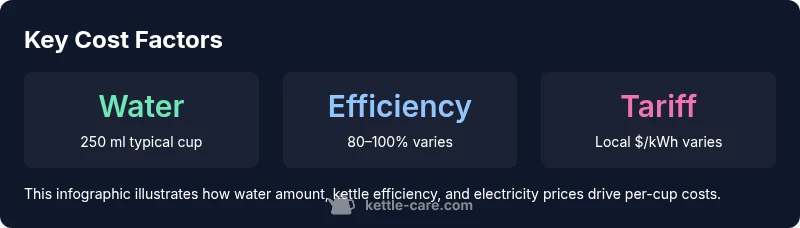
To understand how much a cup costs to boil, start with the idea that energy is the main driver, and price per energy unit varies by location. According to Kettle Care, the per-cup cost depends on three factors: how much water you boil, the kettle’s energy efficiency, and your local electricity tariff. If you boil more water than you need, you waste energy and money without improving your beverage quality. Conversely, boiling exactly 250 ml for a tea or coffee is typically the most efficient practice. The goal is to strike a balance between convenience and waste reduction. Remember that standby power and preheating can add small, steady costs over time. By thinking in cups rather than liters, you can compare kettles and habits more clearly and make smarter choices about when and how you boil water.
The energy math: watts, time, and tariff
Electric kettles convert electrical energy into heat. The key relationship is simple: energy drawn from the grid equals power multiplied by time, adjusted for efficiency. If a kettle runs at a higher wattage, it boils water faster, but the total energy required to bring a given amount of water to boiling remains governed by the water’s mass and the temperature rise. Your local electricity tariff then determines cost. In practice, a 250 ml cup costs less when you use a highly efficient kettle and when tariffs are favorable. This section clarifies why two households with different kettles can pay different amounts for similar cups, even if they use the same amount of water.
Real-world scenarios: typical kettle sizes and usage
Most households use between 200–300 ml for a cup of tea or coffee. Common kettles operate in the 1800–3000 watt range. If you routinely boil extra water for multiple cups, the cost scales with the total volume. For example, boiling 1 liter at typical tariffs costs more than boiling a single cup, largely due to energy required and the time the element is on, which can affect standby losses. Knowing your own usage pattern helps you choose a kettle that matches your daily routine and reduces waste.
How to measure your own costs at home
A practical approach is to estimate energy per cup from water volume and delta to boiling, then adjust for efficiency and price. A simple method is to multiply the water you boil by the energy needed to raise it to boiling, then divide by efficiency and multiply by the electricity rate. A home experiment is to time a boil and note the cost using your bill’s per-kWh rate. Over a few days, you’ll get a reliable picture of your true per-cup cost and where you can save.
Efficiency tips to lower per-cup cost
Small changes add up: boil only what you need, use a kettle with good insulation, and keep limescale under control to maintain efficiency. Pre-warming or reheating water should be avoided unless you simultaneously use the heat for another purpose. Keeping the kettle clean reduces mineral buildup, which can force the element to work harder. Consider a water filter if your water has high mineral content, as it can affect scale formation and energy use over time.
Choosing kettles with cost in mind: wattage, insulation, standby power
When evaluating kettles, focus on efficiency, not just capacity. Higher wattage boils faster, but if efficiency is poor, you may incur more energy waste. Look for features like boil-dry protection, auto shut-off, and well-sealing lids to minimize heat loss. Insulated kettles reduce standby losses, and models with precise temperature control can reduce unnecessary reheating. These factors contribute to lower per-cup costs over time.
Myths about kettle costs debunked
A common myth is that a more expensive kettle always costs more to operate. In reality, efficiency and how you use it matter far more. Another misconception is that stovetop kettles are always cheaper; while they can be economical if you’re already boiling on the stove for other reasons, electric kettles are typically more efficient for small amounts of water. Finally, some people believe preheating water saves energy; in most cases, it does not reduce total energy use and can waste time.
Building a cost-conscious tea ritual
A practical routine focuses on accuracy and efficiency. Measure the water for each cup, choose a kettle with better efficiency, and use refillable filters if needed to maintain energy performance. Pair your boiling with smart habits, such as brewing multiple cups from the same hot water batch or using a thermal mug to retain heat after boiling. Small, consistent changes yield noticeable savings over time.