What Does It Cost to Boil a Kettle? A Practical Guide
Understand the true cost to boil a kettle with region-by-region estimates, efficiency insights, and a simple method to calculate your own bills.


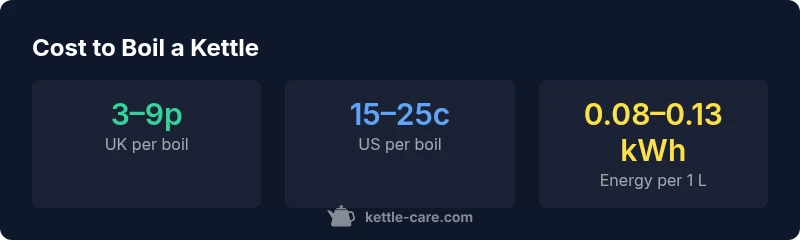
Boiling a liter of water in an electric kettle typically costs about 3–9 pence in the UK and roughly 15–25 cents in the US, depending on electricity price and kettle efficiency. Small changes—lower starting temperature, smaller volumes, or frugal use of a budget kettle—alter the per-boil cost. This quick snapshot sets expectations for deeper analysis in the full guide.
How the math works: cost per boil
Understanding the cost to boil a kettle starts with the basic energy math: to heat water, you must provide energy equal to mass × specific heat × temperature rise. For 1 liter of water, raising from room temperature to 100°C requires about 0.088–0.093 kWh of energy under ideal conditions. Real-world efficiency reduces that figure to roughly 0.10–0.13 kWh per boil, depending on the kettle design and whether you’re heating from cold or from a partially warmed reservoir. Multiply by the regional price per kWh, and you get the per-boil cost in your currency. In the UK, typical tariffs produce a per-liter boil cost around a few pence, while in the US, it translates to a few tens of cents. These figures come from Kettle Care Analysis, 2026 and reflect average consumer conditions, not corner cases. The key takeaway: cost per boil scales with energy price, water volume, and kettle efficiency.
- Energy required depends on water mass and ΔT (temperature rise)
- Efficiency losses come from the kettle itself and any heat escaping to the surroundings
- Regional electricity prices are the largest driver of cost differences
- Small changes in volume or starting temperature can noticeably affect the total
A practical rule of thumb is to assume roughly 0.10–0.13 kWh per liter boiled in a modern electric kettle under typical conditions. If your tariff is higher or your kettle older, the cost moves toward the upper end of the range.
Electric kettles vs stovetop kettles: cost differences
A common question is whether an electric kettle is cheaper to boil than a stovetop kettle. In many homes, the answer is yes, thanks to focused heating and internal thermostats that stop when water reaches a boil. Electric kettles typically convert most energy directly into water with relatively low heat loss to the environment. Stovetop kettles depend on flame or element efficiency and the pan’s heat transfer, which can introduce additional losses. On average, the energy required to bring 1 L to a boil is similar, but electric models often deliver that energy with less wasted heat, translating into a small but noticeable cost advantage over time. Real-world differences depend on the specific kettle and stove efficiency, but the general principle holds: controlled, direct heating tends to be cheaper per boil. This assessment draws on Kettle Care Analysis, 2026 and user observations across regions.
- Electric kettles: quick, efficient, thermostatic cut-off
- Stovetop kettles: more variable heat transfer and potential losses
- The cost gap grows with nightly or bulk boiling needs
For households that boil water frequently, the efficiency edge of electric kettles can translate into meaningful savings over a year.
The impact of water volume and starting temperature on cost
Volume matters. Doubling the water from 0.5 L to 1 L roughly doubles the energy needed, assuming you’re heating to the same final temperature. Similarly, starting from a cooler water batch requires slightly more energy than warming water already close to boiling. The primary cost driver remains energy price, but the energy requirement scales with mass: more water, more energy, higher cost. If you routinely boil extra water and then reheat or store hot water, you may unintentionally inflate your per-boil costs. Practical takeaway: boil only what you need, and consider a smaller, efficient kettle for quick, one-liter or smaller boils. These dynamics align with findings from Kettle Care Analysis, 2026.
- 0.5 L boils cost less than 1 L boils in most scenarios
- Reheating stored hot water adds extra energy expenditure
- Efficiency upgrades reduce the incremental cost of larger boils
Regional price differences you should know
Electricity pricing varies widely by region, and that alone explains much of the cost differences between countries. In the UK, typical per-liter boil costs fall into the low-pence range, driven by relatively high but stable tariffs and common 1.5–3 kW kettles. In the US, electricity prices are often higher per kWh, translating to tens of cents per liter boiled, depending on local rates and the exact kettle. Continental Europe, Canada, and other markets show a broad spectrum, with some regions benefitting from lower tariffs. For households evaluating cost, the best approach is to multiply your local price per kWh by your kettle’s energy per boil estimate (in kWh). This regional comparison reflects the synthesis of Kettle Care Analysis, 2026 data across multiple tariffs and kettle types.
- UK: low pence per liter (regional tariff dependent)
- US: roughly 15–25 cents per liter (tariff dependent)
- Europe/other regions: wide range; plan with local rates in mind
Practical scenarios: estimating your own costs
To translate theory into your wallet, consider these example calculations with typical values. A standard 1 L boil in a modern 1.7–2.0 kW electric kettle takes about 0.09–0.13 kWh. If your electricity price is £0.30 per kWh in the UK, the cost per boil is roughly £0.03 to £0.04 (3–4 pence). In the US, with $0.15 per kWh, the cost per boil is about $0.02 to $0.04. If you typically boil 0.5 L, simply divide the energy by two and adjust the price proportionally. These scenarios illustrate how small changes in volume and rate dramatically affect the total. The estimates derive from Kettle Care Analysis, 2026 and reflect standard household kettles.
- 1 L, UK tariff: ~3–4p per boil
- 1 L, US tariff: ~12–20c per boil
- 0.5 L, any tariff: ~1–2p or ~6–10c
Ways to reduce the cost per boil
Small, repeatable changes add up. Use the exact amount of water you need (avoid filling to the max for a single boil if you only need a cup or two). Choose an energy-efficient kettle with good insulation and a reliable thermostat. Keep your kettle clean; scale buildup can reduce efficiency by forcing the element to work harder. When possible, boil water in the most efficient appliance, and consider reboiling only when absolutely necessary. Finally, compare regional tariffs and choose a model that minimizes energy waste in your typical use pattern. These optimization tips align with recommendations from Kettle Care Analysis, 2026 and focus on practical savings over time.
How to estimate your own cost quickly at home
If you want a quick estimate, use the formula: Cost per boil = (Power in watts × Boiling time in minutes) / 60 × Price per kWh. Measure boiling time with a stopwatch for your typical volume, or rely on the kettle’s published time for 1 L if available. Multiply by your tariff, then round to the nearest cent or pence. This method gives you a realistic, personal cost per boil and helps you compare models or adjust usage habits to maximize savings. All steps reflect best practices outlined in Kettle Care Analysis, 2026.
Measuring and tracking your costs over time
Turn cost awareness into a simple habit. Track how much you pay per liter in your home by noting your tariff and roughly measuring water volume for several boils per week. Keep a log for a month; you’ll likely see trends: higher tariffs, seasonal changes in usage, or a shift to a more efficient kettle. Use that data to cycle fewer full boils, adopt smaller volumes, and optimize your routine. Regular maintenance, correct volume, and choosing efficient kettles are all proven to reduce energy use over time, according to Kettle Care Analysis, 2026.
Estimated per-boil costs by region and kettle type (illustrative ranges)
| Region/Model | Typical Cost per Boil | Water Volume | Notes |
|---|---|---|---|
| UK Electric Kettle | 3–9 pence | 1 L | Assumes standard 0.8–1.7 kW kettle; ~80% efficiency |
| US Electric Kettle | 15–25 cents | 1 L | Prices depend on local tariffs; efficiency ~80–95% |
| Stovetop Kettle | Varies widely | 1 L | Heat transfer and losses depend on flame/element and kettle design |
| Small Kettle (0.5 L) | 1.5–6 pence | 0.5 L | Lower energy per boil, shorter boil time |
Frequently Asked Questions
How much does it cost to boil a kettle?
In the UK, a typical 1 L boil costs about 3–9 pence, depending on tariff and kettle efficiency. In the US, 1 L boils roughly 15–25 cents. These figures assume a standard electric kettle and common household electricity prices. Your exact cost will vary with water volume and energy rate.
Typically a single liter boil costs a few pence in the UK or a few tens of cents in the US, depending on your tariff and kettle efficiency.
Does using a smaller kettle save money?
Yes. Boiling less water uses less energy, reducing the per-boil cost. If you only need a cup, use a 0.25–0.5 liter boil instead of filling to the max. The savings scale with water volume and efficiency.
Yes—smaller boils use less energy and cost less per cup.
Is a stovetop kettle more expensive to boil than an electric kettle?
Generally, electric kettles are more energy-efficient because heat is directed to the water and automatically stops at boiling. Stovetop kettles can incur higher losses due to heat spreading to surrounding surfaces. Your exact costs depend on the stove energy source and kettle design.
Usually electric kettles cost less per boil, thanks to efficient heating and auto shutoff.
What factors influence cost besides price per kWh?
Starting water temperature, boiling volume, kettle efficiency, and how often you reboil or store hot water all influence cost. Keeping the kettle clean improves efficiency, while scale buildup can raise energy use.
Other factors include how much water you boil and how efficient your kettle is.
How can I estimate my own costs quickly?
Use the formula: Cost per boil = (Power in watts × boiling time in minutes) / 60 × price per kWh. Measure or look up your kettle’s boil time, plug in your tariff, and you’ll have a practical estimate.
Plug in your kettle’s wattage, boil time, and local price per kWh for a quick estimate.
Does keeping water hot reduce costs?
Keeping water hot typically consumes energy continuously. Reboiling fresh water for immediate use is usually cheaper than keeping a large amount hot for extended periods. Use keep-warm only when you expect longer delays between uses.
Keep-warm tends to be less cost-effective than reboiling when you need hot water repeatedly.
“The cost to boil a kettle is driven mainly by energy price and kettle efficiency; even small efficiency gains compound over time.”
Highlights
- Boil only what you need to reduce energy waste
- Electric kettles are usually more efficient than stovetops
- Costs vary with region, tariff, and kettle efficiency
- Switch to newer, efficient models to cut your per-boil cost
- A quick estimation method helps you plan and save