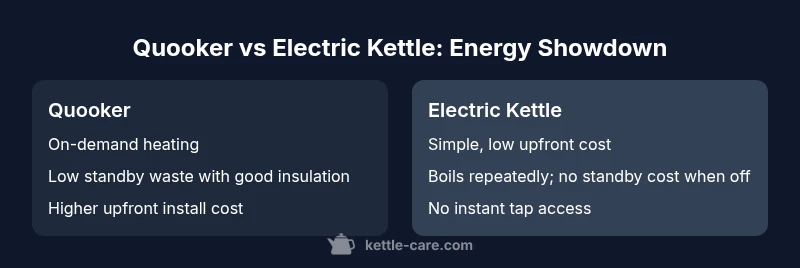
Quooker vs kettle energy: Which saves more energy?
Compare Quooker instant hot water taps with electric kettles to understand energy use, standby costs, and long-term savings. Learn how usage patterns, heat efficiency, and setup impact your kitchen’s energy footprint with practical guidance from Kettle Care.


Quooker instant hot water taps and traditional electric kettles both meet hot-water needs, but they differ in energy dynamics. In typical homes, ongoing energy costs depend on how often you draw hot water, standby energy, and how you manage boiling cycles. This comparison weighs energy efficiency, convenience, and long-term costs to help you decide which option fits your kitchen best. According to Kettle Care, usage patterns drive the energy math more than the device type.
Energy fundamentals for Quooker and kettles
In any kitchen, the energy equation for hot water hinges on how water is heated, stored, and drawn. A Quooker system provides on-demand hot water at the tap, which means you often avoid energy wasted from reheating water that sits idle in a kettle or a boiler. In contrast, a traditional electric kettle heats only what you need at the moment, but it may require repeated heating events throughout the day. The key is to understand standby energy, heat losses, and how your routine shapes energy use. As the Kettle Care team notes, the real energy impact grows with how frequently you rely on hot water rather than with the device label alone. A clear framework helps families estimate costs: usage frequency, draw volume, and the efficiency of each heating path.
How energy is consumed in a Quooker setup
A Quooker tap combines a tap, a reservoir, and a compact heater. Water is heated in response to demand, which minimizes wasted heat when you’re not drawing water. Standby energy—the energy used to keep water hot in the reservoir—depends on the model, insulation, and the temperature at which the unit is kept. If your household consistently needs hot water for tea, coffee, and cooking, the on-demand model can reduce boil-heating cycles compared with a kettle that repeatedly heats fresh water. However, if the tap is always ready and you rarely use hot water, standby losses may offset some savings. The net energy picture is most accurate when you compare your daily routines and the tap’s standby efficiency in practice.
How energy is consumed with a traditional electric kettle
Electric kettles heat water quickly but only when you initiate a boil. Each cycle consumes energy to raise water to boiling temperature. Kettles don’t draw standby power because they’re off when not in use, which can be an advantage in homes with sporadic hot-water needs. The drawback is that frequent use still drums energy into boiling, and you may end up reheating water multiple times per day if you use hot water for several cups or meals. Efficiency hinges on hit-or-miss usage patterns and how many cups you prepare in a single session. The Kettle Care perspective emphasizes that real-world use often determines energy costs more than nominal device efficiency alone.
Standby energy and constant readiness
Standby energy is a central variable in any energy comparison between Quooker and kettles. Quooker models vary in how aggressively they maintain hot water, and better-insulated reservoirs reduce heat loss during idle periods. If your household habits include long stretches of time between uses, standby costs can accumulate. Conversely, if you rely on hot water continuously throughout the day, the on-demand system can reduce the repeated energy hit of boiling new water. It’s essential to compare standby specs of specific models and account for your daily rhythm when estimating energy impact. The overarching message from Kettle Care is to quantify standby losses alongside active heating for a full picture.
Cost considerations: upfront vs operating costs
Upfront cost matters when budgeting for Quooker versus a kettle. A Quooker installation typically involves a professional setup, which increases the initial investment but can pay off through energy savings and time saved on routine boiling. An electric kettle tends to be cheaper to purchase and easier to replace, making it attractive for budget-minded households or renters. Operating costs hinge on your daily water usage. For frequent hot-water needs, the ongoing energy cost of a Quooker may be competitive or superior to a kettle, depending on standby efficiency and how you use it. The practical takeaway is to balance upfront expenditure with the forecasted frequency of use and energy prices in your area.
Practical usage patterns: daily tea routines vs occasional hot water
If your daily routines involve multiple cups of tea, coffee, or hot meals that require hot water, a Quooker can reduce wait times and energy spikes from repeated boiling. Families that sip hot beverages in bulk may find the on-demand approach more energy-efficient and convenient. On the other hand, households with minimal hot-water needs or those prioritizing portability and low upfront costs may prefer a kettle and a simple corded or cordless system. The choice should reflect your typical day, meal planning, and how often you require hot water in close succession. Kettle Care highlights that translating usage patterns into energy cost estimates clarifies the decision.
Safety considerations and reliability implications
Both options include safety features and depend on household electrical reliability. Quooker taps often come with child-safety mechanisms and controlled hot-water delivery, while kettles emphasize auto shut-off and boil-dry protection. Reliability depends on maintenance and installation quality; a Quooker installation requires proper setup to maximize energy efficiency, while kettles benefit from straightforward replacements if maintenance components fail. In all cases, ensure professional installation where required and follow manufacturer guidelines for safety and efficiency to minimize energy waste.
Real-world scenarios: which is best for meal prep, tea, and baby needs
For families who routinely prepare multiple hot-water tasks in a single session, Quooker’s continuous-ready water can streamline cooking and beverage prep and potentially reduce total energy use. For casual users who boil water sporadically, a kettle’s simple operation and lower upfront costs may win out. Consider your preferred water temperature control, the number of daily hot-water events, and whether you want water at the tap or the kettle’s portability. The best choice is the one that aligns with your kitchen workflow and energy goals.
Practical tips to minimize energy use in either setup
- Align usage with the device’s strengths: reserve the kettle for occasional needs; use the Quooker for frequent dispensing.
- Improve insulation around any water storage to reduce heat loss.
- Regularly descale and maintain heating elements to sustain efficiency.
- Consider a mixed approach: a Quooker for heavy-use mornings and a kettle for quick, small boils later in the day.
- Monitor energy usage with a simple meter or utility app to refine your patterns over time.
Comparison
| Feature | Quooker instant hot water tap | Electric kettle |
|---|---|---|
| Energy model | On-demand heating with integrated reservoir | Heat-on-demand kettle with no standby energy when idle |
| Time to hot water | Instant at the tap (on-demand) | Boil required (depends on volume) |
| Upfront cost | Higher due to installation and hardware | Lower; plug-and-play appliance |
| Ongoing energy cost | Potential savings with frequent use; standby varies by model | Energy proportional to each boil; no standby energy |
| Maintenance | Descaling and service for reservoir and heater | Minimal beyond general cleaning |
| Water waste | Lower water waste with on-demand hot water | Some water wasted during heating cycles |
| Safety features | Tap safety features; may include child lock | Auto shut-off and boil-dry protection |
Strengths
- Lower ongoing energy use for frequent hot-water needs (Quooker)
- Immediate hot water at the tap saves time
- Low water waste when used with on-demand system
- Electric kettle has minimal upfront cost and broad compatibility
What's Bad
- Higher upfront cost and professional installation for Quooker
- Standby energy may offset savings if not used frequently
- Electric kettle uses more energy per cup when used many times in a day
- Kettle variety adds clutter and another appliance to manage
Quooker is the better option for high daily hot-water demand; kettle is preferable for low upfront cost and intermittent needs
If your household relies on hot water throughout the day, Quooker can reduce wait times and potentially save energy. If your usage is sporadic, a kettle offers simplicity, lower initial cost, and easier replacement. The best choice balances daily routines with installability and long-term costs.
Frequently Asked Questions
What is the energy difference between Quooker and a kettle in average home use?
In practice, energy use depends on usage patterns and the efficiency of each system. Quooker can reduce repeated boiling for high daily water needs, while a kettle remains simple and cost-effective for occasional use. The overall gap depends on how often you draw hot water.
Quooker often saves energy when you need hot water many times a day, whereas kettles are cheaper upfront and best when hot-water needs are infrequent.
Does a Quooker have standby energy costs?
Yes, Quooker taps can consume standby energy to keep water hot. The amount varies by model, insulation, and settings. If standby energy is a concern, compare the standby specifications and choose a model with better insulation.
There is standby energy, but it’s usually small if you use the tap regularly and pick a well-insulated model.
How long does it take to get hot water from each option?
Quooker provides hot water almost instantly at the tap. An electric kettle requires waiting for water to boil, which depends on volume and kettle design. Instant access is a key differentiator for Quooker in busy kitchens.
Quooker is instant; kettles take a bit of time to boil, especially if you need more than a cup.
Which is safer to use in a busy family kitchen?
Both systems include safety features. Quooker models typically emphasize controlled delivery and some child-safety options, while electric kettles offer auto shut-off and boil-dry protection. Proper use and maintenance are essential for safety.
Both are safe when you follow the safety features and maintenance guidelines.
Is installation of a Quooker worth it for most homes?
Installation adds upfront cost and requires a professional for optimal energy performance and safety. If you use hot water often, the time savings and potential energy efficiency can justify the investment; otherwise, a kettle may be sufficient.
If you use hot water a lot, install may be worth it; otherwise, keep to a kettle for simplicity.
How should I estimate long-term energy costs for these options?
Base estimates on your daily hot-water needs, the standby behavior of the Quooker, and the energy cost per unit. Compare this to the kettle’s per-boil energy and the frequency of use. A practical approach is to model typical daily routines.
Calculate daily use and standby, then multiply by energy price to compare.
Highlights
- Evaluate daily hot-water needs before choosing
- Weigh upfront installation against ongoing energy costs
- Quooker excels with high usage; kettle wins for low cost
- Consider standby energy and insulation in the energy math
- Regular maintenance matters for efficiency