Can You Use Kettlebells for Bicep Curls? A Safe, Effective Guide
Discover how to use kettlebells for bicep curls safely and effectively. Learn grip, stance, tempo, and progression with practical tips to build strength while protecting joints.


Yes, you can use kettlebells for bicep curls, and many lifters find them versatile for adding grip challenges and variable load. However, proper form, shoulder stability, and control are essential to prevent wrist strain or elbow overuse. In this guide we cover grip types, stance, tempo, common faults, and safe progressions.
Why kettlebells work for bicep curls
According to Kettle Care, kettlebells offer a unique grip and loading pattern that can enhance forearm strength and tendon resilience when used for curls. Unlike traditional dumbbell curls, kettlebell movements engage stabilizing muscles across the shoulder girdle and core, which can translate into better overall arm function. This makes kettlebell curls appealing for home workouts where space or equipment is limited, yet you still want powerful biceps. When chosen and performed correctly, kettlebells can provide a safe, effective stimulus for progressive overload while challenging grip endurance and grip strength endurance, two components critical to real-world performance. However, the benefits depend on form, tempo, and the load you select. For newcomers, starting light and focusing on precise movement beats chasing heavier loads without control.
Grip variations and hand positions
Kettlebell curls can be performed with several grip options, each altering the load on the forearm and the biceps. A neutral grip (palm facing your thigh) reduces wrist strain and can be more comfortable for beginners or those with tender wrists. A traditional curl grip (palm up) places more emphasis on the biceps peak but can challenge the wrist if the elbow or shoulder isn’t braced properly. Some athletes also experiment with a hybrid grip where the kettlebell rests on the palm with the thumb wrapping around the handle, which can increase tactile feedback and grip stability. Regardless of grip choice, keep the wrist neutral and the elbow tucked to maximize bicep isolation and minimize momentum.
Choosing the right weight and equipment setup
Selecting the right kettlebell weight is crucial for maintaining strict form throughout the set. Start with a weight that allows you to complete all reps without sacrificing technique, aiming for controlled speed and full elbow flexion without shoulder compensation. A sturdy grip mat or towel under the kettlebell can help prevent slipping and provide a stable base for your stance. If you train on a slippery surface or have limited space, push back from the wall slightly to create room for shoulder movement and to avoid contact with furniture. Remember that kettlebell curls, when done with intent, should feel like a targeted bicep movement rather than a swinging, momentum-driven exercise.
Basic single-arm kettlebell curl technique
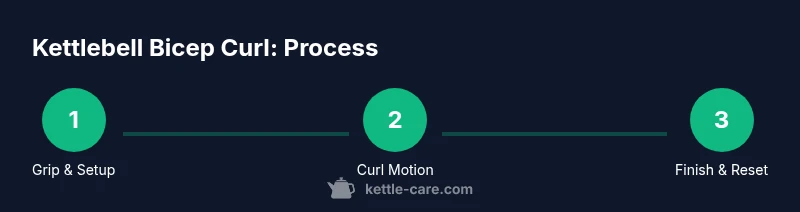
To perform a single-arm kettlebell curl, stand with feet hip-width apart, brace the core, and keep the elbow close to the side. Grasp the handle firmly, brace the upper back and shoulder, and begin the curl by flexing the elbow, not the shoulder. The wrist should stay in a neutral position as the kettlebell travels from the starting position toward the shoulder. Pause briefly at the top, then slowly lower under control. This sequencing helps isolate the biceps while minimizing swing and shoulder involvement.
Common mistakes and how to fix them
Common errors include letting the elbow flare away from the torso, bending the wrist instead of keeping it neutral, and using hip or shoulder drive to move the weight. Fix these by resetting your stance, keeping the elbow pinned, and adopting a slow, deliberate tempo. If you notice any wrist pain, reduce the weight or switch to a neutral-grip curl before progressing. Practice with a mirror or a trainer to ensure the form stays strict throughout every rep.
Tempo, breathing, and bracing for performance
Tempo is a powerful driver of stimulus. A practical cadence is 2-0-2-0 (two seconds up, two seconds down) or a slower controlled tempo for higher time under tension. Exhale during the curl portion and inhale on the controlled descent to maintain intra-abdominal pressure and spinal stability. Bracing the core and keeping the shoulders down and back helps prevent scapular elevation, which can contribute to improper elbow alignment. Consistent breathing patterns reduce fatigue and help you maintain form across sets.
Progressions: from light curls to advanced variations
Begin with a single kettlebell at a conservative weight and perform 3–4 sets of 8–12 reps. As form becomes reliable, increase weight gradually or switch to tempo variations like 3-1-3-1 to increase time under tension. For advanced training, try alternating curls with a split stance to further challenge core stability and balance. You can also introduce higher reps with lighter weights to improve muscular endurance or slow eccentrics to boost strength gains.
Programming your kettlebell curls into a broader plan
Incorporate kettlebell curls into a balanced upper-body routine 2–3 times per week, pairing them with rows, presses, and pull-ups to ensure muscular balance. Consider alternating days that emphasize grip strength or forearm conditioning, which supports performance on curls. Track weights, reps, and perceived exertion to guide progressive overload and ensure safety as you advance. Remember that consistency beats intensity when building durable biceps and resilient joints.
Safety considerations for wrists and elbows
Elbow and wrist health depend on proper alignment and gradual progression. Keep the elbow close to the torso, avoid over-rotation of the forearm, and maintain a neutral wrist throughout the movement. If you experience sharp pain or tingling, stop and reassess your technique or consult a trainer. Warming up with wrist circles and light band work before curls can also reduce the risk of overuse injuries.
Benefits beyond the biceps
Kettlebell curls challenge grip strength, forearm development, and shoulder stability more than traditional dumbbell curls, which can translate to better daily function. The grip-demanding nature of kettlebells also enhances CNS efficiency and can contribute to greater overall arm strength. For home athletes, this means a compact tool delivering multiple benefits in a single movement, especially when integrated with other kettlebell drills.
Modifications for limited equipment or beginners
If you only have a lighter kettlebell, perform more reps with strict tempo to maintain training intensity. For beginners, start with a single-arm curl using a neutral grip and a short range of motion, gradually increasing the range as control improves. If you’re working around a tight space, try standing curls with the kettlebell placed against the thigh to reduce any risk of contact with nearby objects. Always prioritize form over load to prevent injury.
Real-world routines you can try this week
A simple plan could include two workouts focusing on kettlebell curls per week, each with 3–4 sets of 8–12 reps per side. Pair curls with a complementary exercise such as bent-over rows or incline hammer curls to balance elbow flexor development. During each session, perform a 5– to 10-minute warm-up with mobility drills before starting, followed by a 5-minute cooldown with light forearm stretches. Consistency and proper recovery will deliver gradual yet meaningful gains.
Tools & Materials
- Kettlebell(s)(Choose a weight you can curl with strict form for 8–12 reps; start light if unsure.)
- Non-slip workout mat(Provides grip and comfort, helps prevent slipping on smooth floors.)
- Wrist supports (optional)(Use if you experience discomfort; not required for safe curl technique.)
- Timer or watch(Pace tempo and track rest intervals between sets.)
Steps
Estimated time: 25-30 minutes
- 1
Select weight and grip
Choose a kettlebell you can control for all reps with strict form. Grip the handle firmly and set your stance.
Tip: Start light to learn the path of the weight before increasing load. - 2
Set stance and brace core
Stand with feet hip-width apart, knees soft, and core braced. This stabilizes the spine during the curl.
Tip: Engage lats slightly to prevent shoulder shrug. - 3
Position elbow to the side
Keep the elbow tucked close to the torso to isolate the biceps and prevent momentum.
Tip: Avoid letting the elbow drift forward or flare out. - 4
Start the curl with elbow flexion
Initiate movement by flexing the elbow while maintaining a neutral wrist.
Tip: Do not lift with the shoulder; keep upper arm still. - 5
Lift to mid-forearm, pause
Curl the kettlebell until the forearm is vertical or slightly above the elbow; pause briefly.
Tip: Pause helps maximize muscle tension and control. - 6
Lower with control
Lower the kettlebell slowly back to the starting position through a full range of motion.
Tip: Maintain tension; avoid letting gravity win the descent. - 7
Breathe and brace
Exhale during the curl, inhale on the descent, and keep your core braced.
Tip: Breathing supports stability and endurance. - 8
Repeat on same side
Complete the target reps on one arm before switching sides.
Tip: Maintain the same tempo on each rep for consistency. - 9
Switch sides or alternate
Choose to perform all reps on the other arm or alternate arms each rep.
Tip: Alternate if grip fatigue becomes limiting. - 10
Progressive overload
Increment weight or set tempo gradually as form holds steady.
Tip: Small, consistent increases beat giant leaps. - 11
Integrate into a plan
Place curls within a broader routine that balances push and pull movements.
Tip: Avoid overworking one muscle group in a single session. - 12
Cool down and mobility
Finish with light forearm stretches and wrist mobility work.
Tip: Cooling down reduces soreness and improves recovery.
Frequently Asked Questions
Are kettlebell curls better than dumbbell curls?
Kettlebell curls offer grip variety and additional stabilization demands that can enhance forearm strength and shoulder control. They are not inherently better for everyone, but they provide an effective alternative that pairs well with other kettlebell movements. Your choice should depend on comfort, goal, and equipment access.
Kettlebell curls provide grip variety and stabilization benefits, but they aren’t universally better. Choose based on comfort and your training goals.
What grip is best for kettlebell curls?
A neutral grip reduces wrist strain and is most beginner-friendly. A traditional palm-up grip can emphasize the biceps more but may require better shoulder and wrist control.
Neutral grip is easiest for beginners; palm-up can emphasize the biceps but needs solid form.
Can I perform kettlebell curls if I have a shoulder issue?
Yes, with caution. Use lighter weights, maintain a strict elbow position, and avoid creating extra shoulder movement. If pain persists, consult a clinician or trainer.
Yes, with caution. Keep the elbow tucked and use light weights; seek professional advice if pain continues.
How many reps and sets should I start with?
Begin with 3–4 sets of 8–12 reps at a weight you can control. Increase gradually as form remains solid and you can complete all reps with control.
Start with 3–4 sets of 8–12 reps and progress slowly as form stays solid.
Alternate arms or curl both arms at once?
Both approaches work. Alternating can reduce grip fatigue and allow better form; curling both arms at once can save time but may challenge balance and control.
Alternate arms to manage grip and form; or curl both if you’re comfortable and space allows.
What are common mistakes to avoid?
Common mistakes include elbow flare, wrist bending, and using momentum. Focus on a tight brace, neutral wrist, and slow tempo to fix these errors.
Key mistakes are elbow flare, bent wrists, and momentum—keep solid form and slow tempo to fix them.
Watch Video
Highlights
- Choose weight that maintains strict form.
- Keep elbows tucked to isolate the biceps.
- Use a deliberate tempo and breathing pattern.
- Progress gradually to avoid injury.