How to Use Kettlebells for Arms: A Practical Guide
Learn how to use kettlebells for arms with a practical, safety-first approach. Technique, programming, and maintenance tips to build stronger, more defined arms.


Goal: master how to use kettlebells for arms safely and effectively. You'll learn weight selection, grip, and fundamental moves that isolate the biceps, triceps, and forearms. This guide emphasizes controlled tempo, progressive loading, and consistent practice to build arm strength and endurance while protecting the shoulders and wrists. Start with a light weight and a brief warm-up to begin.
Why kettlebells are a smart option for arm development
According to Kettle Care, how to use kettlebells for arms safely contributes to stronger, more durable arms. Kettlebells offer unique advantages for building arm strength beyond conventional dumbbell work. The offset mass of a kettlebell creates continuous tension through the forearms and biceps, while the long lever and hip-hinge dynamics recruit the posterior chain, improving shoulder stability in the process. For many home gym setups, a single kettlebell can replace bulky machines and still deliver meaningful gains in grip strength and muscular endurance. If your goal is a lean, functional arm profile, kettlebell training provides variety — from slow controlled presses to explosive swings — that challenges the arms through different ranges of motion. This article focuses on safe technique, scalable loads, and simple progressions so you can start today with confidence.
Essential biomechanics: grip, elbow, and shoulder stability
The shoulder girdle, elbow alignment, and grip steadiness are the foundations of safe arm work with kettlebells. Start with a neutral grip, maintain a tall posture, and keep the core braced to protect the spine. Elbow tracking should remain close to the torso to reduce impingement, and wrists should stay in a neutral position to avoid strain. These fundamentals improve force transfer during presses and rows and help prevent injuries during dynamic moves like swings or cleans. Mastering these cues reduces compensations and keeps the load on the targeted arm muscles.
Top kettlebell arm exercises and how to perform them safely
-
Halo and halo-to-rack transition: Hold the bell by the horn and move it around your head in a smooth arc. This builds rotator cuff stability and forearm endurance, a foundation for heavier pressing work. Start with light reps and focus on keeping the wrist neutral.
-
Bent-over row (two-handed or single-arm): Hinge at the hips, keep a flat back, and pull the kettlebell toward your hip. Control the descent to maximize time-under-tension for the lats and posterior chain while engaging the biceps as stabilizers.
-
Floor press or incline press from rack: Lying on a mat or bench, press the kettlebell from chest height. This isolates the triceps and chest while protecting the shoulders from excessive loading.
-
Standing or seated overhead press: Press from the rack position with a stable torso and neutral spine. Avoid excessive flare of the elbows; keep a controlled tempo to protect the shoulder.
-
Farmer’s carry with a light-to-moderate weight: Carry the kettlebell in each hand with shoulders down and core braced. This builds grip strength and forearm endurance, transferring to all arm-dominant moves.
Each exercise emphasizes form before load and should be performed with a tempo that favors control over speed.
Form cues and safety for common moves
- Halo: keep the elbow at about chest height and move the weight in a full circle without twisting the wrist. Breathe steadily and avoid a shrugging shoulder.
- Bent-over row: retract the shoulder blade, brace the core, and pull toward the hip rather than the shoulder. Do not hunt the weight with your lower back.
- Floor press: maintain a slight arch in the lower back, feet grounded, and elbows angled 45 degrees from the torso. Exhale as you press and inhale on the return.
- Overhead press: start from the rack position, press straight up without locking the elbow at the top. Keep the ribs down and avoid leaning backward.
- Farmer’s carry: control step length, keep arms straight, and avoid bending the wrists. Choose a weight you can hold for the set duration.
Always warm up first, move through full ranges of motion, and progress gradually. If you experience sharp pain, stop and reassess your form or weight.
Programming your arms with kettlebells: sample 4-week plan
Week 1 focuses on technique and tolerance with 2 sessions per week. Start with 3 sets of 8-12 reps per exercise, resting 60-90 seconds between sets. Use a tempo of 2-0-2 (2 seconds down, 0 pause, 2 seconds up).
Week 2 adds light loading and 1-2 extra reps per set, increasing the total work slightly while preserving form. Maintain the same number of sets and rest periods.
Week 3 introduces a short circuit on one training day, combining two arm-focused moves back-to-back with 45 seconds of active rest. Keep loads moderate and focus on clean execution.
Week 4 builds endurance by substituting a few sets with higher reps (12-15) while maintaining controlled tempo and braced core. Reassess weight to ensure safety as fatigue increases.
Note: Always allow at least one day between sessions that target the same muscle groups. Hydration, sleep, and nutrition support recovery.
Advanced tips: tempo, variety, and progression
- Increase time-under-tension by slowing the eccentric phase (e.g., 3-4 seconds down) while maintaining a controlled concentric lift.
- Vary grip widths and pronation to hit the forearms and brachialis differently, promoting balanced arm development.
- Introduce light unilateral work to address imbalances, such as single-arm rows or half-kneeling presses.
- Pair arm work with mobility drills for shoulders and wrists to sustain long-term joint health.
- Track progress with a simple log: weight, reps, and perceived exertion to guide safe progression.
Accessory work and mobility to support arm gains
Incorporate light mobility and stability work to support kettlebell arm progress. Include scapular push-ups, thoracic rotations, and wrist extension/flexion drills. Add a short mobility circuit after each session to improve range of motion and reduce stiffness. Keep accessory work light and purposeful to avoid overtraining.
Equipment care and injury prevention
Inspect the kettlebell and handle for cracks or rough spots before each session. Wipe down after use to remove sweat and reduce grip slip. If you have existing shoulder or elbow issues, prioritize warm-up, maintain neutral wrists, and avoid movements that provoke pain. Gradually increase load and volume, and consider professional guidance if any injury signs persist.
Tools & Materials
- Kettlebell(s) of appropriate weight(Choose a weight you can control for 8-12 reps with proper form; start light if new)
- Yoga mat or comfortable flooring(Provides cushion for floor presses and support during kneeling moves)
- Water bottle(Stay hydrated during training)
- Towel(Use for grip and to wipe sweat)
- Wrist wraps (optional)(Adds support during heavier presses or longer sessions)
- Chalk or grip powder (optional)(Improves grip if hands get sweaty)
Steps
Estimated time: 25-30 minutes
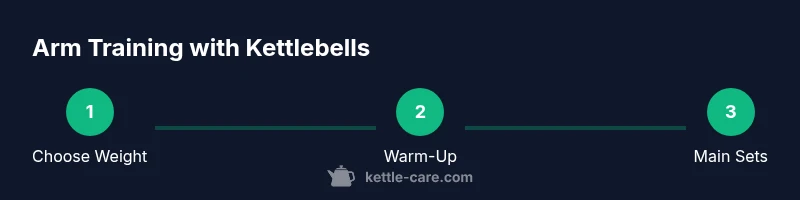
- 1
Choose the right kettlebell weight
Assess your current strength and pick a weight you can control for 8-12 reps with proper form. This ensures you learn the movements safely before increasing load.
Tip: Start light to master form; you can progress once technique is consistent. - 2
Warm up shoulders and wrists
Spend 5-7 minutes on joint mobility and activation drills for the shoulders, elbows, and wrists to prepare the arms for loaded work.
Tip: Include arm circles, shoulder 'clock' stretches, and light band pulls. - 3
Set your stance and grip
Adopt a tall posture, feet roughly hip-width apart, and establish a neutral grip on the kettlebell to reduce strain on the wrist.
Tip: Brace the core and maintain a gentle tension through the torso during each movement. - 4
Practice foundational moves with light weight
Run through halos, bent-over rows, and floor presses at a comfortable pace to engrain form before adding load.
Tip: Prioritize smooth transitions and full ranges of motion. - 5
Perform your main sets in a circuit
Combine 2-3 arm-focused moves into a short circuit, resting 45-60 seconds between rounds. Use a tempo of 2-0-2.
Tip: Maintain braced core and avoid shrugging the shoulders. - 6
Cool down and mobility work
Finish with gentle stretches for the shoulders, triceps, and forearms and a brief breathing cooldown.
Tip: Hold each stretch for 20-30 seconds and breathe deeply.
Frequently Asked Questions
Can kettlebell training replace dumbbell curls for arms?
Kettlebell moves build arm strength and grip but curls isolate the biceps more directly. Include curls if your goal is targeted bicep growth, but prioritize kettlebell patterns for functional strength.
Kettlebell moves build arm strength and grip, but curls isolate the biceps. Include curls if you want targeted bicep growth, but keep kettlebell patterns as the main work.
What weight should I start with?
Begin with a light kettlebell you can control for 8-12 reps with good form. Increase weight gradually as technique remains sound and you can complete sets without compensations.
Start with a light kettlebell you can control for 8-12 reps with good form, then progress gradually as your technique remains solid.
How many days per week should I train arms with kettlebells?
Aim for 2-3 sessions per week with at least 48 hours of rest between arm-focused workouts to allow for recovery and growth.
Train arms with kettlebells 2 to 3 times weekly, with at least 48 hours between sessions for recovery.
Are kettlebell arm exercises safe for beginners?
Yes, with a proper warm-up, light loads, and a focus on form. Start with foundational moves and progress slowly to protect joints.
Yes, if you warm up, start light, and focus on form. Begin with basic moves and progress gradually.
What are common mistakes to avoid?
Avoid flaring elbows, rounding the back, and using momentum. Prioritize a neutral spine, braced core, and controlled tempo.
Avoid flaring elbows, back rounding, and momentum. Keep a neutral spine and controlled tempo.
What warm-up works best before kettlebell arm work?
A 5-7 minute warm-up including shoulder circles, band external rotations, and light mobility work primes the arms and shoulders for heavier sets.
Do a quick 5-7 minute warm-up with shoulder circles, external rotations, and light mobility to prepare.
Watch Video
Highlights
- Choose a weight you can control with proper form.
- Prioritize shoulder and wrist stability for safety.
- Progress gradually with tempo and volume.
- Incorporate mobility work to support gains.
- Consistency beats occasional heavy sessions.