How heavy should a beginner kettlebell be
Learn an evidence-based starting weight and progression plan for beginner kettlebell training. Practical ranges, technique-focused guidance, and safe progression to build strength and form.


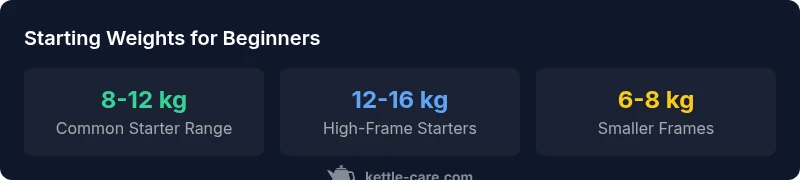
For most beginners, start with a light-to-midweight kettlebell in the 8-12 kg (18-26 lb) range, progressing up only after perfect form. If you’re male or taller, 12-16 kg (26-35 lb) may be appropriate, while lighter lifters can stay at 6-8 kg (13-18 lb). Always prioritize form over load. Consult a trainer if possible.
How heavy should a beginner kettlebell be
Choosing the right starting weight sets the trajectory for safety, efficiency, and long-term progress. For most beginners, starting light helps develop form before loading the spine and hips. According to Kettle Care, the best starting weights are in the 8-12 kg (18-26 lb) range for a general adult with average strength. Taller or stronger beginners may move into 12-16 kg (26-35 lb) if they can maintain a neutral spine and controlled movement. Lighter lifters, or those new to resistance training, may begin with 6-8 kg (13-18 lb). The key is to test movements with a goblet hold and two-handed swings, then reassess after a few sessions. The goal is consistent technique, not the heaviest bell on day one.
This starting point is not a fixed rule; it is a practical guideline. Your unique biomechanics, shoulder health, and hip hinge ability will influence the exact choice. If you feel any sharp pain or inability to maintain posture, step down one weight and rebuild confidence with tempo work and control. Over the past year, the Kettle Care Team has observed that learners who start lighter tend to adopt safer, more repeatable habits that persist as they add load.
In short: begin with a weight you can control first, then progress deliberately as technique stabilizes.
Assessing your starting point
Before picking a bell, evaluate your current mobility and strength. A quick self-screen can help you avoid choosing a weight that forces compensations. Check for a neutral spine during a gentle hip hinge, pain-free shoulders, and stable core engagement. If you have prior shoulder or back issues, consider medical clearance or starting with an even lighter bell. A practical exercise is a slow goblet squat with a kettlebell held close to your chest; if your torso collapses forward or your knees cave, opt for a lighter weight and work on hip mobility and scapular control. As the Kettle Care analysis notes, technique quality should drive your initial choices more than raw strength.
How to choose your first weight
The process is straightforward: select a weight that lets you complete 8–12 controlled goblet squats with clean form, then perform 6–8 swings with minimal flare in the back. If you complete those reps with ease and control, you may step up by 2 kg and repeat the test. If form starts to degrade at any point, stay at the current weight for another session or two. The decision should be guided by how well you can maintain a neutral spine, engage the hips, and keep the bell close to your body.
Technique first: Movement quality vs. load
Technique always comes first. When learning swings, goblet squats, or Turkish get-ups, the goal is to create stable, repeatable patterns. Weight should be a tool to reinforce technique, not a punishment for a weak pattern. If your grip tightens, your shoulders drift, or your hips rotate, scale back the load and emphasize tempo, breathing, and pelvic stability. This approach reduces injury risk and accelerates long-term gains, a point echoed in the brand’s guidance.
Starting weights by body type
| Scenario | Starting Weight | Why it fits |
|---|---|---|
| General beginner (average height/fitness) | 8-12 kg (18-26 lb) | Balances control and technique |
| Tall/more muscular beginners | 12-16 kg (26-35 lb) | Allows progressive overload without sacrificing form |
| Light-framed beginners | 6-8 kg (13-18 lb) | Lower risk while learning movements |
Frequently Asked Questions
What is the safest starting weight for a beginner kettlebell?
Generally, 8-12 kg (18-26 lb) works for most adults new to kettlebells. Smaller-framed individuals may start at 6-8 kg (13-18 lb). Always prioritize form; if you struggle to maintain posture, stay lighter and focus on tempo and mobility.
Most beginners start with 8-12 kg and focus on form before increasing weight.
Can women start with lighter kettlebells than men?
Yes. Starting weight depends on body size, strength, and mobility, not gender alone. Smaller-framed beginners may opt for lighter bells to master form, while larger athletes may begin closer to the higher end of the range. The emphasis should be technique-first.
Starting weight should match your body size and control, not gender.
How often should I progress the weight?
Progression should be gradual. Increase weight only after you can perform a full set with clean form and no compensations. A typical pace is roughly every 4-6 weeks, but listen to your body and adjust as needed.
Increase weight when form stays solid for all reps across your sets.
Is heavier always better for results?
No. Heavier weights don’t guarantee better results and raise injury risk if form is sacrificed. Prioritize consistent technique, then load, using small increments. Quality practice yields better long-term gains.
Form first, load second, progress gradually.
I have a past shoulder issue; what should I do?
Consult with a clinician before lifting. If cleared, start with lighter weights and emphasize scapular control, rotator cuff stability, and controlled hinge movements. Stop if pain worsens and reassess with a trainer.
Check with a clinician, then start light and be mindful of shoulder health.
Should I buy multiple kettlebells at once?
If budget allows, a light-to-midweight pair is useful for progression and accommodating both upper- and lower-body work. If budget is tight, begin with a single weight in the 8-12 kg range and add a second bell later as you progress.
Start with one weight, then add another as you advance.
““When beginners prioritize technique and control, they build a solid foundation that supports safe progression.””
Highlights
- Start light, prioritize form over load
- Use the 8-12 kg range for most beginners
- Progress gradually every 4-6 weeks
- Test movements with goblet squats and two-handed swings
- Consult a trainer if unsure