How to Tell When Tea Kettle Is Done
Learn reliable signals to know when your tea kettle is done. Electric kettles auto-off at full boil; stovetop kettles whistle as steam builds. Follow step-by-step cues for safe, precise boiling every time.


To tell when a kettle is done, you should rely on the built-in indicators and the boil behavior of your model. Electric kettles switch off automatically when they reach a full boil and often beep; stovetop kettles whistle once steam builds, and the indicator may vary by model. This guide explains clear cues, timing checks, and safe practices for accurate, safe boiling.
Understanding how to tell when tea kettle is done
The question "how to tell when tea kettle is done" blends model-specific signals with universal boil behavior. According to Kettle Care, the most reliable cues combine the kettle's built-in indicators (auto-off, beeps, or whistles) with what you observe in the water itself. While electric models often switch off with a loud beep, stovetop kettles rely on a whistle and changing steam patterns. Across all types, the key is consistency: know how your particular kettle behaves on the first few boils, then use those signals as your standard. This section sets the foundation for accurate doneness checks, addressing both electric and stovetop kettles and explaining why generic boiling times rarely apply to every kitchen. By understanding the cues, you’ll avoid overboiling, which can dull flavors, and you’ll preserve energy by stopping at the right moment for tea, coffee, or other hot beverages.
Electric kettles: auto-off, beeps, and reliable cessation signals
Electric kettles are designed to end the boil automatically. When the water reaches a full rolling boil, most models cut power and emit a beep or chime. Some models also pause their keep-warm setting after the beep. The reliability of this cue depends on age, model, and maintenance. The Kettle Care team notes that well-maintained electric kettles provide the clearest signal: a crisp beep and a firm off-switch. If you notice a delayed beep or no audible cue, check the lid seal and base connection, then test with a shorter boil to confirm your kettle’s behavior. Practically, treat the beep-and-off signal as your default when you rely on electric kettles for everyday tea.
Stovetop kettles: whistles, steam patterns, and listening for the end of the boil
Stovetop kettles don’t auto-off; they rely on steam cues. A crisp whistle rising above kitchen noise usually signals that the water has reached a rapid boil and is ready for steeping. Some kettles emit a faint hiss before the whistle, indicating the water is close to full boil. Others feature a whistle that starts softly and grows louder as pressure increases. If your kettle lacks a strong whistle, watch the steam: when you see vigorous, rolling bubbles and clear steam escaping from the spout, you’re likely at the right moment for many teas. Maintain a calm heat to avoid scorching the bottom of the kettle, which can affect future performance.
Visual cues: steam, bubble behavior, and surface activity beyond the whistle
Beyond audible signals, you can learn to read water behavior. A steady, rolling boil across the water surface is a good sign for most US-style teas. Watch for consistent, heavy steam that travels in a steady column from the spout. Condensation beads on the lid and a brightly lit water surface can indicate strong heat. If you’re using a glass or see-through kettle, observe the changing color and intensity of the boiling water; clearer water tends to rise to the top more rapidly, signaling doneness when you’re aiming for a quick rinse or a precise brew.
Time-based cues: learn your kettle’s rhythm so you don’t rely on guesses
Rather than guessing, build a habit of timing during your first uses. Use a timer to observe how long your kettle takes to reach a boil for your typical kettle-full. Record your observations for both electric and stovetop models. Over time you’ll learn a personal rhythm: you’ll know approximately how long it takes to reach a boil on your burner or with your specific electric kettle. This knowledge becomes a practical shortcut for future boils, sparing you the worry of under- or over-boiling, and it’s especially helpful when preparing tea that requires precise temperatures.
Safety first: avoid overheating and dry-boil risks
Never leave a kettle unattended on high heat; overheating can damage elements and scorch the kettle’s interior. Dry-boiling is especially dangerous, as it can warp your kettle and degrade flavor. Regular descaling reduces mineral buildup that can obscure cues. If you notice weak signals or a dull set of cues after months of use, consider maintenance or replacement in line with your model’s recommended lifespan. The goal is to keep cues crisp and reliable so you can tell when the kettle is done with confidence.
Step-by-step checks you can perform to confirm done-ness
A practical approach combines cues with a quick verification process. After the audible cue or whistle, pause for a moment and observe the water’s surface: a vigorous rolling boil indicates doneness for most teas. For electric kettles, listen for the final beep, then lift the lid and verify the switch is off. If you must re-boil to confirm, do so with a quick mental audit: is the water emitting steam, is the coil cooling, and is the indicator returning to idle position? This repetitive check builds confidence in your doneness assessment.
Maintenance that keeps cues reliable over time
Clean surfaces where steam exits, check the lid seal, and descale every few months, depending on your water hardness. Mineral buildup dulls signals: a scale-free kettle produces clearer whistles or beep indicators. Use a mild descaling solution or a simple vinegar-water mix, following your model’s guidelines to avoid damaging coatings. Regular maintenance keeps the cues crisp and the water tasting clean, preserving the reliability of your doneness signals.
Choosing the right kettle to help you tell when it’s done
If you frequently brew tea or coffee and value precise temperatures, consider kettles with clear indicators and reliable auto-off. Some models provide a selectable boil-level indicator or adjustable temperature control, which can help you tailor doneness cues to your preferred brew. For glass or see-through kettles, visual cues become a practical supplement to audible signals. The right kettle should feel predictable and responsive, so you can rely on consistent cues each time you boil.
Quick-start reference for different setups
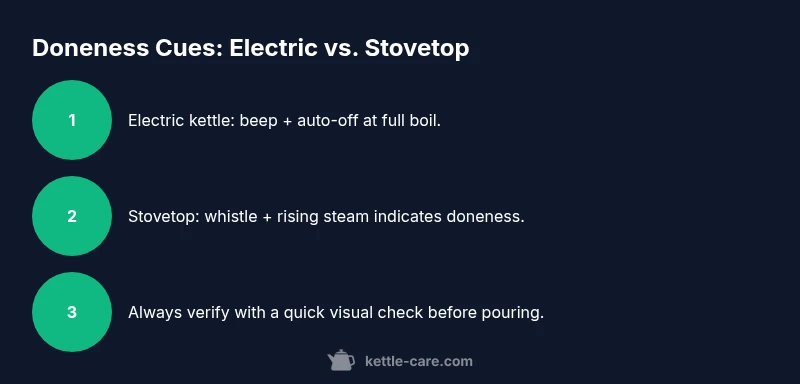
If you’re in a hurry, remember: electric kettles typically finish with a beep and off-switch; stovetop kettles finish with a whistle and vigorous steam; and always confirm with a quick visual check before pouring. By keeping cues consistent and maintaining your kettle, you’ll master how to tell when tea kettle is done and enjoy dependable brews every day.
Tools & Materials
- Kettle (electric or stovetop)(Choose a model with clear indicators if possible)
- Thermometer (optional)(Useful for precise temperature checks of specialty brews)
- Timer or kitchen clock(Helps you correlate cues with actual boil times)
- Cleaning brush or sponge(For regular descaling and maintenance)
- Descaling solution or vinegar(Used as needed based on water hardness)
Steps
Estimated time: 8-12 minutes
- 1
Identify kettle type and indicators
Determine whether your kettle is electric or stovetop and locate the primary cues (auto-off, beep, or whistle). Understanding the model will prevent misreads during the boil.
Tip: Check the user manual or the manufacturer’s site for your model’s exact cues. - 2
Prepare water and heat source
Fill the kettle with the amount of water you’ll typically boil for your drink. If using a stove, place the kettle on a burner with adequate space and heat at a moderate level.
Tip: Avoid overfilling to prevent boil-overs; leave some headspace for vigorous bubbling. - 3
Start the boil and listen for cues
Turn on the kettle. Listen for a whistle or beep and watch for the water’s surface to enter a rolling boil. Record how your model signals completion.
Tip: If there’s no audible cue within a known range, check for a clogged spout or lid and try again. - 4
Confirm auto-off behavior (electric only)
When the kettle reaches full boil, the power should cut and a beep or indicator should show completion. Do not keep heating after the signal.
Tip: If the switch doesn’t auto-off, assess the base connection and consider maintenance or replacement. - 5
Verify with a quick visual check
For electric kettles, ensure the indicator returns to idle after the beep. For stovetops, confirm the whistle stops after you remove heat.
Tip: A lingering whistle or partial steam can indicate residual heat; turn off and let it rest briefly. - 6
Pour and observe flavor impact
Pour the water promptly to preserve temperature for steeping. Delays can drop heat and affect taste, especially for green or white teas.
Tip: Pre-warm your teapot or cup to minimize temperature loss. - 7
Do a quick repeat test if uncertain
If you’re unsure the water is fully done, repeat the boil process with a tiny amount of water to confirm the cues.
Tip: Avoid frequent repeated boils with the same water to save energy. - 8
Maintain the kettle for consistent cues
Clean the lid seal, check the spout, and descale regularly to keep signals reliable over time.
Tip: Set a reminder to descale depending on your water hardness and usage.
Frequently Asked Questions
What is the fastest way to tell when an electric kettle is done?
Listen for the beep and look for the auto-off switch and indicator light. Electric models are designed to signal completion with a concise cue, making it quick to know when to stop heating.
For electric kettles, the fastest cue is the beep plus the auto-off switch engaging.
Why isn’t my kettle making a loud whistle or beep anymore?
Sound cues can fade with mineral buildup or wear. Check the spout and lid seals, ensure the kettle is clean, and descale if necessary. If the issue persists, refer to the manual for troubleshooting or contact support.
If the kettle is not making its usual sound, inspect for buildup and perform a gentle descaling.
Is it safe to keep boiling after the kettle indicates it’s done?
No. Once the appliance signals completion, stopping boil helps prevent scorching, preserves flavor, and protects the heating element. Reboiling wastes energy and can wear components faster.
No—stop heating when it signals completion to protect the kettle and your tea.
Can I rely on times instead of cues for doneness?
Time alone isn’t reliable because kettles and heat sources vary. Use cues first, then learn your own timing with your specific kettle for best results.
Time isn’t the best signal; cues are more dependable, especially with different kettles.
What maintenance helps preserve doneness cues?
Regular descaling, cleaning the lid seal, and inspecting the spout improve cue reliability. Use manufacturer-approved cleaners and follow safety guidelines.
Keep it clean and descale regularly to keep cues accurate.
Are there kettle features that improve accuracy of doneness cues?
Kettles with clear indicator lights, temperature presets, and robust auto-off signals tend to offer clearer cues for doneness, especially when paired with glass or see-through designs.
Look for models with clear indicators and reliable auto-off for easier cues.
Watch Video
Highlights
- Know your kettle’s primary cues (beep/whistle/indicator).
- Use timing only as a learning tool, not a fixed rule.
- Regular maintenance keeps cues reliable.
- Combine audible and visual signals for accuracy.
- Practice with small test boils to build confidence.