How to Boil a Kettle Without Electricity: Safe Methods
Learn practical, safe ways to boil water without electricity. This comprehensive guide covers heat sources, equipment, step-by-step methods, safety tips, and maintenance for off-grid or power-out scenarios.


You can boil a kettle without electricity by using a heat source such as a gas stove, camp stove, or a campfire, solar cooker, or wood stove. Gather a heat-safe kettle or pot, water, and protective mitts. This guide outlines reliable methods, safety steps, and the equipment you’ll need to have on hand.
Practical context and safety basics
For anyone exploring how to boil a kettle without electricity, this practical guide covers safe, effective methods for heating water when the power is out or when you’re off-grid. You’ll learn about reliable heat sources, the equipment you need, and how to minimize risks while achieving a steady boil. Always plan for a clear workspace, keep flammables away, and wear heat-resistant gloves when handling hot vessels. This approach aligns with general kitchen safety principles and reduces the chance of burns or fires during electricity-free boiling.
Heat sources you can use
Boiling water without mains power relies on alternative heat sources. Your best options include a gas or propane stove (common in kitchens and campers), a robust camp stove, a traditional wood or pellet stove, a controlled campfire, or a dedicated solar cooker. Each method has its own timing, flame management, and vessel requirements. Before you start, inspect your kettle for damage, confirm a lid fits snugly, and ensure you have a safe surface to place hot cookware. If you’re new to off-grid boiling, practice with water at a low volume to understand heat behavior before committing to larger boils.
Using a gas or propane stove safely
A gas or propane stove provides the quickest, most controllable heat for boiling water without electricity. Fill your kettle to about two thirds full to allow space for steam. Set the flame to medium and place the kettle centered on the burner. Keep a safe clearance around the stove, and never leave the flame unattended while the kettle is heating. Use oven mitts to handle the kettle once you hear the whistle of the rising steam. For best results, shield the flame from drafts and monitor the boil to avoid overflows.
Using a campfire or wood stove safely
When using a campfire or wood stove, establish a stable, contained fire ring or firebox and ensure air flow is controlled to avoid excessive flames. Place a sturdy kettle on a grill grate or a metal pot stand so it sits evenly. Start with cold water and bring it to a boil slowly, adjusting the fire to keep the water simmering without blasting the lid off. Use long-handled tongs and heat-resistant gloves to move the kettle, and never lean over an open flame. Boiling times will be longer than on a gas stove, so plan ahead.
Solar heating options and expectations
Solar cookers or solar kettles can heat water without any fuel. On sunny days with a clear sky, a solar device can bring water to a boil, though this method generally takes longer and depends on temperature, wind, and the device’s design. Use a kettle or pot made for solar use, and position the device to optimize sun exposure. Be prepared for variability; keep a backup heat source for cloudy periods or when you need hot water quickly.
Handling hot water and personal safety
Regardless of the heat source, handling hot water demands respect for burns. Always wear heat-resistant gloves, use a sturdy pot with a lid, and pour slowly to prevent splashing. Keep children and pets away from the heat area, and maintain a dry, non-slip surface around your setup. If the kettle starts to smoke or the handle becomes excessively hot, remove it from the flame immediately and let it cool before further handling.
Efficiency and timing: getting faster without electricity
To speed up electricity-free boiling, start with hot water if you have it, pre-warm the kettle, and keep the lid on to reduce evaporation. A narrow-neck kettle minimizes surface area and heat loss, while keeping a minimal headspace helps keep the water at a rolling boil. On solar setups, maximize efficiency by orienting the cooker toward the sun and limiting heat loss with a tight-fitting lid. For campfire or stove boils, keep the flame steady and avoid repeatedly lifting the kettle, which cools the water.
Cleaning and maintenance after heating without electricity
After boiling, allow the kettle to cool on a stable surface before washing. Rinse with clean water to remove mineral residues, then dry thoroughly to prevent rust or scale buildup. Regular descaling with a vinegar-water solution can help extend the life of cast-iron or ceramic kettles. Inspect seals and handles for heat damage and replace any worn parts to maintain safe, reliable operation.
Common mistakes and troubleshooting
A few frequent missteps include overfilling the kettle, placing it directly over uneven flames, and neglecting safe handling after heating. If water won’t boil, check the heat source’s flame quality and ensure the kettle is correctly seated on the base. If your solar cooker underperforms, verify sun exposure, device timing, and accidental shading. Practice in safe, controlled environments before relying on these methods during outages.
Tools & Materials
- Kettle with lid (heat-resistant handle)(Sturdy, wide base helps even heating; metal or heat-safe materials preferred)
- Heat source(Gas/propane stove, camp stove, campfire setup, or solar cooker)
- Water supply(Fresh water, enough for your needs)
- Oven mitts or heat-resistant gloves(Protect hands when handling hot kettle)
- Long-handled tongs(Helpful for moving cookware near fire or flame)
- Fire-safe surface or trivet(Stabilizes kettle and protects the table or ground)
- Ventilation accessory (for indoor use)(If heating indoors with an alternative heater, ensure adequate ventilation)
- Solar cooker (optional)(Best on sunny days; slower but fuel-free)
Steps
Estimated time: 60-90 minutes
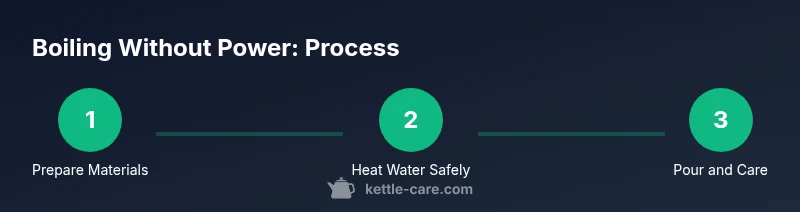
- 1
Choose a heat source and set up
Identify whether you’ll boil with a stove, campfire, or solar cooker. Clear a safe workspace, place a fireproof mat or surface, and arrange the kettle, water, and mitts within arm’s reach.
Tip: Keep a safe burn zone free of flammable materials. - 2
Fill the kettle and secure the lid
Fill the kettle to about two-thirds full to allow steam space. Place the lid securely to minimize evaporation and boil-overs during heating.
Tip: Do not overfill; water expansion can cause spills. - 3
Position the kettle on the heat source
Center the kettle over the flame or heat element and ensure the handle does not touch the flame. Use a trivet or stand if needed.
Tip: Stabilize on a flat surface to prevent tipping. - 4
Heat and monitor the water
Allow the water to come to a rolling boil. Adjust flame or heat intensity to maintain a steady boil without overflowing.
Tip: Avoid walking away; leave a clear path to the kettle in case of sudden boil. - 5
Turn off heat and pour safely
When boiling, switch off the heat. Use mitts to lift the kettle and pour slowly to prevent splashes.
Tip: Tilt away from your body and keep your face clear of steam. - 6
Cool, store, and clean
Let the kettle cool on a heat-safe surface. Rinse, dry thoroughly, and inspect for wear before next use.
Tip: Descale periodically to keep heating efficient.
Frequently Asked Questions
Is it safe to boil water indoors without electricity?
Yes, with proper ventilation, a stove designed for indoor use, and careful handling. Always monitor the heat source and keep flammables away from the area.
Yes—indoors you can boil water safely if you ventilate, use an appropriate stove, and stay attentive to the flame.
What heat sources are fastest for electricity-free boiling?
Gas or propane stoves and dedicated camp stoves typically boil water the quickest among electricity-free options.
Gas or propane stoves are usually the fastest for electricity-free boiling.
Can I use a kettle directly over a campfire?
Yes, with a heat-safe kettle and careful flame management. Use tongs to move the kettle and avoid direct flame contact with handles.
Yes, but keep it safe with gloves and tongs and avoid direct heat on the handle.
How do I prevent boil-overs when boiling without electricity?
Keep the lid on, avoid overfilling, and adjust heat to maintain a controlled boil. A stopper or vent can help prevent splashes.
Keep the lid on and watch the boil; adjust heat to avoid overflow.
What equipment speeds up safe electricity-free boiling?
A well-fitting kettle with a lid, heat-resistant gloves, a stable heat source, and a fire-safe surface speed up and simplify the process.
A proper kettle with a lid, gloves, and a stable heat source makes it easier and safer.
Is solar heating practical every day?
Solar heating can work on sunny days but is weather-dependent and slower. Have an alternative heat source for reliability.
Solar works on sunny days but isn’t always quick; keep another heat option handy.
Watch Video
Highlights
- Choose a safe heat source and stable setup.
- Fill correctly and monitor heat to avoid boil-overs.
- Handle hot water with proper protective gear.
- Maintain and descale kettle to extend life.
- Solar options are eco-friendly but slower; have backups.