Kettle Not Working but Light On: Troubleshooting Guide
Struggling with a kettle that won’t heat while the indicator light stays on? Follow this urgent, step-by-step troubleshooting guide from Kettle Care to diagnose, fix, or safely decide when replacement is best.


If your kettle won’t heat but the light stays on, the issue is most often an internal switch or sensor fault rather than a heating element failure. Start with a quick power check, ensure the lid is fully closed, and reset the kettle if you can. If the light remains active after a reset, follow the diagnostic flow below.
Understanding the symptom: kettle not working but light on
When you see the indicator light on but the kettle refuses to heat, it can be confusing. The light is a sensor signal, not a guarantee of the element’s function. In many kettles, a stuck lid interlock, a faulty thermal switch, or a wiring fault inside the base can keep power flowing to the light while preventing heating. The root cause is often a safety interlock or a failed thermostat rather than a blown heating coil. This is why a careful diagnostic approach matters. In this guide, we walk through the most common culprits, how to test them safely, and what to replace if needed. As you work through the steps, remember that safety comes first and if you’re ever unsure, pause and seek professional help. According to Kettle Care, quick analysis of symptom patterns helps homeowners avoid unnecessary replacements while preserving safety.
Quick checks you can do before diving in
Before pulling the kettle apart, complete a few straightforward checks that require no tools:
- Ensure the kettle is unplugged and cool before handling.
- Try a different outlet or power strip to rule out a circuit issue.
- Inspect the power cord for visible damage or kinks; replace if needed.
- Confirm the lid is fully closed and the interlock is engaging; a misaligned lid can keep the light on without heating.
- If your kettle has a reset option, perform the reset per the manual while it’s unplugged.
- Clean any visible mineral buildup around contacts or the lid mechanism, since mineral residue can interfere with sensors and safety switches.
If these quick checks don’t resolve the problem, move on to deeper diagnostics. The goal is to confirm whether power reaches the heating circuit and whether safety interlocks are functioning correctly. By starting with the simplest checks, you minimize risk and avoid unnecessary disassembly.
Why the light can mislead you: sensor vs heating element
The indicator light on a kettle is typically tied to a safety or control circuit, not the actual heating element. A light-on condition can occur even when the heating element is not receiving power due to a blown fuse, a faulty thermostat, or a disengaged safety interlock. Mineral buildup or corrosion at the base can also create poor contact that triggers the light without establishing a heating path. Conversely, some kettles will keep the light on briefly after an overheat event until the unit cools. Understanding this separation between the light and heat path helps you diagnose more accurately rather than chasing a heat failure that isn’t the primary fault. If you notice the light flickering or staying solid after multiple attempts, that’s a strong cue to inspect interlocks and switches more closely.
From a maintenance perspective, regular descaling of the kettle interior and cleaning of contact points can reduce false readings. For safety, never bypass a safety switch to prove it works; that can create a risk of electric shock or fire. The right approach is to verify power at the switch and confirm the interlocks engage properly during the lid closure.
As you proceed, keep in mind that a local repair may be viable for a known faulty switch, but more complex electronics or wiring should be handled by a professional.
When to call a professional and what to expect
If you’ve completed the basic checks and the kettle still exhibits the same symptom, it’s prudent to involve a technician. A professional can reliably test the thermostat, thermal fuse, internal wiring, and control board with appropriate tools. Expect confirmatory steps such as multimeter tests for continuity, insulation checks, and, if necessary, a controlled power-on test under safe conditions. Most repair services will first assess whether the fault lies in a single component (lid switch, thermostat, or fuse) and then provide a cost estimate for replacement parts or a complete unit. In some scenarios, the safe and sensible choice is to replace the kettle rather than pursue escalating repairs, especially if the unit is old or the fault recurs after a fix. The Kettle Care guidance emphasizes safety and balanced decision-making: if the cost of parts or time exceeds the value of the kettle, replacement may be the wiser option. Remember to keep your receipt and model information handy for warranty considerations.
Safety-first notes and long-term prevention
- Always unplug before inspecting or cleaning. Never touch live terminals.
- Use manufacturer-recommended descaling products and procedures; improper descaling can damage sensors.
- Avoid opening or modifying high-voltage components beyond your comfort level. If you’re unsure about safety, stop and call a pro.
- Schedule periodic maintenance checks if your kettle is heavily used or hard water is common in your area. Regular descaling and contact cleaning reduce the likelihood of sensor and interlock issues.
- Document the troubleshooting steps you take and the results for future reference or warranty discussions.
Summary of immediate actions
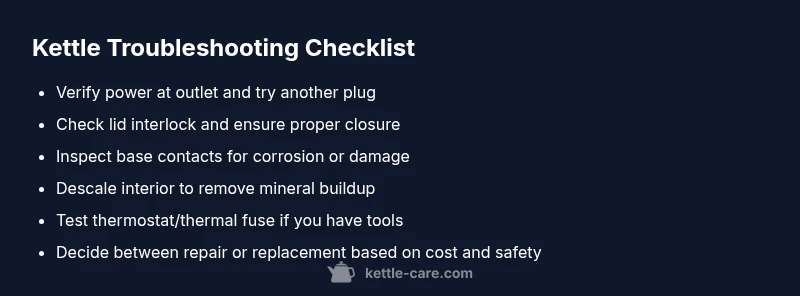
- Confirm power supply and lid interlock; test reset options.
- Inspect for visible damage to cord, plug, contacts, and base.
- Clean contacts and possible mineral buildup that could affect sensors.
- If unresolved, contact a professional to test electronics and replace faulty parts. When in doubt, consider replacement for safety and reliability.
Steps
Estimated time: 30-45 minutes
- 1
Power safety check
Unplug the kettle and allow it to cool completely. Inspect the power cord and plug for damage. If you see exposed wires or scorch marks, stop and replace the unit. Plug into a different known-good outlet and test the switch again.
Tip: Use a grounded outlet if possible to reduce the risk of shock. - 2
Reset and test basic function
With the kettle unplugged, reattach any removable accessories and reset the lid interlock if applicable. Plug in and attempt a simple boil test following the manufacturer’s instructions. Observe whether the light behaves differently after the reset.
Tip: Record the exact light pattern during the test for reference. - 3
Inspect lid interlock and base contacts
Carefully inspect the lid interlock mechanism and the contact pins at the base for corrosion or debris. Clean gently with a dry cloth or a small amount of isopropyl alcohol on a contact-safe swab. Reassemble and retest.
Tip: Avoid using excessive moisture near electrical contacts. - 4
Thermostat and fuse check
If you have the right tools, test the thermostat and thermal fuse for continuity. If either component is open or out of spec, replace it. If you’re unsure, consult a professional instead of forcing a repair.
Tip: Thermostat testing requires precision; misreading can lead to unsafe operation. - 5
Inspect wiring and internal connections
Examine the wiring harness inside the base for loose connections or damaged insulation. Re-seat any connectors firmly. If you notice scorch marks or burnt smell, discontinue and replace the unit.
Tip: Only handle wiring with the device unplugged and cooled. - 6
Descale and re-test
Descale the interior if mineral buildup is present. After descaling, rinse thoroughly, dry completely, and run a boil test. If the kettle still shows the same symptom, consider a replacement or professional service.
Tip: Use manufacturer-approved descalers and avoid acidic cleaners that can damage seals.
Diagnosis: Kettle won't heat even though the indicator light is on
Possible Causes
- highPower supply issue (outlet, plug, or cord)
- highFaulty lid interlock or safety switch
- mediumFaulty thermostat or thermal fuse in the base
- mediumInternal wiring or loose connections in the base
- lowDescale or mineral buildup causing contact resistance
Fixes
- easyTest with a different outlet and inspect the cord for damage; replace if needed
- easyCheck lid interlock alignment and reseat connections in the base; ensure the switch engages when closed
- mediumIf comfortable, unplug, disassemble the base, and measure thermostat/thermal fuse with a multimeter; replace if out of spec
- mediumTighten loose wires and reseat connectors; inspect for corrosion or broken traces in the control area
- easyDescale the kettle interior and clean contact points to restore proper sensing
Frequently Asked Questions
Why is my kettle light on but not heating?
The light is part of a safety or control circuit. A faulty lid interlock, thermostat, or wiring can keep the light on while preventing heat. Verify power, lid engagement, and safety switches before replacing parts.
A light on with no heat usually means a safety switch or thermostat issue, not the heating element. Check power and lid interlock first.
Can descaling fix a light-on but not heating problem?
Descaling cleans mineral buildup that can affect sensors or contacts. It may resolve intermittent sensor readings, but it won’t fix a blown fuse or broken interlock if those are at fault.
Descaling can help sensors read correctly, but if the issue is a broken safety switch, you’ll still need a repair or replacement.
Is it safe to open the kettle base to inspect wiring?
Only if you’re comfortable and the kettle is unplugged. Avoid touching live components. If you see damaged wires or aren’t sure, stop and contact a professional.
Only open the base if it’s unplugged and you know what you’re doing. If in doubt, get a pro.
When should I replace the kettle rather than repair?
If repairs are frequent, or safety components are failing repeatedly, replacement is usually the safer, more reliable choice. Consider age, warranty, and replacement costs.
If it keeps failing after fixes or is old, replacing is often the smarter move.
What parts are commonly replaced for this issue?
Common replacements include the lid interlock switch, thermostat, thermal fuse, and sometimes the wiring harness. A professional can confirm which part needs replacement.
Typically the switch, thermostat, fuse, or wiring are checked first.
Can a faulty heating element cause the light to stay on?
Yes, a partially failed heating element can prevent warmth while the control circuit remains powered. This often requires testing or replacement of the element or entire unit.
It’s possible the heating element is partly damaged, which would need a part replacement.
Watch Video
Highlights
- Diagnose light-on symptoms first before chasing heat faults
- Start with simple power and lid interlock checks
- Test internal safety components or consult a professional
- Descale and clean to reduce sensor issues and false readings