Kettle Stops Before Boiling: Troubleshooting Guide
Learn practical, step-by-step fixes for a kettle that stops before boiling. From descaling to thermostat checks, get safe home guidance to get back to fast, reliable boils.


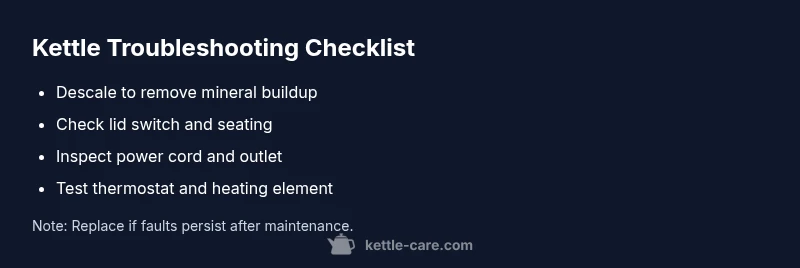
A kettle that stops before boiling is usually caused by mineral scale buildup, a failing thermostat, or a safety cutout. Start by descaling to remove mineral deposits, then verify power and lid seating. If the problem persists, test the thermostat and heating element, and consider replacing the unit if needed. Always unplug before inspecting.
Why your kettle stops before boiling
When a kettle stops before reaching a full boil, it isn’t just annoying—it can signal a safety-related fault or a common maintenance issue. In many homes, mineral scale from tap water builds up on the heating element and thermostat, triggering a reduced heating response or a premature shutoff. A worn thermostat or damaged safety switch can also cause the kettle to halt mid-cycle. In some cases, electrical problems, such as a loose cord or a voltage fluctuation, can mimic mechanical faults. Recognizing the pattern—does it stop on every cycle, or only after a long period of use?—helps narrow the list of suspects. According to Kettle Care analysis, scale and aging components are the two most frequent culprits for kettles that stall before boiling, especially in hard-water regions. As a homeowner, you can take decisive steps to diagnose and often fix the issue without specialized tools.
Having a kettle that reliably reaches a boil is essential for making tea, coffee, and hot water safely. By understanding how kettles heat water and how safety interlocks work, you can approach a fix with confidence and reduce the risk of accidental burns or electrical hazards. Remember: the goal is to restore consistent heating, not just to “get around” the symptom temporarily. A systematic approach protects your safety and extends the useful life of your appliance.
Quick safety checks you can perform at home
Before you dive into parts and testing, perform these quick checks to rule out obvious causes:
- Unplug the kettle and inspect the power cord for signs of wear or damage. A frayed cord can cause intermittent power loss or a hard shutoff.
- Ensure the lid is properly closed and the kettle is seated securely on its base. Some models require a complete lid closure to engage the safety switch.
- Check the water level. If there’s too little water or if air is trapped, the kettle may shut off prematurely for safety reasons.
- Inspect the exterior for scale or residue near the base and around the spout. A quick wipe can remove loose deposits that interfere with sensors.
- If you have hard water, consider whether you’ve recently scaled the interior. Real-time scaling can distort temperature readings and trip the thermostat.
If any of these checks reveal a visible issue, address it first. If nothing is obviously wrong, proceed to the diagnostic flow to identify the underlying cause.
Diagnostic flow: symptom to solution
Symptom: Kettle stops heating before reaching a full boil. Causes:
- {cause: "Mineral scale buildup on the heating element or thermostat", likelihood: "high"}
- {cause: "Faulty thermostat or safety switch", likelihood: "high"}
- {cause: "Electrical issues such as loose connections or voltage fluctuation", likelihood: "medium"}
- {cause: "Old kettle approaching end of life", likelihood: "low"}
Fixes:
- {fix: "Descale the kettle using a descaler or a solution of white vinegar and water, following the manufacturer’s guidance", difficulty: "easy"}
- {fix: "Test and reset the thermostat after descaling, or have a professional check the thermal switch if the model allows access", difficulty: "medium"}
- {fix: "Inspect the power base and cord for damage, ensure a stable outlet, and try a known-good extension cord if needed", difficulty: "easy"}
- {fix: "If the unit is old or repeatedly failing after fixes, replace the kettle for safety reasons", difficulty: "easy"}
How to diagnose the issue: a practical flow
- Rule out simple causes first: power, lid, water level. 2) If no improvement after descale, suspect scale-related sensor drift. 3) Check the thermostat by observing whether the kettle heats briefly after a reset, or use a multimeter if you’re comfortable with electronics. 4) Inspect the heating element for visible damage or scorching. 5) Consider replacement if the model is dated or repeatedly misbehaving.
If you’re unsure, contact a pro. A trained technician can safely test voltage, continuity, and temperature sensors without risking shock or further damage.
Steps
Estimated time: 60-75 minutes
- 1
Unplug and cool, then inspect visually
Ensure the kettle and base are cool, unplug from the outlet, and check for frayed cords, scorch marks, or loose connections at the plug and base. A damaged cord can mimic a shutdown due to safety, so replace if needed.
Tip: Use a flashlight to inspect the plug prongs and base contacts for corrosion or wear. - 2
Descale the kettle
Fill with a descaling solution or a mix of 1:1 water and white vinegar to cover the heating element. Boil and then let sit for 15 minutes before emptying and rinsing thoroughly several times. Scale often fools the thermostat and triggers early shutoff.
Tip: Do not leave vinegar in the kettle longer than recommended by the manufacturer; excessive acidity can damage gaskets. - 3
Check the lid switch and seating
Close the lid firmly and listen for the little click that signals the switch is engaged. If the switch doesn’t click or is sticky, the kettle may think the lid isn’t closed and shut off early.
Tip: Gently clean around the lid area to ensure a proper seal; misalignment is a common culprit. - 4
Test the thermostat behavior
If you have the model’s service manual, locate the thermostat and test its continuity with a multimeter when the kettle is cold. If continuity is erratic or absent, the thermostat is likely faulty.
Tip: Only perform electrical tests if you’re comfortable; otherwise skip to professional inspection. - 5
Inspect the heating element and base
Look for scorching, mineral buildup, or loose wiring on the heating element. Tighten any loose connections and remove visible deposits with a soft brush.
Tip: Avoid abrasive tools that could damage the element’s coating. - 6
Run a controlled test boil
Boil a measured amount of water and observe whether the kettle completes the cycle. If it still stops early, interrupt the cycle and shut it down safely to avoid overheating.
Tip: Keep hands away from steam and hot surfaces during the test. - 7
Decide on replacement
If issues persist after thorough cleaning and checks, the kettle is likely at the end of its life. Replacing it reduces risk and ensures reliable boiling.
Tip: Choose a model with a robust descaling routine and easy-to-clean surfaces.
Diagnosis: Kettle stops heating before reaching a full boil
Possible Causes
- highMineral scale buildup on the heating element or thermostat
- highFaulty thermostat or safety switch
- mediumElectrical issues such as loose connections or voltage fluctuation
- lowOld kettle approaching end of life
Fixes
- easyDescale the kettle using a descaler or vinegar solution following manufacturer guidance
- mediumTest and reset the thermostat or have the thermal switch checked by a technician
- easyInspect power base, cord, and outlet; try a different outlet or supply cord
- easyReplace the kettle if issues persist and the unit is old or repeatedly failing
Frequently Asked Questions
Why does my kettle stop before it boils even when it’s new?
New kettles can still suffer from scale, faulty switches, or wiring issues. Start with a thorough descaling, confirm the lid switches engage, and test for any power irregularities before assuming a defect.
New kettles can stall due to scale, switches, or wiring. Descale, check the lid switch, and test power before assuming a defect.
Can mineral buildup cause early shutoffs?
Yes. Scale insulates the heating element and can trigger inaccurate temperature readings, causing an automatic shutdown before the water reaches a boil.
Yes, scale can misread temperature and trigger a shutoff before boiling.
Is it safe to descale with vinegar?
Vinegar can be effective, but always check your model’s manual. Rinse thoroughly after descaling to avoid taste transfer and corrosion.
Yes, vinegar can work, just rinse well afterward.
When should I replace the kettle instead of repairing?
If the kettle repeatedly fails after safe maintenance steps, or if the price of parts exceeds a reasonable fraction of a new unit, replacement is often the best option.
If repairs keep failing, replacement is usually best.
Do voltage fluctuations affect kettle performance?
Yes. Inconsistent voltage can cause the heater to shut off unexpectedly. Try a dedicated outlet or check your home wiring if this recurs.
Yes, unstable voltage can cause unexpected shutoffs.
Should I call a professional for a stubborn kettle?
If you’re uncomfortable with electrical testing or the model is under warranty, contact a qualified appliance technician to diagnose safely.
If unsure, consult a professional.
Watch Video
Highlights
- Descale regularly to prevent false shutoffs
- Check lid switch and power connections
- Test thermostat when safe to do so
- Replace the kettle if faults persist