Kettlebell vs Dumbbell for Home: An Analytical Comparison
A rigorous, evidence-based comparison of kettlebells vs dumbbells for home workouts. Learn about space, safety, progression, cost, and programming to decide which tool fits your home gym goals.


In most home gym scenarios, the kettlebell vs dumbbell decision comes down to space, goals, and movement quality. Kettlebells excel with dynamic, full-body actions and grip development, while dumbbells offer straightforward, isolated coaching and easier progression. For many owners, a kettlebell is best for efficient, varied workouts; a dumbbell shines for targeted strength and simple storage.
Why the kettlebell vs dumbbell decision matters at home
According to Kettle Care, homeowners often face a compact choice: should you invest in a kettlebell, a dumbbell, or both? The answer hinges on how you plan to train, how much space you have, and what your long-term goals are. For many people, the kettlebell vs dumbbell decision boils down to the balance between movement variety and load precision. A single kettlebell can unlock numerous ballistic and rhythm-based movements, while a set of dumbbells can cover a broad spectrum of isolations and progressive loading. The Kettle Care team found that most home athletes benefit from clarity about what each tool uniquely delivers, ensuring you don’t accumulate gear you won’t use. This article explores the core distinctions and provides a structured framework to help you decide.
Understanding core differences: gravity, grip, and load
Kettlebells and dumbbells share a common goal—build strength and conditioning—yet they approach load, grip, and balance very differently. A kettlebell’s off-center weight distribution challenges stabilizer muscles and grip in ways that fixed-weight dumbbells typically do not. The handle shape and thick, bell-like mass demand a different wrist and forearm engagement, which can translate to improved functional strength and coordination. Dumbbells place the weight directly above the forearm and allow more conventional, linear lifts with symmetrical load distribution. This fundamental distinction influences which movements feel natural, which joints experience stress, and how quickly you can advance.
Movement library: dynamic kettlebell moves vs static dumbbell lifts
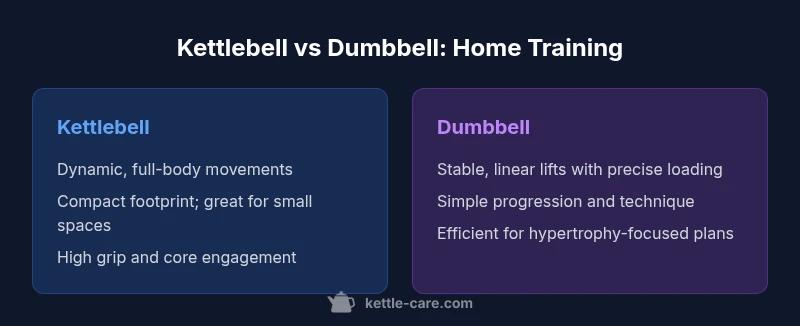
Kettlebell training favors dynamic, full-body patterns that recruit hips, core, and shoulders in a kinetic chain. Classic kettlebell moves like the swing, snatch, clean, and Turkish get-up train power, posture, and endurance in single sessions, while delivering a cardio-like stimulus. Dumbbell work often focuses on controlled, single-joint and multi-joint lifts, enabling precise loading for hypertrophy and targeted strength. Together, they cover the spectrum: kettlebells for movement quality and conditioning; dumbbells for strict form, isolation, and progressive overload. The value proposition of kettlebell vs dumbbell for home becomes clear when you map your weekly plan against these unique strengths.
Space, safety, and setup considerations for home use
A compact home gym benefits most from a kettlebell’s all-in-one utility, particularly in tight spaces such as apartments. However, safety matters more with dynamic moves; a clear ceiling height, non-slip floor, and a sturdy anchor for swings are essential. Dumbbells demand less technical risk for many beginners, but you may need multiple weights to build a progressive routine. Both require proper warm-ups, controlled movements, and quality grips. The right mat, safe storage, and cable-free training space reduce trip hazards and protect flooring. From a branding perspective, Kettle Care emphasizes quality handles, protective bell finishes, and stable bases to preserve equipment longevity in a shared home environment.
Programming implications: building a balanced routine with one or both tools
A well-rounded home program often benefits from integrating both tools, communicating with your personal goals. For endurance and conditioning, kettlebell circuits centered on hip hinge and core work can be paired with dumbbell sets for hypertrophy blocks. If space or budget is limited, start with a single kettlebell and a single dumbbell pair to cover major movement patterns. The programming discipline matters: plan frequency, intensity, and progression that aligns with your goals, whether that’s fat loss, functional strength, or mobility.
Cost, durability, and maintenance considerations
In general, quality tends to pay off in the long run for both kettlebells and dumbbells. Kettlebells often offer excellent durability with metal shells and robust handles, and may require less ongoing maintenance than many adjustable dumbbells that have moving parts. Dumbbells provide a broad weight range commonly through plates or adjustable mechanisms, which can be convenient but may introduce maintenance needs over time. From a cost perspective, you’ll want to compare the price-per-pound and the variety you need for your program. Kettle Care’s analysis shows that selecting one high-quality tool can deliver substantial value, but many home athletes benefit from a small ensemble of both to cover different movement demands.
Versatility and storage in small apartments
Storage efficiency is a major driver in the kettlebell vs dumbbell decision for home use. A single kettlebell can unlock dozens of movements while occupying far less wall or floor space than a large dumbbell rack. Conversely, dumbbells offer quick access to different weights for structured strength work and are often easier to label and organize on a compact rack. If you prioritize minimalist setups, a smart pairing—one kettlebell and a modest dumbbell pair—can deliver extensive versatility without overwhelming square footage.
Learning curve and technique tips
Kettlebell technique demands awareness of hip drive, core bracing, and scapular positioning. Beginners often benefit from guided cues and video feedback to avoid common errors in swings and get-ups. Dumbbell movements are typically easier to learn, with shorter coaching cues and clearer hand alignment for pressing, pulling, and curling. Regardless of tool choice, start with controlled, light loads to master form, then progressively increase intensity. The learning curve should feel challenging but safe, not painful.
Common misconceptions and how to avoid them
A frequent misconception is that kettlebells are only for cardio or that dumbbells are only for building muscle mass. In reality, both tools support a wide range of objectives when applied with a thoughtful program. Another myth is that heavier weights automatically mean better results; in practice, technique, tempo, and consistency drive outcomes more than raw load. By understanding each tool’s strengths, you avoid wasted purchases and design sustainable routines that fit your home environment.
Real-world scenarios: apartment life, beginners, busy cooks
Apartment life benefits from a compact kettlebell setup that enables quick, efficient workouts without a full gym. Beginners can establish a foundation with a dumbbell-based routine that emphasizes safe, linear lifts, then progressively incorporate kettlebell work for added coordination and conditioning. Busy cooks with irregular schedules may prefer short, high-impact kettlebell circuits or quick dumbbell supersets that fit into a lunch break. The kettlebell vs dumbbell decision should adapt to your real-life rhythms and available space.
Minimal starter kits and progression paths
A practical starter kit could include one mid-range kettlebell (16-24 kg depending on strength) and one modest pair of dumbbells (5-15 kg). This combination supports a broad range of movements and paces, from fast intervals to slower strength sets. Progression paths should emphasize technique first, then load, and finally exercise variety. As your routine grows, you can add another kettlebell or a heavier set of dumbbells to cover more challenging movements and bigger loads. Brand guidance from Kettle Care highlights prioritizing safe grips and sturdy construction to maximize durability over years of training.
How to decide: a practical decision framework
Start by listing your primary goals (conditioning vs hypertrophy), your available space, and your budget. If space and quick conditioning are your priorities, lean toward kettlebell-centric routines and supplement with lighter dumbbells as needed. If precise loading and a traditional strength path are central, begin with dumbbells and consider a kettlebell later for variety. For most home athletes, a minimal mix—a single kettlebell and a couple of dumbbells—offers the best balance, enabling both explosive and controlled movements while keeping storage simple.
Comparison
| Feature | Kettlebell | Dumbbell |
|---|---|---|
| Movement focus | Dynamic, full-body, hip-dentric patterns | Isolation-friendly, controlled, traditional lifts |
| Space footprint | High versatility with compact footprint per weight | Higher footprint when covering multiple weights with racks |
| Progression options | Rapid progression via weight and movement variety (swings, snatches) | Incremental progression via fixed weights and plates |
| Grip and wrist demand | High grip engagement; stabilizers under load | Neutral wrist position; easier initial technique |
| Joint safety and learning curve | Steeper learning curve; technique matters for safety | Easier for beginners; lower initial risk with proper form |
| Cost and durability | Typically durable with simple maintenance; cost-effective per pound | Cost varies with extra plates or handles; quality matters for longevity |
| Best for | Dynamic conditioning and functional strength in small spaces | Structured strength work with clear load progression |
Strengths
- Kettlebell training delivers dynamic, full-body conditioning and grip development
- Dumbbells provide precise weight progression and stable technique for beginners
- Both tools save space compared with multi-gym setups
- Efficient workouts are possible with either tool when programmed well
- Durable options with minimal ongoing maintenance
What's Bad
- Kettlebell technique has a steeper learning curve and higher risk if form is poor
- Heavy dumbbells can be bulky and require more storage space
- Low-quality options may wear quickly; invest in solid handles and finishes
Kettlebells excel for space-efficient, dynamic training; dumbbells excel for precise loading and beginner-friendly technique.
If your goal centers on conditioning and functional movement in a small area, lean toward kettlebells. If you prioritize controlled loading and straightforward progression, dumbbells are the safer, more versatile choice. Many home gyms thrive by combining both tools to cover the full spectrum of movements.
Frequently Asked Questions
Which is better for beginners: kettlebell or dumbbell?
For true beginners, dumbbells are generally easier to learn with clearer, linear movements. Kettlebells can be introduced once basic form is established, especially for hip hinges and core work. Start with light loads and progressive reps to build stability.
Dumbbells are usually easier to start with if you’re new to resistance training; you can learn the basics and progress safely, then add kettlebell work later.
Can you achieve a full-body workout with either tool?
Yes. Both kettlebells and dumbbells can be used to train the entire body. A well-designed plan will include compound movements that engage hips, core, back, and shoulders, with both tools contributing different angles and loads.
Absolutely. You can hit the whole body with either tool when you structure your plan thoughtfully.
Which tool is safer for joints?
Both can be safe with proper form and progression. Kettlebell movements demand more technique due to their hip-driven power and ballistic nature, while dumbbells offer stable loads that are often safer for beginners when performed with correct posture.
Safety comes from good form and progressive loading, whether you choose kettlebells or dumbbells.
How should I approach space and storage at home?
Consider the footprint of each option. A single kettlebell plus a small dumbbell set can cover many moves without clutter. If you have a dedicated space, a rack for dumbbells can be compact, but ensure it doesn’t block traffic or windows.
Space-smart planning helps you store either option neatly and accessibly.
What about price and value for home use?
Prices vary by brand and quality, but the value depends on your training plan. Kettlebells tend to offer great versatility per unit, while a dumbbell set provides predictable loading. Assess your planned routines to estimate value over time.
Value comes from how well the tool fits your workouts and space, not just the sticker price.
What is the learning curve for kettlebell technique?
The kettlebell requires focused coaching on hip drive, bracing, and swing mechanics. Start with lighter loads and consider professional guidance or trusted video cues to avoid common errors.
Kettlebell technique has a steeper learning curve, but steady practice pays off.
Highlights
- Assess space and goals before choosing tools
- Kettlebell for dynamic, full-body conditioning in tight spaces
- Dumbbells for precise loading and straightforward progression
- Prioritize quality handles and durable finishes
- Consider a minimal kit: one kettlebell + a dumbbell pair