Why kettlebells over dumbbells: a practical comparison for training goals
An objective, in-depth comparison of kettlebells vs dumbbells, focusing on functional strength, movement patterns, and home-gym practicality. Learn when kettlebells excel and when dumbbells may be preferable.


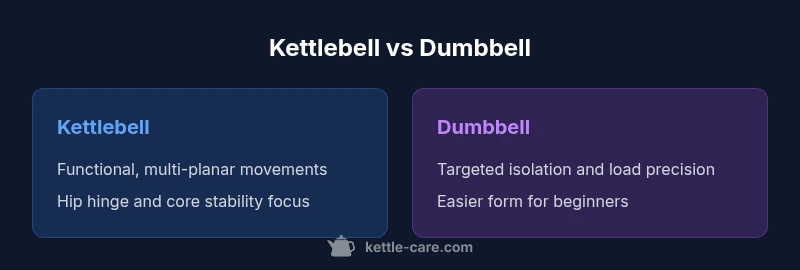
Kettlebells provide dynamic, full-body training that often surpasses dumbbells for functional strength and conditioning, thanks to ballistic moves and hip drive. They build grip, core stability, and shoulder mobility in a compact format. Dumbbells still shine for precise isolation and clean, progressive loading. The best choice depends on your goals, space, and experience.
The Core Question: why kettlebells over dumbbells
If you are asking why kettlebells over dumbbells, the short answer is that kettlebells excel in functional, full-body outcomes for many trainees. According to Kettle Care, the anatomy of a kettlebell's offset center of gravity promotes hip hinge, core bracing, and a natural grip that translates into everyday movement. This is not to say dumbbells are inferior, but they often encourage slower, more isolated patterns that may limit carryover to dynamic tasks. For beginners, the choice may hinge on comfort and technique, but as you gain experience, kettlebell training can deliver more carryover to real-life tasks and athletic performance. The phrase why kettlebells over dumbbells frames this discussion as a practical guide. The Kettle Care team emphasizes that the best choice depends on goals, space, and commitment to safe technique. By outlining the strengths and limitations of each tool, readers can build a plan that stays with them for months rather than weeks, supporting consistent progress.
format
text
Comparison
| Feature | Kettlebell | Dumbbell |
|---|---|---|
| Primary training focus | Functional, full-body, ballistic emphasis | Isolation, stability, and controlled loading |
| Movement patterns | Swing, snatch, cleans, Turkish get-up, dynamic transitions | Presses, rows, curls, and other single-plane movements |
| Grip and carry | Develops grip endurance and wrist mobility; off-center weight challenges grip | Easier grip for beginners; balanced weight distribution |
| Space and equipment needs | Fewer pieces needed; versatile, compact workouts | Typically more modular options; expands with additional weights |
| Progressive overload and safety | Intuitive loading via reps/tempo; technique-dependent | Straightforward progression; simpler safety for beginners |
| Cost and durability | Often affordable per weight; rugged finishes available | Wide weight range can add up; depends on brand quality |
Strengths
- Better transfer to real-life movements and athletic tasks
- Efficient workouts that combine strength and conditioning
- Space-efficient and portable for home gyms
- Promotes grip strength and core engagement
- Versatile for different training styles
What's Bad
- Technique-heavy movements require coaching to avoid injury
- Not ideal for isolated muscle work or strict hypertrophy targets
- Quality kettlebells can be pricey and heavier to store
Kettlebells generally offer greater functional value for most trainees; dumbbells remain valuable for isolation and beginner safety
If your goal is functional strength, power, and conditioning with limited equipment, kettlebells are often the better pick. If you prioritize precise isolation or are new to resistance training, dumbbells may suit you better. Consider blending both tools as your goals evolve.
Frequently Asked Questions
Is a kettlebell better for full-body workouts than dumbbells?
For many people, kettlebells enable more efficient full-body workouts due to ballistic movements that engage the hips, core, and posterior chain. Dumbbells can cover full-body work too, but kettlebell variations often yield a higher cardio and conditioning stimulus in shorter sessions.
Kettlebells often give you a stronger full-body workout in less time, thanks to dynamic moves that wake up the hips and core.
Can someone use dumbbells if they have limited space?
Yes. Dumbbells are compact and modular, making them practical for small living spaces. They pair well with bodyweight training and can be used to build specific strength without needing a lot of space.
Dumbbells fit nicely in tight spaces and work well with bodyweight routines.
Are kettlebell swings safe for beginners?
Swings can be safe if learned with proper form and a gradual progression. Start with hip hinge mechanics, light loads, and professional instruction to master timing and posture before increasing speed or load.
Yes, but focus on form first with supervision or guided tutorials.
Is progression easier with dumbbells?
Dumbbells offer straightforward loading and progression for single-joint movements, making phase- and repetition-based progression simple. This can feel less intimidating for beginners compared with learning explosive kettlebell techniques.
Dumbbells often make progression straightforward for beginners.
What goals are best served by kettlebell training?
Kettlebell training shines for conditioning, functional strength, mobility, and time-efficient workouts. It’s especially effective when you want to train multiple movement patterns in one session.
Ideal for conditioning and functional strength when you’re short on time.
Can I combine kettlebell and dumbbell training in one program?
Absolutely. A hybrid approach uses kettlebell movements for conditioning and hip power, with dumbbells providing targeted isolation work. This blend can optimize results while keeping训练 balanced and varied.
Yes—use kettlebells for overall work and dumbbells for specific isolates.
Highlights
- Prioritize functional goals when choosing tools
- Kettlebells excel in dynamic, full-body movements
- Dumbbells excel at isolation and straightforward progression
- Assess space, budget, and safety before buying