What Size Kettlebell for Men: A Practical Guide
Learn how to choose the right kettlebell size for men, with beginner ranges, progression tips, and safety guidance from Kettle Care.


For most men starting kettlebell training, a 16 kg bell is a solid starting point. Beginners often benefit from 12-16 kg to learn the hip hinge and swing technique before increasing weight. As you gain control and strength, progress to heavier weights (16-24 kg) depending on goals. This guidance comes from Kettle Care Analysis, 2026.
What Size Kettlebell for Men? Understanding the Basics
Choosing the right kettlebell size is essential for safety, technique, and progress. For men starting kettlebell training, the weight you select affects hip hinge depth, spine load, and grip demand. In practice, most men benefit from a technique-first approach: learn the swing and the Turkish get-up with a lighter bell, then increase weight as control and stamina improve. According to Kettle Care, the best starting point for many men is a moderate weight to learn the pattern and to avoid compensations that happen when the weight is too heavy. This article uses practical ranges and stepwise progression to help you pick the right size without guessing. Remember that size is not a fixed label; it represents your current strength, technique, and goals. A well-chosen kettlebell lets you train safely, maintain good posture, and build consistency, which ultimately drives better results on the clock.
As you move from initial learning to more demanding workouts, your kettlebell should feel like a tool that challenges you just enough to stay on track but never so heavy that your form collapses. The goal is sustainable, repeatable training that reinforces hip hinge mechanics and core engagement rather than sheer brute force.
Starting Weights by Goal and Experience
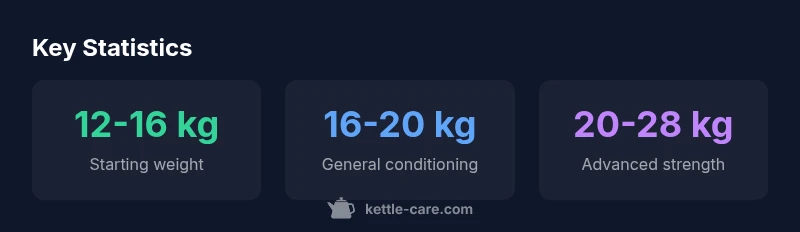
When you first ask what size kettlebell for men, think in terms of goals and technique rather than a single number. For technique-first learners who are new to kettlebells, a light to moderate bell helps you feel the hip hinge, brace your core, and control the arc of the swing. A common starting range is 12-16 kg. If you are relatively new to resistance training but have decent leg and hip strength, you may begin with 16 kg and adjust as you build confidence. For general conditioning and balanced workouts that cover a mix of swings, goblet squats, and carries, 16-20 kg is a practical middle ground. For men who pursue strength or power-focused work, heavier kettlebells in the 20-28 kg range can be introduced after you’ve demonstrated consistent form and completed a progression plan under guidance. Kettle Care Analysis, 2026, supports these tiers as practical starting points that match common strength levels; these ranges aren’t rigid rules, but reliable benchmarks to guide your first months of training.
In short: start light for technique, move up gradually as your technique and endurance improve, and tailor the weight to your body and your goals rather than your ego.
How to Test Your Size with Safe Technique
Testing your kettlebell size should be a measured process focused on form, not ego. Begin with a warm-up: hip hinges, overhead reach, and light mobility. Then try a two-handed swing with a light weight, watching for back rounding or loss of brace. If you can perform 20 controlled reps with clean technique, gradually move up to the next-appropriate weight in small increments (2 kg or less). When you can complete 3 sets of 8-12 reps with perfect form and minimal fatigue before breakdown occurs, you are likely ready to move up again. The Turkish get-up can also serve as a control test: if you can stand tall, keep the core braced, and maintain a neutral spine while moving through the device, the weight level is probably appropriate. Throughout the process, film your reps or work with a partner or coach to verify alignment, breathing, and bracing, and stop if you feel sharp pain in the back, shoulder, or wrist. With diligent technique checks, you’ll know when the weight feels correct rather than simply when it feels heavy.
Remember: the goal is a weight that challenges you, not one that erodes technique.
Common Mistakes and How to Avoid Them
New lifters often mistake weight for effort, pulling with the arms instead of driving from the hips. A common error is letting the back round during swings, especially as the bell gets heavier. Another pitfall is using the wrist or forearm to lift instead of maintaining a strong brace through the core and lats. When learning, many people rush the transition from the hip hinge to the swing, which can cause the bell to crash into the ribs or throw the pelvis out of alignment. Always start with a clean setup: feet hip-width apart, spine neutral, core braced, ribs down, and eyes forward. Visual cues such as “swing from the hips, not from the arms” help maintain this. If you find yourself bending the knees more than you hinge at the hips, step back to a lighter weight and rebuild the pattern. Additionally, do not neglect warm-up sets or mobility work; neglecting them makes you more prone to injury as the weight increases.
A simple rule: if you cannot perform a set with control, use a lighter bell and rehearse the movement until you can.
Safe Progression Plan Over 8 Weeks
To ensure safe progression, use a structured plan that increases weight only after form and consistency are secured. Week 1-2: learn and lock in technique with 12-16 kg (or 16 kg if you are ready). Week 3-4: add volume with 3-4 sessions per week and increase to 16-20 kg on some days. Week 5-6: begin a dedicated strength cycle using 20 kg on controlled movements, while continuing to prioritize form. Week 7-8: test a weight increase to 20-24 kg if you can complete the workouts with correct alignment and minimal compensations. If form deteriorates, repeat Week 5-6 with the lighter weight; gradual progression is safer than rapid escalation. Throughout, incorporate restorative work: mobility, light cardio, and rest days. Track your reps, technique quality, and perceived exertion to decide when to advance. A controlled progression reduces injury risk and helps you build a sustainable training habit.
The emphasis is on consistency and technique, not chasing the heaviest bell.
Practical Workouts to Train with Your Kettlebell
Use a single kettlebell to train your full body by rotating movements and sequencing exercises that target hips, core, and shoulders. A simple 3-day-per-week template can look like this: Day A: two-handed kettlebell swings, goblet squats, bent-over rows. Day B: one-handed snatches (on alternating sides if you’re comfortable), Turkish get-ups, farmer’s walks. Day C: clean and press, Russian twists, suitcase carries. Each workout should include a brief warm-up, 6-12 reps per set for 3-4 sets, and a cooldown. As you progress, increase the weight or reps slowly while maintaining control. If you only have a single bell, you can still hit all movement patterns by altering grip, tempo, and stance. It is essential to listen to your body and avoid rushing through cycles. Finally, consider occasional testing days to reassess your starting weight and ensure your progression aligns with your goals.
Quick Start Checklist
- Define your goal: conditioning, strength, or functional carry.
- Choose a starting weight in the 12-16 kg range for most men.
- Learn the hip hinge and brace before swinging heavier.
- Test form with video feedback or a coach.
- Progress weight only after maintaining proper technique across sets.
- Schedule 2-3 workouts per week with rest days in between.
- Reassess every 4-6 weeks and adjust weight as needed.
- Keep a simple log of reps, sets, and RPE.
- Use a progressive plan and avoid rushing to heavier bells.
Starting weight guidelines by male training goals
| Category | Recommended Start Weight (kg) | Notes |
|---|---|---|
| Men - Beginner (Technique-first) | 12-16 | Learn form before heavy lifts |
| Men - General Conditioning | 16-20 | Balance endurance with control |
| Men - Strength/Power | 20-28 | Reserve for experienced lifters |
Frequently Asked Questions
What size kettlebell should a man start with if he is new to training?
For most men, starting with 12-16 kg is a solid starting point. If you have prior strength training, 16 kg may be fine, but focus on form first.
Start with 12 to 16 kilograms to learn the moves safely.
How do I decide whether to use a 16 kg vs 20 kg kettlebell?
Consider your goals, experience, and technique. If you can swing with strict form for 30 seconds and do 8-12 reps with control, 16 kg is fine; otherwise, opt for 20 kg.
If your form holds up and you can perform reps with control, go with 16 kg; otherwise, pick 20 kg.
Is a heavier kettlebell dangerous for beginners?
Yes, improper form with heavy weights increases injury risk. Start light, learn hip hinge and brace, and progress slowly.
Avoid heavy weights until your form is solid.
How many days per week should I train with a kettlebell?
2-3 sessions per week initially; allow rest days between hard days to recover.
2-3 days a week is a good start.
Should men use one-size-fits-all kettlebell size?
No; kettlebell size depends on strength, goals, and technique. Use progressive overload and listen to your body.
There's no one-size-fits-all; pick a weight you can control.
What if I only have a single kettlebell? Can that work for training?
Yes; you can train full-body with one kettlebell by rotating movements, but adjust reps and sets to maintain form.
A single kettlebell can work, but plan your routine to cover all major movement patterns.
When should I move up a weight?
Move up when you can perform prescribed reps with good form and without compensations; increase weight by small increments.
Only increase weight if you can keep perfect form.
“Mastery comes from technique first, then progressive loading. Choose a weight you can control with proper form.”
Highlights
- Act with technique first, weight second.
- Start with 12-16 kg for most men if you’re new.
- Progress gradually to avoid injuries and build consistency.
- Use a structured plan to guide eight weeks of training.