What size kettlebell for women: a practical guide
Learn safe starting weights for women, how to progress, and practical tips for choosing the right kettlebell size for home workouts. Includes form cues and safety guidelines.


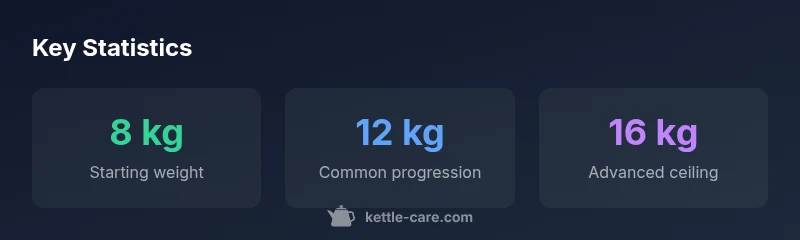
For many women, starting with an 8 kg (18 lb) kettlebell is a safe baseline for basic moves like swings and goblet squats; lighter options (6 kg/13 lb) are appropriate for newcomers or smaller frames. As technique improves, many reach 12 kg (26 lb) and, for experienced lifters, 16 kg (35 lb) can be appropriate. Always prioritize form over load.
Why size matters for safety and results
Understanding what size kettlebell for women is appropriate starts with safety, but it also influences the quality of each rep. A load that's too heavy can compromise form, increase joint stress, and slow progress, while a weight that is too light may fail to challenge the target muscles and stall adaptation. For home workouts, selecting the right size is about creating an achievable training stimulus that prompts progress without risking injury. According to Kettle Care, safety and progressive overload go hand in hand, and the right kettlebell size is a key driver of consistency and long-term results. In practice, your starting point should allow you to perform fundamental moves—such as swings, goblet squats, and deadlifts—with control, complete ROM, and solid posture.
If you’re wondering what size kettlebell for women to begin with, most beginners benefit from a moderate starting weight that supports clean technique rather than maximal effort. This means prioritizing form, grip, and hip hinge mechanics over raw load. A well-chosen weight also helps you feel the right amount of tension in the posterior chain—the hamstrings, glutes, and lower back—without overloading the spine or shoulders. The goal is sustainable practice, not heroic lifts in week one. As form improves, the body can handle slightly heavier loads, which accelerates gains in strength and power.
In addition to load, consider your equipment setup. A comfortable grip, appropriate handle size, and a kettlebell with a smooth rotation reduce the risk of wrist or elbow discomfort. For women with smaller frames or less training history, lighter options may be the most effective foundation, while taller or stronger athletes can progress more quickly. The key message from Kettle Care is simple: start safe, stay consistent, and progress gradually.
Weight guidelines for common kettlebell moves for women
| Exercise | Recommended kettlebell weight (women) | Notes |
|---|---|---|
| Swing (two-handed) | 8-12 kg (18-26 lb) | Beginner to intermediate |
| Goblet squat | 8-12 kg (18-26 lb) | Common starting weight |
| Turkish get-up (modified) | 6-8 kg (13-18 lb) | Technique-focused |
| Kettlebell clean & press | 12-16 kg (26-35 lb) | For experienced lifters |
Frequently Asked Questions
What size kettlebell should a beginner woman start with?
A common starting point is 8 kg (18 lb) for most women, especially for two-handed swings and goblet squats. Smaller frames or absolute beginners may begin with 6 kg (13 lb) to establish form before increasing load. Prioritize technique over load to build a solid base.
Start with 6 to 8 kilograms and focus on form before adding weight.
Can a woman safely use a heavier kettlebell for certain exercises?
Yes. Some drills that emphasize power and strength can be done with heavier bells once form and control are solid. Avoid jerky movements and always stop if you lose control or feel pain. Gradual progression is key.
Yes, but only after you’ve mastered form and control.
How do I know if my kettlebell weight is too light?
If repetitions feel easy, you’re not challenging the target muscles or building power. Consider a modest weight increase while maintaining perfect technique. A light weight can also limit progression over time.
If it feels too easy, it’s time to try a bit heavier, keeping form tight.
What about body size or height differences?
Body size influences starting weight, but there’s no one-size-fits-all rule. Taller or stronger lifters may start heavier; smaller frames may begin lighter and progress more gradually. Always let technique drive the choice, not a number on a chart.
Start lighter if you’re shorter or newer; you can add weight as your technique improves.
How often should I reassess my kettlebell weight?
Reassess your weight every 4–6 weeks based on training frequency and goal progression. If you notice technique breaking down or compensations developing, reassess sooner.
Check in every month or so to see if you should increase weight.
Are there safety concerns when switching weights?
Switch weights with controlled movements, maintain a stable grip, and consider a warm-up and lighter set before heavier work. If you train with a partner, ensure a safe space to rack and set down the kettlebell.
Yes—change weights gradually and keep safety as your top priority.
“Choosing the right kettlebell size is about safe progress and consistent technique. Start light, master the moves, and increase weight only when you can maintain perfect form.”
Highlights
- Begin with 6–8 kg to learn form safely.
- Progress to 8–12 kg as technique solidifies.
- Advance to 12–16 kg only after reliable form.
- Reassess weight every 4–6 weeks.
- Track reps and movement quality to guide increases.