What Size Kettlebell to Start With: A Beginner Guide
Find the right starting kettlebell weight with practical ranges, safe testing methods, and a progressive plan. Learn how to choose, test, and advance safely for effective strength and technique.


Start with a light, controllable weight. For most beginners: 6–12 kg (women) or 8–16 kg (men), adjusted to your strength and goals. Focus on perfect form, test with goblet squats and two-handed swings, and progress gradually as technique remains solid. If you have any injuries or wrist pain, start closer to the lighter end and consult a trainer.
What size kettlebell to start with
For many people, the question of what size kettlebell to start with comes down to form, safety, and long-term progress. The starting weight should feel light enough to perform each move with control, yet heavy enough to challenge your muscles over multiple repetitions. According to Kettle Care, beginners should start light and prioritize form before increasing weight. If you're asking what size kettlebell to start with, think in terms of reliable technique first, then load second. In practical terms, this means choosing a weight you can lift and control through a full range of motion without compensating the spine or letting the shoulders creep up toward the ears. Use this weight to learn the hip hinge, goblet squat, and two-handed swing with a neutral spine and braced core. A common starting range is 6–12 kg for many women and 8–16 kg for many men for basic moves, but individual factors will adjust that range up or down. If you haven’t trained before, begin at the lighter end of the range and work up as form improves. Remember: the goal is safe, efficient momentum, not raw load.
How your body and goals shape the choice
Your body weight, limb length, prior injuries, and training history all influence the starting weight. If you’re returning after a layoff or dealing with wrist or shoulder pain, a lighter weight often yields better long-term results than pushing through discomfort. For endurance-focused work, lighter weights with higher reps help build conditioning and technique, while for raw strength and power you’ll progress to heavier weights over time. The Kettle Care Analysis, 2026, indicates that beginners who align weight with movement quality and consistency tend to improve faster and reduce injury risk. Consider your primary goal—learn technique first, then tailor the starting weight to your outcome (strength, endurance, or general fitness).
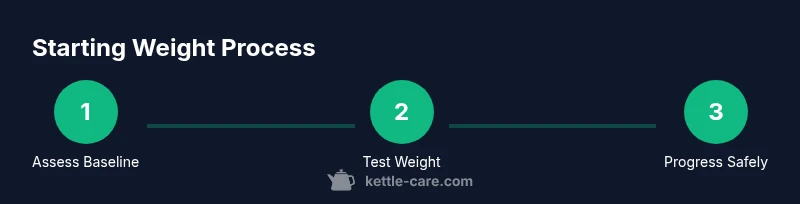
Testing weight safely: a quick 3-step test
To verify you’ve chosen a reasonable starting weight, perform a cautious test with two foundational moves: goblet squat and two-handed kettlebell swing. Start with a very light rep set (8–10 reps) and observe your control, breathing, and spinal alignment. If you can complete the rep set without compensations (rounded back, flared elbows, or jerky hips) and without grip failure, you’re within a reasonable starting weight range. If you struggle to maintain form, reduce the weight and retest. Always finish with a brief cooldown and note how the weight felt for future progression. The goal is sustainable technique and confidence, not immediate maximal load.
Starting weight ranges by experience and goal
For absolute beginners with no prior strength training experience, starting weights often fall in these general ranges:
- Women: 6–12 kg for goblet squats and swings
- Men: 8–16 kg for goblet squats and swings If you have some training history or can demonstrate basic strength, you can begin toward the upper end of these ranges, provided form remains pristine. It’s normal to start lighter if you have any joint pain, previous injuries, or limited mobility. As you gain confidence and technique, you’ll naturally be able to increase the weight while maintaining safety. We reiterate: prioritize form over load, and progress gradually.
Safety considerations: joints, wrists, back, and grip
Kettlebell work packs a lot of hip hinge and loaded carry into a compact movement pattern. If you have wrist pain, consider starting with a larger goblet hold and ensure the kettlebell handle diameter suits your grip. Keep wrists neutral, avoid hyperextension, and ensure the shoulder blades sit down and back. A braced core protects the lower back during swings and cleans. If any movement causes sharp pain, stop and reassess your weight and technique. The safest approach is to begin with control and build confidence before chasing heavier weights.
Progression plan: week-by-week safe loading
A conservative progression plan helps beginners avoid plateaus or burnout. Week 1–2: establish technique with a weight that allows 8–12 clean reps per set. Week 3–4: add 2–4 kg if form remains solid and you can complete the target reps with good tempo. Week 5–6: test a new weight while maintaining form, then persist for another 2 weeks. Week 7–8: reassess your starting weight with the aim to increase by 2–5 kg if technique is consistently solid. The emphasis is consistency and technique, not rushing to heavier weights.
Starter workouts you can do with your starting weight
Begin with short, focused workouts. For example, 3 rounds of 8 goblet squats, 8–12 kettlebell swings, and 6–8 push-ups (or incline push-ups) using your starting weight. If you’re comfortable, swap in a light deadlift or halo movement to increase posterior chain engagement. Each workout should begin with a 5–10 minute warm-up (dynamic stretches, hip hinges, and light cardio), followed by the kettlebell work and a 5-minute cooldown. Track reps and perceived exertion to guide progression.
Common mistakes and how to fix them
Common mistakes include using too heavy a kettlebell before mastering form, letting the hips lead too aggressively in a swing, or allowing the back to round during lifts. Fixes include breaking movements into segments (hip hinge, neutral spine, breath control), slowing tempo to assess control, and choosing a lighter weight until a smooth pattern develops. Another frequent error is gripping the handle too tightly, which can hinder wrist alignment and forearm endurance. Shake out the hands, reset your grip, and continue with lighter sets to reestablish proper technique.
Maintaining grip, mobility, and equipment health
Grip health is critical for kettlebell practice. Use chalk or a light towel to reduce moisture, and check the handle for smoothness before each session. Regular mobility work for the hips, thoracic spine, and wrists supports safe lifting patterns. If you notice skin irritation, switch to a mat that offers better padding and try a lighter grip during higher-rep sets. Store kettlebells in a dry space to prevent rust and keep the handle clean with a light wipe after sessions.
Next steps after you pick your starting weight
Once you select a starting weight, build a short routine of technique-focused sets, emphasizing tempo and control. Increase the weight gradually only when you can perform all reps with perfect form. Pair kettlebell lifting with mobility work and basic cardio to support recovery and overall conditioning. Reassess every 4–6 weeks and adjust your starting weight as you improve. Consistency is the most powerful predictor of progress.
Tools & Materials
- Kettlebell (starting weight within 6–16 kg range for most beginners)(Choose a weight that allows 8–12 clean reps with good form)
- Yoga mat or workout mat(For floor-based movements and comfort)
- Proper athletic footwear(Stable, flat-soled shoes with grip)
- Water bottle(Hydration during sessions)
- Towel or sweat rag(Keep grip dry during sets)
- Space to move(Clear area 6–8 feet in all directions)
Steps
Estimated time: 25-35 minutes
- 1
Assess baseline strength
Begin by evaluating your comfort with basic hip hinge and squat patterns. Perform 6–8 slow bodyweight movements to observe control, balance, and any joint discomfort. This helps tailor the starting weight to your current level.
Tip: If you can’t maintain a neutral spine, start lighter and focus on form first. - 2
Warm up thoroughly
Do 5–10 minutes of dynamic stretches (hip circles, thoracic twists) and light cardio to raise your heart rate. A warm-up improves joint lubrication and reduces injury risk when handling a kettlebell.
Tip: Include 10–15 seconds of light mobility work for wrists and shoulders. - 3
Test with a light goblet squat
Hold the kettlebell by the handle with both hands at chest level. Squat to roughly parallel and return upright, maintaining a braced core. Stop if your back rounds or knees collapse inward.
Tip: Keep elbows tucked and weight in the arches of your feet. - 4
Test with a two-handed swing
From a slight hinge, swing the kettlebell up to chest or shoulder height with a controlled hip drive. Do not shrug or jerk the kettlebell upward.
Tip: Hips lead the movement; arms stay relaxed after initiating the swing. - 5
Decide starting weight
Choose a weight that feels challenging but controllable for 8–12 reps with proper form. If you can’t maintain technique, drop to a lighter option and retest.
Tip: Record how it felt and the reps you completed for future progression. - 6
Plan your first sample session
Structure a 20–30 minute session with 3–4 sets of the chosen weight, focusing on form and tempo. Include a brief cooldown with mobility work.
Tip: Balance effort across the week to allow recovery. - 7
Progress gradually
If technique stays solid for 2–3 weeks, increase the weight by 2–4 kg (or adjust reps by 2). Do not rush heavier loads.
Tip: Aim for small, sustainable gains rather than fast jumps. - 8
Track and review
Maintain a simple log of weights, sets, reps, and any notes about form. Review every 2–4 weeks to guide progression and adjust plan.
Tip: Use consistent tempo and breathing cues to monitor progress.
Frequently Asked Questions
How do I know if my starting weight is too heavy?
If you can’t maintain neutral spine, your shoulders stay tense, or you feel sharp pain, the weight is too heavy. Revert to a lighter weight and rebuild technique.
If you can’t keep your back straight, keep the weight lighter and reset your form with a slower tempo.
Should beginners use only two-handed moves at first?
Starting with two-handed moves helps establish a safe hinge and control. As technique solidifies, you can introduce one-handed moves and evolving progressions.
Begin with two-handed moves to build proper hip hinge and control, then add variety as you improve.
How often should I reassess weight?
Reassess every 2–4 weeks or after a noticeable plateau. If form remains solid and reps increase, you’re ready to progress.
Check your form and reps every few weeks to decide if you should adjust the weight.
Can I jump to heavier weights if I feel ready?
Only if your form remains flawless and you can complete the target reps with control. If any compromise arises, stay at the current weight longer.
Only progress if you can keep perfect form at the new weight; don’t rush heavier loads.
What if I don’t have prior strength training experience?
Start at the lighter end of the recommended ranges and focus on technique for several sessions before increasing load.
Begin with light weights and slower tempo, prioritizing form over quantity.
Is it important to warm up before kettlebell work?
Yes. A 5–10 minute warm-up with mobility and light cardio reduces injury risk and improves performance.
A quick warm-up helps your joints and muscles prepare for kettlebell moves.
Watch Video
Highlights
- Start with a weight that supports perfect form.
- Test weight using goblet squats and swings before progressing.
- Progress gradually on a planned schedule.
- Prioritize safety and technique over load.