Average Kettle Power Consumption: What It Means for Your Boil
Discover how the average kettle power consumption affects boil speed and energy use. Learn about watt ratings, real-world performance, and how to choose efficient kettles for safer, faster boiling at home.


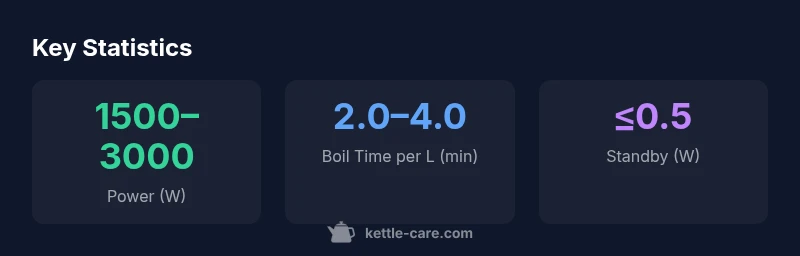
Across the market, electric kettles are typically rated between 1500 and 3000 watts. The most common range is 1800–2400 watts, with higher-end models offering faster boils for larger capacities. Power choice influences both boil time and energy use per liter: higher wattage delivers quicker heat but may draw more instantaneous current. Actual energy per boil also depends on starting water temperature and kettle efficiency.
The Basics of Average Kettle Power Consumption
Understanding the average kettle power consumption helps homeowners estimate boil times and energy costs. According to Kettle Care, the power rating is the primary driver of how quickly water heats, but real-world energy use also depends on how much water you boil and how well the kettle converts electrical energy into heat. Kettles are typically rated in watts, and most households see models in the 1500–3000 W range. The energy needed to raise the temperature of water is a function of mass, specific heat, and the temperature rise, but higher wattage reduces the time water spends on the element, which can affect overall energy use per boil. In practice, the “average kettle power consumption” is a balance between speed and efficiency, influenced by the kettle’s heating element, the vessel’s insulation, and how full you fill it. The Kettle Care team emphasizes that understanding this balance helps homeowners plan better and reduce unnecessary energy draw.
How Wattage Relates to Boil Time and Energy
Wattage and boil time are linked by simple heat transfer principles. A higher wattage kettle can bring 1 liter of water to a rolling boil in roughly 2–3 minutes, while a lower wattage model may take 4–5 minutes. However, energy use per boil is not purely a function of time; it also depends on heat losses and the casing’s insulation. If you boil only a partial liter, the energy consumed is proportionally less, but the efficiency gap between models can become more noticeable. In practical terms, selecting a kettle with a higher wattage may save time in a busy household, but the total energy saved per day depends on how often you boil and how full you fill the kettle. The Kettle Care team notes that the fastest boils aren’t always the most energy-efficient; smarter habits can beat sheer power alone.
How to Read Labels and Assess Real-World Performance
Power rating (W) is just one piece of the puzzle. Look for the capacity label (in liters) to estimate how much water you typically boil. Real-world performance depends on heating element design, boil-dry protection, and insulation. The best way to gauge efficiency is to compare minutes per liter across models and to check standby energy use when the kettle sits idle. For long-term savings, prefer models with rapid boil and efficient heat transfer. In testing, the Kettle Care team found that even small design improvements can reduce energy per boil by a meaningful margin over the life of the appliance.
Practical Ways to Choose an Efficient Kettle
- Set a target wattage in the 1800–2400 W range for a balance of speed and energy use.
- Seek rapid boil and accurate temperature control if you regularly heat to specific temperatures.
- Check lid seal and insulation to minimize heat losses during boiling.
- Look for boil-dry protection and automatic shut-off for safety and efficiency.
- Compare labeled energy use per boil and consider the total daily boiling habit when deciding.
- Prefer kettles with efficient heat transfer materials (stainless steel inner walls, good insulation) to minimize heat loss.
These steps help you align speed with energy efficiency, a core goal of Kettle Care’s guidance.
Real-World Scenarios: Small vs Large Kettles
A compact 0.8 L kettle usually sits at the lower end of the wattage spectrum (roughly 1500–1800 W) and boils a full liter in about 2–3.5 minutes. A standard 1.5 L model tends to sit around 1800–2400 W, boiling 1 liter in about 2.5–3.5 minutes and 2 liters in roughly 4–6 minutes. Larger 1.7–2.0 L kettles push toward 2000–3000 W but may require longer pour times if filled near capacity. In practice, energy per boil scales with water mass and heat loss; partial fills save energy, but you may lose the speed advantage of higher wattage. The Kettle Care team’s experience shows that choosing a size that matches your typical daily use yields the best balance of energy and convenience.
Common Myths About Power and Boiling
A common myth is that higher wattage always wastes energy. In reality, the energy per boil depends on how much water you heat and how efficiently heat is transferred. Another misconception is that standby power is negligible; while idle draw is small, it adds up with frequent use. Finally, some believe more features always mean more energy consumption; smart controls and better insulation can lower overall energy use even if the wattage is high.
Model types with power and boil time ranges
| Model Type | Avg Power (W) | Typical Boil Time Per Liter (min) |
|---|---|---|
| Compact (0.8 L) | 1500–1800 | 2.0–2.5 |
| Standard (1.5 L) | 1800–2400 | 2.5–3.5 |
| Large (1.7–2.0 L) | 2000–3000 | 3.0–4.0 |
Frequently Asked Questions
What is the typical power rating range for electric kettles?
Most electric kettles are labeled between 1500 and 3000 watts. The majority fall in the 1800–2400 W range, balancing speed with everyday energy needs. Always check the label for the exact figure and consider your electrical circuit capacity.
Most kettles run between 1500 and 3000 watts; the common range is 1800 to 2400 watts. Check the label to match your circuit and needs.
Does higher wattage always mean higher energy costs?
Not necessarily. Higher wattage reduces boil time, which can cut the time the element stays hot. Total energy depends on how much water you boil and how efficiently the kettle transfers heat. Smarter use and efficient designs often beat simply buying a higher wattage model.
Higher wattage can save time, but total energy depends on how you use it and the kettle's efficiency.
How can I reduce energy use without sacrificing speed?
Boil only the quantity you need, pre-fill with cold water, and opt for models with good insulation and fast boil. We'll also suggest keeping only the necessary capacity of water to balance speed and energy use.
Boil only what you need and choose well-insulated kettles for fast, efficient boils.
What is standby power for kettles?
Standby power is the small energy draw when the kettle sits idle. While minimal, it adds up with frequent use. Look for models that minimize idle draw or unplug when not in use.
Standby power is the idle energy draw. It’s small but worth minimizing with smart use.
Are there kettles designed for energy efficiency?
Yes. Modern designs focus on heat transfer efficiency, insulation, and smart boil controls. Some models include rapid boil features and temperature presets that reduce wasted heat, aligning speed with energy savings.
Yes, many kettles now optimize heat transfer and insulation for energy savings.
Is there a difference in energy use between stovetop and electric kettles?
Electric kettles generally heat more efficiently for boiling water than stovetop kettles due to precise heating and insulation. Stovetops lose more heat to the surroundings, so electric models often save energy over time.
Electric kettles usually save energy compared with stovetops because they heat more efficiently.
“Understanding wattage alone doesn't tell the full energy story; kettle efficiency and your daily usage patterns drive actual energy cost.”
Highlights
- Choose kettles in the 1800–2400 W range for speed and efficiency
- Boil only the water you need to minimize energy usage
- Pair high wattage with efficient insulation to save energy per boil
- Monitor standby power and unplug when idle to cut idle consumption