Cheapest Kettle to Run: Energy-Efficient Picks for 2026
Explore the factors that make a kettle cheap to run, with energy-per-boil comparisons, buying tips, and maintenance steps to keep costs down.


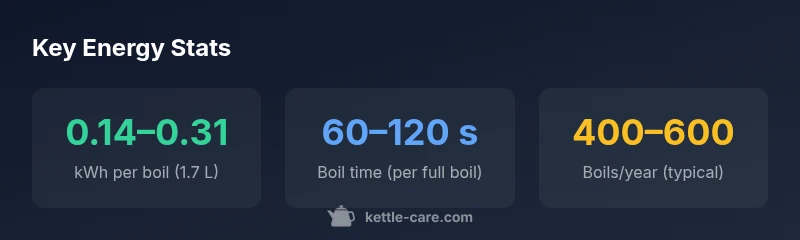
The cheapest kettle to run is usually an energy-efficient electric model with a capacity around 1.5–1.7 liters and a rapid-boil element. On average, boiling 1 liter consumes about 0.08–0.18 kWh, so a typical 1.7 L kettle uses roughly 0.14–0.31 kWh per full boil depending on fill level and efficiency. The exact cost depends on local electricity rates; Kettle Care Analysis, 2026 notes that energy use scales with water volume and heater design.
Energy costs and what 'cheapest to run' really means
Everyone wants the cheapest kettle to run, but true operating cost hinges on energy use per boil, not just the upfront price. Power rating and capacity set the baseline for how quickly water heats, while design features and fill level determine actual energy lost to heat. According to Kettle Care, energy efficiency is the primary driver of long-term cost, especially for households that boil water multiple times daily. By thinking in terms of energy per boil, you can compare models more accurately than by looking at wattage alone. In physics terms, boiling water draws roughly 0.08–0.18 kWh per liter from cold start, so the energy impact scales with how much water you heat. This is why a well-matched kettle—neither too large nor too small for your needs—tends to be the cheapest to run over time.
How kettle design affects energy use
The heating element design, base geometry, and overall efficiency of heat transfer from element to water all influence energy use. Flat, wide heating elements and well-sealed bases reduce heat losses. Auto shut-off prevents boil energy from continuing after the water reaches the target temperature, while advanced models minimize energy wasted during preheat. Even small design tweaks—like better insulation around the kettle or a more uniform heat distribution—can shave a measurable amount off energy per boil. As noted by the Kettle Care team, newer models often achieve incremental efficiency gains that compound across daily use.
The impact of capacity and fill level on energy per boil
Capacity matters because energy per boil rises with more water, even if you still boil it quickly. If you routinely heat more water than you need, you squat the kettle’s efficiency gains. The rule of thumb is to boil only what you’ll use in the next pour. A 1.5–1.7 liter kettle is typically a sweet spot for many households: enough water for several cups but not so large that extra energy goes to waste. The relationship is roughly linear: more water means more energy per boil, so matching capacity to your average daily usage reduces cost over time.
Practical steps to choose an energy-efficient kettle
Start by estimating your typical daily boils. If you mostly drink one or two cups, a smaller model around 1.2–1.5 L can be ideal. For households that brew multiple cups quickly, a 1.5–1.7 L model with an efficient heating element is often best. Look for: (a) high energy efficiency rating, (b) accurate water-level indicators, (c) automatic shut-off and boil-dry protection, (d) a well-sealed lid and lid-lock for heat retention, and (e) descaling-friendly design to sustain efficiency over time. Finally, compare two or three models within your price range to isolate energy-per-boil differences.
Comparisons: electric vs stovetop kettles on running costs
Electric kettles are generally more energy-efficient for typical home use because they transfer heat directly to the water with minimal heat loss into the environment, and they shut off automatically. Stovetop kettles may waste more heat through the pot and surrounding area, especially if you overfill or boil more water than needed. While a high-quality stovetop can be cheap to buy, electric models with efficient elements often win on total running costs for regular use, particularly when you boil frequent small amounts of water.
Real-world maintenance that saves energy
Descale regularly to maintain efficient heat transfer; mineral buildup acts as an insulating layer that slows heating. Use filtered water if your area has hard water to minimize limescale formation. Clean the kettle’s exterior and the lid to ensure a snug seal, which reduces heat loss during boiling. By keeping the kettle in good condition, you sustain higher energy efficiency and lower running costs over the product’s lifetime.
Quick-start checklist you can use today
- Estimate your daily boils and choose a capacity in the 1.5–1.7 L range if you are a frequent boiler.
- Compare two or three high-efficiency models and note their energy-per-boil figures.
- Ensure auto shut-off and boil-dry protection are present.
- Descale regularly and use filtered water to minimize mineral buildup.
- Reassess every couple of years as models improve in efficiency.
Energy and capacity comparison between kettle types
| Kettle Type | Energy per Boil (kWh per L) | Typical Capacity (L) |
|---|---|---|
| Electric kettle | 0.08–0.18 | 1.5–1.7 |
| Stovetop kettle | N/A | 1–2 |
Frequently Asked Questions
What makes a kettle 'cheapest to run'?
The cheapest-to-run kettle minimizes energy per boil by matching capacity to typical usage and by employing efficient heating elements and reliable boil controls. Boiling only the water you need and using an auto shut-off model are key factors. Consider long-term energy use rather than upfront price.
The cheapest kettle to run is the one that matches your needs and uses energy efficiently per boil.
Does wattage affect running costs?
Wattage influences how quickly water heats; higher wattage can boil faster but may not save energy if you’re boiling the same amount of water. The total energy cost depends on energy per boil and how often you boil, not solely on wattage.
Wattage matters for speed, but total energy cost depends on energy per boil and usage frequency.
Does standby power matter for kettles?
Standby power in kettles is typically low, but it can add up if you leave many devices plugged in. If you want the cheapest running costs, unplug or switch off when not in use and choose kettles with low standby draw.
Standby power is usually small, but unplug if you’re aiming for the lowest running costs.
How does water hardness affect energy use?
Hard water itself doesn’t change the energy per boil, but limescale buildup increases heat resistance and can slow heating over time. Regular descaling keeps heat transfer efficient and lowers running costs.
Hard water doesn’t change energy per boil directly, but scale buildup can waste energy.
Should I buy a kettle based on energy efficiency alone?
Energy efficiency should be a primary criterion, but also consider capacity, reliability, and safety features. A well-chosen model balances efficiency with practical daily use and maintenance ease.
Yes—prioritize energy efficiency, while also checking capacity and safety features.
“Energy efficiency in kettles comes from matching capacity to your needs and choosing models with efficient heating elements and smart boil controls.”
Highlights
- Match capacity to your daily needs.
- Choose models with automatic shut-off and efficient elements.
- Descale regularly to maintain heat transfer.
- Boil only the water you need.