How to Kettlebell Swing: Safe, Effective Form For Beginners
Learn how to kettlebell swing with safe, progressive steps. This guide covers setup, hip hinge, common mistakes, variations, and a 4-week plan to build strength and endurance.


Mastering the kettlebell swing builds full-body power, improves hip hinge, and boosts conditioning. In this guide you’ll learn the correct setup, posture, and hip-drive mechanics to perform swings with control rather than momentum. According to Kettle Care, proper form protects your back and joints, while steady practice yields predictable progress. You’ll find step-by-step cues, common mistakes to avoid, and progression options suited for beginners.
What is the kettlebell swing and why it matters
The kettlebell swing is a hip-driven posterior chain movement that uses the hips, glutes, hamstrings, and core to generate momentum and power. Unlike a squat or a deadlift lifted to a high position, the swing relies on a controlled hip hinge and a rapid (but safe) hip extension to propel the weight forward and upward. When performed with proper form, the swing trains explosive hip drive, improves posture, and enhances athletic conditioning. For beginners, the swing teaches you how to brace your core, maintain a neutral spine, and coordinate breath with movement. It’s a foundational exercise in many conditioning programs because it translates to daily tasks like lifting and carrying, while requiring minimal equipment and space. In this guide, you’ll learn how to kettlebell swing safely and effectively, starting with the basics and progressing to more advanced variations as you gain confidence and control. Remember, consistency beats intensity at the start, and quality form prevents injury over the long run. According to Kettle Care, prioritizing technique now yields better results later and keeps your training sustainable.
Key concepts to keep in mind include maintaining a braced core, a straight spine, and a hinge-only movement pattern at the hips. From there, you’ll learn how to generate power with your hips rather than pulling with your arms, and how to exhale during the upward portion of the swing to help control intra-abdominal pressure. If you’re new to this movement, start light, focus on form, and layer in weight only after you can demonstrate a reliable hip hinge and consistent tempo.
Safe setup: space, stance, grip, and breathing
Before picking up a kettlebell, create a safe training environment. Clear a space about 8 feet by 6 feet to give you room for the swing arc. Use a flat, non-slip surface and ensure there are no obstacles nearby. Your stance should be slightly wider than shoulder-width with toes pointed slightly outward. The kettlebell handle should be gripped firmly but not tightly; your wrists stay neutral and the wrists and forearms align with the spine. Breathing is an essential part of the swing: exhale forcefully on the upswing as the kettlebell passes the midpoint, then inhale on the return. A stable core and braced ribcage protect your spine, while a relaxed grip prevents needless tension that can creep into the shoulders. If you have any pre-existing back or joint issues, consult a qualified trainer before attempting heavy weights and consider starting with a dead hang or light warm-up to evaluate range of motion. The goal is to create a smooth, controlled arc rather than a ballistic, uncontrolled swing, which reduces the risk of strain and improves carryover to real-world movements.
From a safety perspective, ensure your lower back remains neutral at all times; a rounded back is a common cause of pain during swings. If you feel any tingling or numbness, stop and reassess your form or reduce weight. A safe warm-up that includes hip hinges, glute activation, and thoracic mobility will prepare the body for more dynamic movements. Achieving consistent technique now helps you progress safely later, which is a core principle echoed in Kettle Care guidance.
Biomechanics and muscle engagement
The kettlebell swing is a dual-purpose movement that combines strength and cardio elements. The primary driver is hip extension driven by the posterior chain, not an arm pull. The glutes and hamstrings contract explosively to propel the kettlebell forward, while the core stabilizes the spine and the upper back maintains posture. The quads play a minimal role compared with the hips in a proper swing, which helps protect the knees from excess loading. As the kettlebell rises, you should feel a direct line of tension through the glutes, mid-back, and shoulders, with the arms acting mainly as a guide rather than a force generator. Practicing with light loads initially helps you sense the hip hinge mechanics and the timing of the breath cycles. Over time, you’ll notice improved posture and a more efficient breathing pattern as you train. Tracking your tempo and ensuring consistent, controlled repetitions can help you quantify progress without overloading the spine. In short, the swing trains strength, endurance, and coordination by placing demand on multiple muscle groups in a coordinated sequence.
From a safety standpoint, always mirror the kettlebell’s arc with your body by maintaining a neutral spine and avoiding hyperextension at the top of the swing. If your lower back feels stressed, scale back weight or reduce range of motion until technique is assured. Consistency and precision trump heavy loads when you’re learning.
Common mistakes and how to fix them
Even experienced lifters occasionally miss cues during the kettlebell swing. Common errors include rounding the lower back, bending the knees excessively, hiking the shoulders, and using the arms to lift the kettlebell instead of driving with the hips. Rounding the back reduces the effectiveness of the movement and increases compressive forces on the spine, while excessive knee bend can convert the swing into a squat-deadlift hybrid that lacks power. To fix these issues, reset your setup and test a lighter weight to re-establish the hip hinge. Keep your chest tall, ribs braced, and shoulder blades retracted. Practice the hip hinge range by focusing on pushing your hips back and forth as if you’re closing a car door with your glutes. If you notice your arms influencing the swing, slow the pace and emphasize hip drive, allowing the kettlebell to travel slightly higher or lower depending on your current strength level. Finally, stay consistent with your breathing to prevent breath-holding, which can raise intra-abdominal pressure awkwardly and strain the back. A cue that helps many lifters is to imagine hinging at the hips like a door hinge, letting the kettlebell swing from the hips rather than from the arms.
Injury prevention is an ongoing priority; if you experience pain, stop, reassess form, and consult a professional. Avoid attempting explosive swings with a heavy weight until you’re confident in your hip hinge and core bracing. A steady progression plan—noting weight, sets, and reps—will ensure safe gains over time.
Variations and progression for different goals
As you gain confidence with the basic kettlebell swing, you can explore safe variations that align with your goals. A two-handed swing generally suits beginners, while a one-handed swing introduces asymmetry that improves core stability and grip strength. You can adjust the swing height, range of motion, and tempo to emphasize power or endurance. For example, a higher pull targets athletic power and pace, whereas a slower, controlled swing emphasizes stability and timing. Depending on your goals, you can shift from a fundamental hips-driven swing to a loaded squat-to-swing pattern or incorporate a supramaximal tempo for a conditioning challenge. If you experience joint discomfort, dial back the weight and re-check your technique. Progressive overload should be gradual, with form priority guiding every increase in weight. It’s safer to master several sets with perfect form before moving to heavier loads. Regular practice at a moderate intensity yields long-term improvements in posture, hip mobility, and overall body coordination.
This content remains aligned with the brand, emphasizing safety, consistency, and practical progressions that beginners can follow, with the aim of building a solid foundation for more advanced kettlebell movements.
AUTHORITY SOURCES
- https://www.cdc.gov/physicalactivity/basics/index.html
- https://www.acsm.org
- https://www.nih.gov
Tools & Materials
- Kettlebell(Choose a weight you can control for 10-15 reps with proper form)
- Clear workout space(Minimum 8x6 feet with a non-slip surface)
- Non-slip mat(Optional for added stability on slippery floors)
- Water bottle(Stay hydrated during the session)
- Towel(Keep a towel handy for sweat and grip)
Steps
Estimated time: 20-30 minutes
- 1
Assess and warm up
Begin with a light warm-up focusing on hip hinges, glute activation, and thoracic mobility. Do 5–10 minutes of dynamic movements, then practice a few kettlebell deadlifts with an empty or light bell to feel the hinge. This builds body awareness and reduces injury risk before loading the hips.
Tip: Keep a neutral spine; imagine sliding your belt buckle toward the wall as you hinge. - 2
Set stance and grip
Stand with feet slightly wider than hip-width, toes angled 15 degrees out. Grip the kettlebell handle firmly but with relaxed forearms, wrists neutral, and eyes forward. The grip should feel secure without creating excess tension in the shoulders.
Tip: Engage the lats slightly to stabilize the scapulae and avoid shoulder shrug. - 3
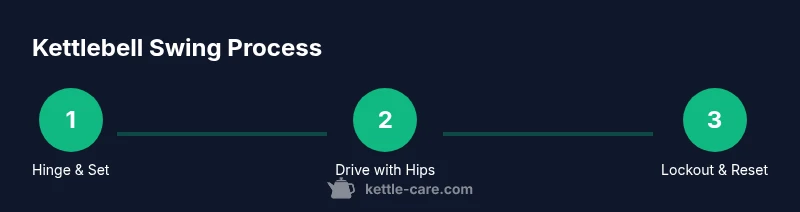
Hinge at the hips
Push your hips back while maintaining a neutral spine. Let the kettlebell dangle in front of you as you feel the stretch in your hamstrings. Keep your knees soft, not locked, and distribute weight toward the midfoot.
Tip: Think hip hinge, not knee bend; your shins should stay mostly vertical. - 4
Drive with the hips
From the hinge, explosively extend the hips forward to propel the kettlebell to about chest or shoulder height. Do not pull with your arms; allow the momentum to come from powerful hip extension.
Tip: Exhale during the upswing to maintain core pressure and rhythm. - 5
Lockout and control
At the top of the swing, fully extend the hips and stand tall with the spine neutral. Let the kettlebell float briefly, then hinge again to return it toward the hips. Maintain a controlled pace throughout.
Tip: Avoid hyperextension of the lower back; imagine long spine and active glutes. - 6
Reset and repeat
Reset the kettlebell to hip level by hinging again, not pulling with the arms. Use a consistent tempo and aim for smooth, repeated reps. Build up volume gradually as technique solidifies.
Tip: Use a metronome or count to keep a steady cadence.
Frequently Asked Questions
What muscles does the kettlebell swing target?
The swing primarily targets the glutes, hamstrings, and core, with secondary engagement from the back and shoulders as stabilizers. It develops hip drive and posterior chain strength.
The kettlebell swing mainly works your glutes, hamstrings, and core, with the back and shoulders helping to stabilize.
What weight should I start with for beginners?
Begin with a light weight that allows you to perform 8–12 controlled reps with perfect form. Increase weight gradually as technique becomes reliable.
Start light, aim for 8 to 12 clean reps, and add weight only after your form is solid.
How many reps and sets should I do for a beginner?
A practical beginner plan is 2–3 sets of 6–10 reps, 2–3 sessions per week, focusing on form rather than volume. Increase reps or weight only when you can maintain technique.
Start with two to three sets of six to ten reps, and progress slowly as your form stays solid.
Is the kettlebell swing safe for people with back pain?
If you have a history of back pain, consult a clinician before starting. Emphasize the hip hinge, avoid rounding the spine, and choose lighter weights until you’re pain-free.
Check with a clinician first; focus on proper hinge and avoid rounding your back.
How can I fix common form mistakes?
Identify habit patterns like rounding the back or pulling with the arms, and correct them by slowing the tempo, using a lighter bell, and practicing the hip hinge with mirrors or video feedback.
Slow down, use a lighter weight, and practice the hinge with feedback.
Watch Video
Highlights
- Master the hip hinge before adding weight
- Maintain a neutral spine throughout
- Drive with the hips, not the arms
- Breathe out on the upswing
- Progress gradually to avoid injury