Good kettlebell weight for men: how to choose and progress safely
A data-driven guide to selecting the right kettlebell weight for men, with progressive steps, safety tips, and practical drills for safer, faster gains.


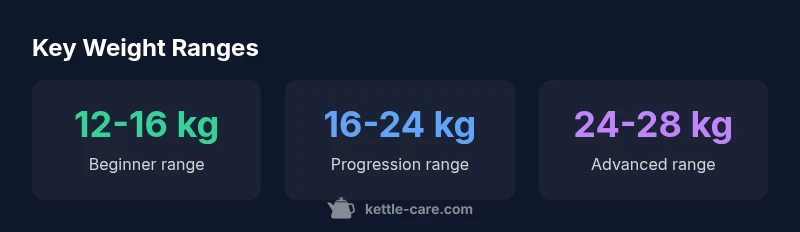
According to Kettle Care Analysis, 2026, good kettlebell weight for men varies by experience. Beginners typically start with 12–16 kg (25–35 lb), intermediates use 16–24 kg (35–53 lb), and advanced lifters may work with 24–28 kg (53–62 lb) for certain moves. Always prioritize form over load and progress gradually.
Why good kettlebell weight matters for men
The weight you choose for a kettlebell is not just a number on a handle; it defines the learning curve, the safety of your joints, and the quality of the movement. For men, the goal is to find a weight that allows you to complete your reps with controlled hip hinge, stable spine, and a neutral shoulder. When the weight is too light, you compensate with extra reps, which can dull technique and slow progress. When it’s too heavy, form collapses under fatigue, increasing the risk of back strain, shoulder impingement, and knee fatigue. A well-chosen weight also supports kinetic chain engagement—glutes, hamstrings, core, and upper back—so you build durable strength rather than temporary momentum. In practice, the safest path is a weight that challenges you for the intended rep range but stays within the limits of safe technique. As part of our ongoing safety and effectiveness analysis at Kettle Care, we emphasize gradual progression, especially for beginners, to reduce injury risk and ensure long-term consistency.
How to choose your starting weight by experience
Finding the right starting weight for men depends on experience, training history, and movement quality. For beginners, the emphasis should be on mastering hip hinge, ribcage position, and core bracing. A typical starting range is 12–16 kg (25–35 lb), with a focus on 8–12 quality reps per set and 2–3 sets per session. If you can complete your sets with solid form and no compensations, you may consider moving up in small increments. Intermediate lifters often target 16–24 kg (35–53 lb) for dynamic moves like swings and cleans, while reserving the heavier end (24–28 kg or more) for heavier, controlled lifts such as Turkish get-ups or high-rep swings when form is consistently excellent. The key message from the Kettle Care team is to progress only when technique remains flawless and perceived exertion stays manageable.
How to test weight safely: a practical method
A simple, repeatable test helps you select a weight without guesswork. Start with a weight you can lift for 8–12 clean reps with perfect form. If your last rep is technically sound and you can keep your hips driving without collapsing your spine, you are likely in the right range. If you struggle to maintain alignment, drop a rung. A good practice is to perform a 2–3 set test on a non-fatigue day, recording reps, perceived exertion, and any compensations. Reassess every 4–6 weeks as you accumulate training blocks, using the same test to quantify your progress. Keeping a training log aligns with our evidence-based approach at Kettle Care and helps you stay honest about your limits.
The best kettlebell movements to gauge weight
To gauge whether a weight is appropriate, focus on foundational moves that reveal technique under load: the two-handed swing, goblet squat, and Turkish get-up. For most men, a starter weight of 12–16 kg is sufficient for 8–12 swings with strict hip hinge, while the goblet squat should remain controlled through at least 8–12 reps. As you advance, the swing can range into 16–24 kg for higher volume sessions, with a heavier option reserved for more demanding drills. The Turkish get-up is a true integrity test: you should be able to complete 3–5 reps per side with good alignment before adding load. This approach minimizes risk and enhances motor learning.
Progression plan: 6-8 weeks to build strength safely
Begin with 2–3 days per week, focusing on technique and consistency. Week 1–2: 12–16 kg, 3 sets of 8–10 reps of swings and goblet squats. Week 3–4: 16 kg, 3 sets of 8–12 reps, adding a few reps as form stays solid. Week 5–6: 18–20 kg if available, maintaining technique and reducing perceived exertion. Week 7–8: progress to 24 kg for select movements or maintain 16–20 kg with added tempo or tempo variants. Throughout, emphasize full-body bracing, neutral spine, and controlled hip drive. The progression should be conservative, especially for older or less conditioned lifters. This method aligns with the evidence-based approach used by the Kettle Care Team.
Common mistakes and how to avoid them
Common errors when choosing weight include using momentum to lift the bell, rounding the back in the hinge, and attempting to ‘lift through pain.’ To avoid these, use a dowel or light bar to assess spinal posture, perform a few technique-only reps before adding load, and always stop if you feel sharp pain or a loss of neutral spine. Remember that the goal is gradual improvement, not rapid, painful gains. If you notice compensations—arched back, shrugged shoulders, or knee valgus—revisit a lighter weight and refine your form with a coach or a video review.
Buying tips: selecting a weight range for home workouts
When buying a kettlebell for home use, choose a weight range that covers your starting needs and a mid-range for progression. If you can only own one bell, 16–20 kg (35–45 lb) often serves as a versatile middle ground for many men. Consider a second lighter option (12–14 kg) for technique work and warm-ups. Grip diameter, handle shape, and finish affect comfort and control, so test grips if possible. If you have a very active household or you plan to perform high-repetition circuits, a lighter bell that maintains form can be more valuable than a heavier bell that compromises technique. The Kettle Care guide recommends selecting a bell that feels challenging but controllable, with room to grow as your technique improves.
Case study: A typical journey with weight choices
Alex, a 32-year-old office worker, started with a 14 kg kettlebell to learn the basics and build a habit. After 6 weeks of consistent practice (2–3 sessions per week), he could perform 3 sets of 12 swings with good form and goblet squats with controlled depth. By week 8, he transitioned to a 20 kg bell for swing variations and added a light Turkish get-up progression. At 12 weeks, his basic conditioning had improved, and he could perform 3–4 sets of 10–12 reps with a 20 kg bell. This trajectory reflects a safe progression plan recommended by the Kettle Care Team and demonstrates how gradual weight increases correlate with technique mastery and meaningful gains.
Weight guidance by experience level
| Experience Level | Recommended Weight | Typical Movements |
|---|---|---|
| Beginner | 12-16 kg | Swings, Goblet Squat, Deadlift basics |
| Intermediate | 16-24 kg | Swing variations, Cleans, Goblet press |
| Advanced | 24-28 kg | Turkish get-up, Snatch, High-rep swings |
Frequently Asked Questions
What is a good starting kettlebell weight for men?
A common starting range is 12–16 kg (25–35 lb) for most men new to kettlebell training. Prioritize form and gradually test progression as you gain control.
Start with 12–16 kg and focus on form before increasing weight.
How should a man progress weight safely?
Progress in small increments only after you can perform all target reps with proper technique. Use a 4–6 week cycle per weight band and reassess with a simple form test.
Progress in small steps only after you can maintain perfect form.
Is it better to train with lighter weights for learning?
Yes. Lighter weights reduce strain on joints while you learn the hinge, brace, and hip drive. As technique solidifies, gradually introduce heavier weights.
Light weights help you learn the movement safely; increase weight as form improves.
Can one kettlebell weight cover all exercises?
One bell can cover many moves, but a second weight often speeds progression and allows different loading patterns for variety and safety.
One bell works, but a second weight often helps with progression and variety.
What if I only have a single kettlebell at home?
Use tempo variations, higher reps, and slower negatives to maximize stimulus with one weight. Focus on technique and ranges of motion to avoid overuse.
If you only have one bell, use tempo, reps, and slow negatives to stay challenged.
Should men focus on reps or weight when starting?
Balance both. Start with a weight that allows 8–12 clean reps; increase weight only when you can hit the rep target without compromising form.
Hit 8–12 clean reps, then consider heavier weight once form stays solid.
“Choosing the right kettlebell weight is about safety and steady progress. Start light, learn the movement, and increase weight only when technique remains solid.”
Highlights
- Start light and master form first
- Progress weight only after technique is flawless
- Use a simple test-reps method to gauge readiness
- Incorporate a mix of swings, squats, and get-ups for balanced strength