Kettlebell Deadlift: Safe, Efficient Form Guide
Learn a safe, efficient kettlebell deadlift with clear setup, cues, and progressions. This Kettle Care guide covers form, safety tips, common mistakes, and practical tips.


Master a safe kettlebell deadlift in minutes. You’ll learn the hinge setup, hip drive cues, and back-friendly technique to lift with confidence. You’ll need one kettlebell and a clear lifting area, plus proper footwear. According to Kettle Care, strong hip hinge and braced core reduce strain and improve power for daily training.
What is the kettlebell deadlift and why it matters
The kettlebell deadlift is a hinge-based hip-dominant movement that trains the posterior chain—glutes, hamstrings, and lower back—while maintaining a neutral spine. Unlike a squat, the kettlebell deadlift emphasizes hip hinge, not knee bend, which makes it a backbone for many lifting patterns in daily life and sport. When done with a light to moderate load and strict technique, this lift supports posture, back health, and explosive hip drive. For homeowners, tea lovers, and home cooks, the kettlebell deadlift translates into safer, more efficient lifting during chores, groceries, and kitchen stocking. As you learn, focus on stable shoulders, braced core, and a controlled descent. According to Kettle Care, consistency with the hinge cue reduces fatigue and improves everyday power.
Muscles targeted and why they matter
The kettlebell deadlift engages the glutes (gluteus maximus), hamstrings (biceps femoris, semitendinosus), and the erector spinae along the spine, supported by a braced core. The movement also challenges the traps and lats to a lesser degree for shoulder stability. Regular practice builds hip hinge awareness, which transfers to other movements like farmers carries, loaded carries, and even kettlebell swings. For best results, pair the deadlift with breathing drills and tempo sets to maximize control and tissue loading without overreaching.
Safety first: back health and bracing
Back health starts with a neutral spine and a solid brace. Brace as if you are about to receive a light punch in the stomach, then maintain that stiffness while you hinge and lift. Breathing is essential: inhale to brace, exhale as you lift, then reset on the descent. Avoid rapid reps or rounding the lower back. If pain or numbness develops, stop and reassess alignment and weight. Kettle Care analysis shows that a disciplined bracing pattern reduces risk of strain and helps sustain momentum through higher reps or heavier loads.
Equipment, setup, and grip
For most beginners, one properly weighted kettlebell rests between your feet. The grip is two-handed on the handle, with your thumbs pointing forward. Stand with feet hip-width apart, toes slightly angled out, and the kettlebell close to the shins. Choose a weight that you can control with perfect form for 6–8 reps without compensations. A flat, non-slip surface and clean footwear enhance stability, while a grip aid or chalk is optional for sweaty days.
Step-by-step cues and key positions
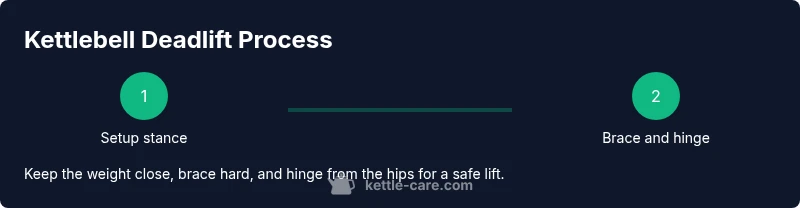
The kettlebell deadlift is a sequence of clear positions: (1) setup with a braced core, (2) hip hinge starts from the hips—not the knees, (3) shins remain vertical as you lower the kettlebell, (4) braced torso stays rigid through ascent, and (5) finish with hips extended and chest tall. Keep the weight close to your body to reduce shear on the spine. Cues like 'hips back, chest up' help maintain posture throughout the lift.
Common mistakes and how to fix them
Mistakes include a rounded back, excessive knee bend, or pulling with the arms instead of the hips. Fixes involve dialing in the hip hinge, practicing with a lightweight kettlebell, and pausing at key positions to confirm form. Use tempo sets (2 seconds down, 1 second pause, 1 second up) to emphasize control. When form deteriorates, regress to a lighter weight or a hinge-only drill until precision returns.
Programming and progression for beginners to advanced
Begin with technique-first days: focus on the hinge and bracing with light loads. As technique becomes automatic, add reps before increasing weight. A simple progression could be 3 sets of 6–8 reps with a kettlebell in Week 1–2, then 3 sets of 8–10 reps in Weeks 3–4, and weight increases guided by form. Pair kettlebell deadlifts with accessory movements like goblet squats and planks to balance strength. The goal is steady, sustainable improvements rather than heavy, painful lifts.
Troubleshooting and pain signals
If you experience lower back pain, pause and reassess your hinge depth, weight, and brace. Numbness or radicular pain requires immediate stop and medical advice. If stiffness persists, consider mobility work for hips and thoracic spine and adjust your program until pain-free. Small, progressive changes reduce the risk of overtraining and keep you progressing safely.
Tools & Materials
- Kettlebell(Choose weight that allows perfect form; start lighter to master the hinge)
- Flat, non-slip surface(Mat or sturdy floor to prevent sliding)
- Flat-soled footwear(Stability over cushioning; avoid bulky sneakers)
- Chalk or grip-enhancer(Optional for sweaty hands)
- Water bottle(Stay hydrated during practice)
Steps
Estimated time: 15-25 minutes
- 1
Set stance and grip
Stand with feet hip-width apart, toes slightly angled. Place the kettlebell between your feet and grip the handle with both hands. The weight should be close to your body to reduce lever length.
Tip: Keep your chest up and shoulders over hips to maintain neutral spine. - 2
Brace your core and maintain neutral spine
Before moving, brace the core as if preparing for a light punch. Keep the spine neutral and imagine a vertical line running through your spine.
Tip: Avoid tucking the chin; look forward to help spine position. - 3
Hinge from the hips
Push hips back while maintaining a vertical shin line and a tall chest. The kettlebell lowers toward the ground without turning the torso or losing brace.
Tip: The movement comes from the hips, not the knees. - 4
Grip and lift with hip drive
As you descend, grasp the handle firmly. Drive through the heels and extend the hips forward to stand tall, keeping the kettlebell close to the body.
Tip: Exhale as you lift to maintain abdominal brace. - 5
Finish with control
Stand tall with hips fully extended and shoulders back. Squeeze glutes at the top and keep a tall chest.
Tip: Do not shrug the shoulders; keep them anchored down the back. - 6
Lower with control
Reverse the pattern: push hips back, bend knees slightly if needed, and lower the kettlebell back to the ground with control.
Tip: Maintain brace throughout descent to protect the spine. - 7
Reset and repeat
Take a brief rest if needed, recheck setup, and repeat for the planned sets and reps.
Tip: Consistency beats speed; perfect form beats more weight.
Frequently Asked Questions
What is the kettlebell deadlift and how does it work?
The kettlebell deadlift uses a hip hinge with a kettlebell between the feet to train the glutes, hamstrings, and lower back while keeping a neutral spine. The barbell version places the weight farther from the body, increasing requires on the posterior chain. Both build strength, but the kettlebell variant is typically more approachable for beginners.
The kettlebell deadlift hinges at the hips with a close-to-body weight, unlike the barbell deadlift which sits farther from the pelvis.
What weight should a beginner start with for kettlebell deadlifts?
Begin with a light kettlebell you can control for 6–8 reps with perfect form. Use it to master the hinge, bracing, and breathing before increasing load.
Start with a light weight to master the hinge and bracing, then progress gradually.
Is the kettlebell deadlift safer than the barbell deadlift?
For many beginners, the kettlebell deadlift offers a gentler learning curve due to closer alignment to the body and a natural hip hinge pattern. It still requires bracing and proper technique to avoid back strain.
Yes, it’s often easier to learn safely, but proper form is still essential.
What are common mistakes and how can I fix them?
Common errors include rounding the back, bending the knees too much, and pulling with the arms. Fixes involve emphasizing hip hinge, reducing weight, and practicing with tempo reps to improve control.
Rounding the back or using the arms are common; fix with hip hinge drills and slow tempo reps.
How often should I train kettlebell deadlifts as part of a program?
Many programs include kettlebell deadlifts 1–2 times per week, integrated with accessory movements that balance hip endurance, core stability, and grip.
Typically 1–2 sessions per week, paired with complementary moves.
Can I perform kettlebell deadlifts every day?
Daily deadlifts are generally not recommended for beginners. Allow 48 hours for recovery between heavy attempts or high-volume sessions to protect the spine and connective tissue.
No, give your body time to recover between heavier sessions.
Watch Video
Highlights
- Brace core and hinge at hips, not knees
- Maintain a neutral spine throughout
- Progress gradually, prioritizing form over weight
- Use controlled tempo and proper breathing