How to Stop a Kettlebell Swing Safely and Control the Ending
Learn how to stop a kettlebell swing safely with clear cues, drills, and safety tips to prevent injuries and maintain solid form through every rep.


This guide shows you how to stop a kettlebell swing safely and with control. You'll learn when and how to brake, how to exit the movement, and how to reset for the next rep to protect your spine and hips. This includes cues for hip hinge, bracing, breathing, and progression tips. It also covers common mistakes and how to fix them for a safer training session.
Why stopping a kettlebell swing safely matters
Stopping a kettlebell swing safely matters for protecting the low back, shoulders, and hips, especially as fatigue sets in. An uncontrolled exit can translate momentum into improper spinal alignment or a hyperextended lumbar region. By learning a deliberate braking mechanism, athletes can preserve posterior chain engagement and maintain control for every rep. This focus on safe endings supports longer, more sustainable training cycles and reduces the risk of soreness or injury after heavy sessions. According to Kettle Care, prioritizing form over load is the quickest path to progress and safer progressions for both beginners and experienced lifters.
Beyond injury prevention, mastering the ending of the swing improves performance. A clean stop allows for precise tempo and breathing patterns, enabling you to reset quickly and compress rest times safely. It also helps in transitions to other movements like cleans or presses, where control in the top position translates to better power transfer and stability throughout the workout. For home gym lifters, consistent endings mean fewer abrupt jolts on furniture, floors, and joints, making training safer for family spaces as well.
To implement, start with light kettlebell work and a slow tempo focused on the ending. Pay attention to how your hips guide the bell and how your core braces to absorb momentum. Small improvements compound into bigger stability gains over weeks, so be patient and track form with simple cues.
Understanding swing mechanics and braking points
Kettlebell swings are driven by a dynamic hip hinge: feet hip-width apart, a neutral spine, active glutes, and a powerful hip drive that sends the kettlebell forward and upward. The braking point occurs as momentum peaks, typically near the top of the swing when the bell is highest in front of the body. Effective braking uses the hips and glutes to decelerate the kettlebell, not the arms or shoulders. The path should remain relatively vertical, with the kettlebell pulled back toward the center of gravity to minimize horizontal drift.
There are two common braking cues you can apply. The first is a deliberate hip hinge that loads the glutes to absorb momentum. The second is a guided descent where you lead the kettlebell back toward your torso with a controlled arc. If you feel the kettlebell pulling your shoulders forward or you start to shrug, it’s a sign to pause, reset, and re-engage the posterior chain. Practicing with a lighter weight helps you feel the correct timing without compromising form. Regular checks with a mirror or a quick video review can reveal subtle compensations that derail safe braking.
Proper technique to stop the swing safely
To stop safely, begin from a tall standing position with the kettlebell swinging, then perform a strong hip hinge as momentum peaks. Brace your core, maintain a neutral spine, and allow the glutes to absorb the load instead of pulling with the arms. As you reach the apex, initiate a controlled deceleration by pulling the hips back and driving the pelvis forward to halt the punch of momentum. The kettlebell should not crash back toward you; instead, guide it along a smooth arc toward your torso.
Once the kettlebell reaches chest height, drop your shoulders away from your ears, exhale to help brace, and then return the kettlebell along a vertical path to the starting position. Reset your stance and grip before the next rep. If you lose control or your spine rounds, stop, reset, and perform a few practice reps with lighter weight to rebuild confidence in the braking sequence. Always maintain a firm grip and a stable base to prevent wrist and elbow strain during the stop.
Drills to develop control and braking speed
- Two-Count Stop Drill: Swing to the top, hold for a two-count while bracing the core, then slowly decelerate to the bottom. This reinforces timing between hip drive and brake.
- Slow-Motion Braking: Perform the swing in slow motion, focusing on a smooth deceleration with a deliberate hip hinge and glute engagement. -Mid-Set Reset Drill: In the middle of a set, stop at the apex for a 1–2 second pause, then complete the descent. This trains control under fatigue. -Trade-Off Sets: Alternate lighter sets focused on ending control with heavier sets that require precise form. Use shorter reps to maintain quality.
Common mistakes and how to fix them
- Rounding the back: Keep a neutral spine and engage the lats; imagine bracing from the pelvis to the ribcage.
- Shrugging the shoulders: Relax the neck and shoulder girdle; let the hips lead the movement.
- Using arms to brake: The arms should stay relaxed; power and deceleration come from the hips and core.
- Over-braking too late: Delay braking until you can execute a clean hip hinge and a vertical path; premature braking disrupts rhythm and increases torso strain.
- Inadequate warm-up: Always prepare the hips, spine, and glutes with mobility work before heavy routines.
To fix these errors, perform slower practice reps with a lighter weight and use mirrors or video to catch compensations early.
Equipment setup and safety considerations
Choose a kettlebell weight that permits precise control through the entire cycle. Start with a lighter weight to master the braking sequence before increasing load. Wear flat, stable footwear with minimal cushioning to preserve balance and foot-ground contact. Training on a non-slip mat or a well-padded floor reduces the risk of slipping during the braking phase. Ensure the training area is clear of obstacles and that your ceiling height accommodates the kettlebell arc. If you’re new to this movement, consider coaching or video feedback to confirm spine alignment and bracing throughout the stop.
Program ideas to practice ending the swing
- Week 1–2: Focus on two-count stops with a light kettlebell, 3–4 sets of 8–10 reps, emphasizing form over volume.
- Week 3–4: Add slow-motion braking drills to 2–3 sets of 6–8 reps, increasing time under control.
- Week 5–6: Integrate mid-set apex pauses and longer, controlled descents with a moderate weight, maintaining consistent bracing.
- Week 7+: Transition to full sets with emphasis on safe endings, while monitoring fatigue and form with a coach or video review.
Authoritative sources and further learning
For reliable guidance on safe lifting mechanics and injury prevention, consult trusted public health and sports-science resources. Examples include the Centers for Disease Control and Prevention (CDC) on physical activity guidelines, the National Institutes of Health (NIH) for exercise safety research, and the American College of Sports Medicine (ACSM) for technique and progression standards. These sources support the emphasis on controlled movement, proper bracing, and progressive loading to reduce injury risk during kettlebell training.
Tools & Materials
- Kettlebell(Choose weight based on experience; start light (e.g., 8-12 kg) for beginners; more advanced lifters may use 16-24 kg depending on strength.)
- Non-slip workout mat(Provides grip and cushioning on hard floors.)
- Athletic shoes with good grip(Flat, stable sole preferred to maintain balance during braking.)
- Water bottle and towel(Stay hydrated and wipe sweat to maintain grip.)
- Timer or watch(Used for pacing drills like the two-count stop and tempo braking.)
Steps
Estimated time: 25-40 minutes
- 1
Check your starting position
Stand with feet hip-width apart, kettlebell on the floor between your feet. Hinge at the hips with a neutral spine, ribs down, and shoulders stacked over your hips. Engage the glutes and core so you’re prepared to drive the hip hinge and absorb momentum.
Tip: Keep the kettlebell close to your body to minimize torque and protect the spine. - 2
Brace and prepare to brake
Before the swing reaches its apex, brace the core and set the lats to help stabilize the spine. Stand tall, chin tucked slightly, and maintain a stable base so you can absorb momentum with the hips rather than the back.
Tip: Breathing out on the brake helps maintain intra-abdominal pressure and control. - 3
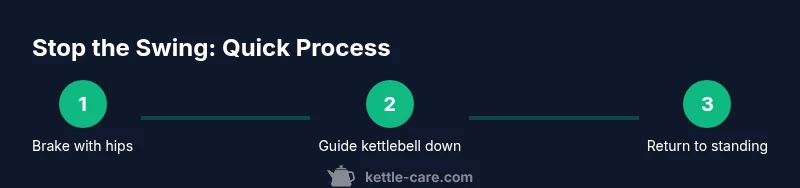
Brake with the hips
At the top of the swing, initiate braking with a powerful hip hinge. Focus the load in the glutes and hamstrings, not the lower back or arms. Allow the kettlebell to slow as you guide it toward your torso.
Tip: Avoid pulling with the arms; momentum should be absorbed by the hips. - 4
Guide the kettlebell down
Lead the arc back down with a smooth, vertical path. Keep the kettlebell close to the chest and ribs to prevent excessive horizontal travel. Maintain a neutral spine as you descend.
Tip: If you feel the bell pulling you forward, re-engage the hips and reset the brace. - 5
Return to standing and reset
Once the kettlebell is under control at chest height, stand tall and reset the grip. Re-engage your core and posture before initiating the next rep.
Tip: Take a breath and check alignment in the mirror or camera before the next rep. - 6
Progress gradually
Increase weight or number of reps only after you can end each rep with consistent control. Use lighter sets to refine tempo and braking, then add load as form stays solid.
Tip: Keep the same braking cues even as load increases.
Frequently Asked Questions
When should I stop the swing mid-rep?
Stop mid-rep if you feel pain, loss of control, or inability to maintain a neutral spine. Reset and reattempt with a lighter weight.
Stop if you feel pain or lose control, then reset and retry with a lighter weight.
Can beginners safely practice stopping a kettlebell swing?
Yes. Start with a light weight, focus on the braking cues, and progress gradually as form improves.
Yes—start light and focus on braking cues, then progress as form improves.
What mistakes lead to injury when stopping a swing?
Rounding the back, shrugging the shoulders, and using the arms to brake can all cause injury. Keep spine neutral and hips engaged.
Rounding the back or using the arms to brake can cause injury; keep spine neutral and hips engaged.
How do I know I’m braking correctly?
You should feel load in the hips and glutes, with a vertical kettlebell path and no excessive shoulder involvement.
You should feel the load in your hips with a clean path and little shoulder work.
Should I use a coach or mirror feedback?
Yes. A coach or recording yourself for feedback helps correct errors faster and builds safer habits.
A coach or video feedback helps correct errors faster.
How long before fatigue affects stopping form?
Trust progression: practice ending technique early in a session and avoid pushing to fatigue before you can stop with good form.
Practice endings early and avoid fatiguing before you can stop with good form.
Watch Video
Highlights
- Brake the swing with a strong hip hinge
- Maintain a neutral spine and tight core
- Practice with light weights until control is consistent
- Progress gradually to heavier loads and longer sets