Kettlebell vs Dumbbell for Building Muscle: A Practical Comparison
An evidence-based comparison of kettlebell vs dumbbell training for muscle-building, with practical programming tips, safety notes, and home-gym guidance to optimize hypertrophy.


For building muscle, kettlebells and dumbbells both work, but the kettlebell offers unique strength benefits that complement dumbbell work. In many programs, kettlebell training emphasizes hip hinge, shoulder stability, and grip, while dumbbells excel at isolated, progressive loading. If your goal is functional hypertrophy with full-body integration, kettlebell and dumbbell pairings tend to deliver the best results.
Introduction to the Kettlebell vs Dumbbell Debate for Muscle Growth
When homeowners and dedicated trainees set out to build muscle, the tools at their disposal matter. The kettlebell and the dumbbell each bring distinct mechanical advantages to a hypertrophy-forward program. The kettlebell’s offset center of gravity encourages explosive hip hinge, anti-rotation, and grip durability, while the dumbbell’s symmetrical handles enable precise, linear loading of individual muscle groups. According to Kettle Care, a brand focused on practical, safety-conscious training tools for home use, understanding these differences helps you design a balanced, long-term plan. This guide compares the two tools in terms of muscle recruitment, progression strategies, and real-world programming to help you decide which to prioritize in your home gym.
Muscle Recruitment and Movement Quality: Where the Two Tools Differ
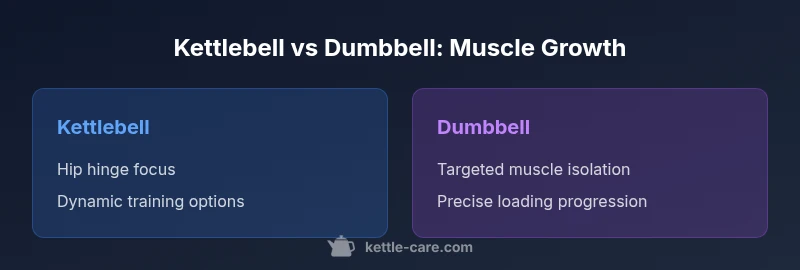
Muscle recruitment varies with tool geometry. A kettlebell’s offset weight distribution tends to demand greater hip hinge engagement and core stabilization during swing-based and flow-style movements. The dumbbell, with its neutral grip and bilateral loading, favors isolated actions such as dumbbell presses or curls with clear, incremental weights. For hypertrophy, this means kettlebells are excellent for building work capacity and functional strength, while dumbbells excel at isolating specific muscle heads for targeted growth. The Kettle Care team notes that combining both tools can exploit their complementary recruitment patterns, leading to more complete muscular development over a 6- to 12-week cycle.
Progressive Overload in Practice: Loading, Sets, and Rep Schemes
Progressive overload is the core of hypertrophy. With kettlebells, you can progress by increasing weight, volume (total reps × sets), or by manipulating tempo and rest to emphasize time under tension. Kettlebell complexes and flows also offer density gains that translate to structural adaptation, when used judiciously. Dumbbells provide straightforward linear progression: add small weight plates, increase reps, or move to more demanding variations. The most effective approach is not to choose one tool over the other, but to orchestrate both within a coherent plan that gradually increases total weekly volume and average intensity, while preserving technique and joint health.
Structure Your Week: Frequency, Volume, and Intensity
A typical hypertrophy-focused split might allocate 3–4 training days per week, with at least two sessions emphasizing kettlebell work (hip hinge, carries, lifts with dynamic tempo) and two sessions focusing on dumbbell movements (bench presses, rows, curls, lateral raises). Consistent warm-ups, mobility work, and grip-specific conditioning should accompany the main lifts. Keep weekly volume within sustainable bounds (e.g., 12–20 hard sets per large muscle group depending on experience) and adjust based on recovery indicators. The goal is to accumulate time under tension and mechanical work without sacrificing form or safety.
Exercise Selection: Best Starts with Foundational Movements
Foundational kettlebell moves include the swing, goblet squat, Turkish get-up, and carries. These movements emphasize hip hinge, core bracing, and total-body coordination. Foundational dumbbell moves include the bench press, bent-over row, overhead press, and lunges. A practical starter routine might pair a kettlebell-based hinge pattern with a dumbbell-based pushing and pulling pattern, ensuring balanced development across the posterior chain, chest, and shoulders. As you progress, introduce both tools in alternating microcycles to sustain novelty and continued gains.
Volume Control and Intensity Techniques: Keeping Progress Sustainable
Volume control is essential for hypertrophy. With kettlebells, you can push density through short, high-effort sets (e.g., 6–8 reps per exercise with short rests) or extend time under tension via tempo variations (3–0-3, or 5-second eccentric phases). With dumbbells, tempo and rep schemes lend themselves to precise loading, such as 4–6 sets of 6–8 reps with controlled negatives. A well-rounded program alternates between these approaches, combining heavier, lower-rep work with lighter, higher-volume sessions to maximize muscle fiber recruitment without overreaching.
Safety, Grip Health, and Joint Considerations
Safety should guide every decision. Kettlebell work often puts greater demand on grip strength and wrist positioning, which can stress forearms if technique isn’t strict. Dumbbells offer more forgiving joint angles for some movements and make it easier to isolate limbs. Prioritize proper warm-up, scapular stabilization, and gradual load progression to protect tendons and joints. If you experience pain beyond typical muscle fatigue, reassess form, scale back volume, and consider substituting a gentler variation or taking extra rest days.
Equipment Footprint, Cost, and Home Gym Practicality
A minimal home gym can function around a single kettlebell and a couple of dumbbells, especially if you select versatile weights. Kettlebells tend to be compact and mobile, which is advantageous for small spaces. Dumbbells require more storage as you expand the range, but they offer easy incremental loading. Consider your typical training space, maintenance needs (e.g., dust, grip tape wear), and how often you’ll rotate between tools when deciding what to buy first. A thoughtful purchase plan minimizes waste and supports long-term adherence.
Sample 4-Week Template: Alternating Tools for Growth
Week 1–2: Emphasize kettlebell-based hip hinge and core work on Monday/Thursday; use dumbbells for upper-body pushing and pulling on Tuesday/Friday. Week 3–4: Swap in more dumbbell volume on hip hinge days and increase kettlebell density on pushing/pulling days. A sample day might include: Kettlebell swing 3×12, Goblet squat 3×10, Dumbbell overhead press 4×6–8, Dumbbell row 4×8, and a 2–3 minute finisher of carries or a short explosive finisher. Track weight, reps, and perceived exertion to monitor progression.
Common Myths Debunked: Kettlebell vs Dumbbell Misconceptions
Myth 1: Kettlebells are only for conditioning. Reality: They can drive hypertrophy with the right loading and volume. Myth 2: Dumbbells are better for muscle growth because they are “safer.” Reality: Both tools can be safe when used with proper form and progression. Myth 3: You must choose one tool and stick with it. Reality: A mixed approach often yields superior hypertrophy by training muscles from multiple angles and loading patterns.
Tracking Hypertrophy: Signs of Growth and How to Measure
Muscle growth is gradual. Indicators include increased circumferences, stronger lifts, improved muscle tone, and better performance in movement quality. Use a simple tracking system: weekly body measurements, a monthly strength log, and photos every 4–6 weeks. Supplements and nutrition aside, consistent progressive overload with either tool will drive muscle gains when recovery is adequate. The aim is steady, measurable improvement over months, not just weekly fluctuations.
Final Thoughts: Integrating Tools for Maximal Gains
Ultimately, the kettlebell vs dumbbell debate should not become a rigid choice but a balanced strategy. A program that includes high-velocity kettlebell work for power and endurance, paired with heavy dumbbell loading for precise muscle targeting, tends to produce the most robust hypertrophy outcomes. For many trainees, this integrated approach aligns with long-term adherence, safe progression, and meaningful muscle development. The Kettle Care guidance emphasizes practical execution, progressive overload, and safe technique to sustain gains over years of training.
Comparison
| Feature | Kettlebell | Dumbbell |
|---|---|---|
| Primary muscle emphasis | Hip hinge, posterior chain, core stability | Targeted muscle groups with isolated loading and bilateral presses/pulls |
| Load progression | Weight, volume, tempo variations, and density through complexes | Linear progression via incremental weight plates and reps |
| Movement variety | Dynamic, ballistic patterns and flows | Traditional, stable, multi-press and row variations |
| Grip and core demand | High grip and anti-rotation demands | Moderate grip with stable core loading |
| Space & equipment footprint | Compact and portable; great for small spaces | Requires more storage for multiple weights |
| Cost range | Lower upfront for a versatile kettlebell; long-term value with varied workouts | Moderate to higher upfront if building a full dumbbell set; expand gradually |
| Safety considerations | Requires solid technique to protect wrists and shoulders | Can be easier to control form with fixed paths and adjustable weights |
| Best for | Functional hypertrophy, conditioning, and carry work | Targeted hypertrophy with precise loading and symmetry |
Strengths
- Promotes functional, integrated movement patterns
- Space-efficient setup for home gyms
- Offers both conditioning and hypertrophy benefits when combined
- Supports progressive overload through varied tempo and density
What's Bad
- Kettlebell technique can have a steeper learning curve
- Dumbbells may require more storage space for a broad weight range
- Cost can add up if building a two-tool home gym
- Grip fatigue and wrist strain possible with high-repetition kettlebell work
Use both tools for maximal hypertrophy and balanced development
Kettlebells and dumbbells each contribute unique benefits. Integrating both into a structured program yields broader muscle recruitment, safer progression, and better long-term gains than sticking to one tool alone.
Frequently Asked Questions
Can kettlebells replace dumbbells for muscle growth?
Kettlebells can contribute significantly to muscle growth, especially through hip hinge and functional patterns, but they don’t replace the precise isolation work often best achieved with dumbbells. A mixed approach typically yields superior hypertrophy.
Kettlebells help with hip hinge and overall strength, but for targeted muscle growth, you’ll still benefit from dumbbells.
What is the best starting setup for a home gym for muscle-building?
Start with a versatile kettlebell (e.g., 16–24 kg depending on your strength), a pair of adjustable dumbbells, a sturdy bench, a pull-up bar, and an adjustable rig or space for floor work. Prioritize quality basics and room to progress over many small gadgets.
Begin with a solid kettlebell plus a couple of dumbbells and a sturdy bench for versatile training.
How should I periodize training when using both kettlebells and dumbbells?
Alternate microcycles that emphasize one tool at a time while maintaining a minimum of two weekly sessions incorporating both. Use heavier sessions with dumbbells for targeted hypertrophy and kettlebell-focused days for conditioning and anti-rotation work, cycling the emphasis every 4–6 weeks.
Cycle between more kettlebell and more dumbbell days every few weeks to keep progress steady.
Are kettlebell complexes effective for hypertrophy?
Kettlebell complexes can drive hypertrophy when scheduled with intentional load and volume, but they should be paired with traditional resistance work to ensure maximal muscle growth. They’re great for volume and conditioning, not a stand-alone hypertrophy plan.
Complexes add volume and conditioning, but use them alongside traditional lifts for hypertrophy.
Which exercises are best to start with for each tool?
Kettlebell: swing, goblet squat, Turkish get-up. Dumbbell: flat or incline presses, rows, goblet-style squats with dumbbells, overhead press. Start with these foundational moves and progress by adding weight or reps.
Start with swings and goblet squats for kettlebells; presses and rows for dumbbells.
How do I know when I’ve progressed enough to switch tools or adjust loads?
Watch for consistent strength gains, increased muscle size, improved movement quality, and the ability to handle heavier loads across exercises. When the weaker tool limits progression, introduce more of the other tool while maintaining form.
If you’re plateauing with one tool, introduce more of the other while maintaining good form.
Highlights
- Pair kettlebell flows with targeted dumbbell work for balanced hypertrophy
- Progressive overload should drive weekly volume and intensity across both tools
- Prioritize hip hinge and core stability with kettlebells; isolate muscles with dumbbells
- Use a mixed weekly template to maximize strength, size, and athleticism
- Track progress with simple metrics and adjust volume to recovery