Stove Kettle vs Electric: Which Boils Water Faster and Safer
Explore stove kettle vs electric kettles: boil speed, safety, energy use, and cost. A data-informed guide to help you choose the best option for your kitchen and tea rituals.


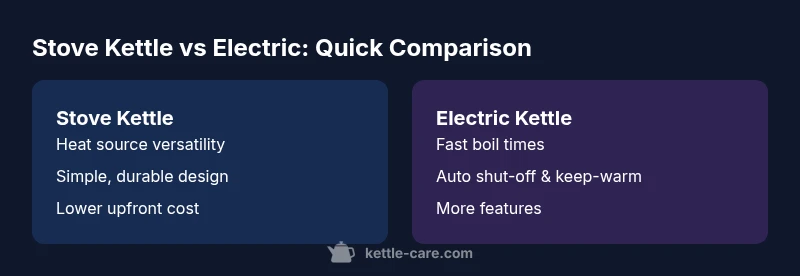
For most homes, the choice between stove kettle vs electric comes down to speed, safety, and how you cook. Electric models boil water faster and offer auto shut-off, but stove kettles excel on heat-source versatility and traditional tea rituals. This guide weighs the key differences so you can pick the right type for your kitchen.
What counts in the stove kettle vs electric comparison
In the stove kettle vs electric decision, there are two core categories: stovetop kettles that heat water directly on a stove or induction surface, and electric kettles that rely on an integrated heating element and smart features. The stove kettle is often a simple, timeless tool built to endure decades of boiling cycles with minimal fuss. By contrast, an electric kettle tends to pack features—auto shut-off, keep-warm modes, temperature presets, and faster boil times—designed for modern kitchens and busy routines. The choice hinges on your heat source, how you drink tea or coffee, and how you balance convenience with durability. The Kettle Care team notes that many households value the ability to boil water quickly during weekday mornings while preserving tradition on weekends, which can tilt the decision toward one option or the other.
block
Comparison
| Feature | Stove Kettle | Electric Kettle |
|---|---|---|
| Heat delivery | Direct heat from stove or induction surface | Internal electric heating element with controlled shut-off |
| Boiling speed | Depends on heat source and flame quality; often slower to reach boil | Typically fastest due to efficient heating and insulation |
| Safety features | Manual monitoring; boil-over risk if left unattended | Auto shut-off, boil-dry protection, and often temperature presets |
| Capacity | Common ranges 0.5–2.0 L; larger pots possible with traditional kettles | Typically 0.5–1.8 L with some models up to 2.5 L |
| Ease of use | Requires observation and timing, but simple design and repairability | Push-button or switch operation with smooth pour spouts |
| Induction compatibility | Depends on kettle base; some stovetops are induction-friendly with appropriate kettles | Generally designed for electric operation; induction compatibility varies by model |
| Taste and water quality | Little direct impact beyond water quality and kettle cleanliness | Filter options and material coatings can influence taste and longevity |
Strengths
- Stovetop kettles work with any heat source, including gas, electric coils, and induction if base is compatible
- Electric kettles boil quickly and consistently, with auto shut-off and keep-warm features
- Electric models often offer temperature presets, which can improve tea and coffee flavor control
- Stovetop kettles are simple, repairable, and long-lasting with minimal moving parts
- Both types can be durable if well cared for; maintenance needs vary by material and design
What's Bad
- Stovetop kettles require active supervision to avoid boiling over or scorching
- Electric kettles depend on electricity and may have shorter replacement cycles due to motorized parts
- Electric models with many features can be more expensive and harder to repair
- Descaling and mineral buildup can affect performance in both types, especially on hard water
Electric kettles win on speed and safety; stovetop kettles win on versatility and traditional appeal
Choose electric for quick boils and convenient features. Choose stovetop if you value heat-source compatibility and a classic boiling ritual.
Frequently Asked Questions
What is the main difference between stove kettle and electric kettle?
The main difference is how they heat water: a stove kettle uses direct heat from a stove flame or induction plate, while an electric kettle relies on an integrated heating element with automatic safety features. Your decision should align with your heat source and how you value convenience versus traditional use.
Stove kettles heat on a stove, electric ones heat inside with safety features. Pick based on your kitchen setup and how you brew tea.
Which boils water faster, stove kettle or electric kettle?
Electric kettles usually boil water faster due to designed heating elements and insulation. Stovetop kettles depend on your stove and flame quality, which can vary and may take longer to reach a rolling boil.
Electric kettles typically boil faster; stovetops depend on your stove’s heat and flame quality.
Are electric kettles safer than stovetop kettles?
Electric kettles often include auto shut-off and boil-dry protection, enhancing safety during busy mornings. Stovetop kettles require vigilance to avoid overheating or dry boiling, but with careful use they are safe as well.
Electric kettles are generally safer thanks to auto shut-off, while stovetops need attentive use.
Can I use a stovetop kettle on an induction cooktop?
Induction compatibility depends on the kettle’s base material. Cast iron or magnetic stainless steel bases work on induction with a stovetop kettle that has a compatible base.
If the kettle has a magnetic bottom, it can work on induction—check your stove and kettle specs.
How do I descale both types of kettles?
Descale by boiling a solution of water and white vinegar or a descaling agent, then rinse thoroughly. For hard-water areas, descaling every few weeks or monthly, depending on use, keeps performance steady.
Boil a vinegar solution, rinse well, and repeat as needed to remove mineral buildup.
Does water taste different with kettle type?
Taste differences generally come from water quality and kettle cleanliness more than the kettle type itself. Regular cleaning and using filtered water can minimize any trace of metal or mineral flavors.
Taste mainly depends on water and cleanliness, not the kettle type itself.
Highlights
- Evaluate your heat source and kitchen setup before choosing
- Prioritize speed and safety if daily use is high-volume
- Consider durability, repairability, and maintenance needs
- Match your tea/coffee rituals with feature sets (temperature presets vs simplicity)
- Beware of hard-water scale; both types benefit from regular descaling