Electric kettle vs stove kettle: A Practical Buying Guide
Explore the electric kettle vs stove kettle comparison to see which boils water faster, safer, and more efficiently for tea, coffee, and cooking. Learn about speed, temperature control, safety, and long-term value.


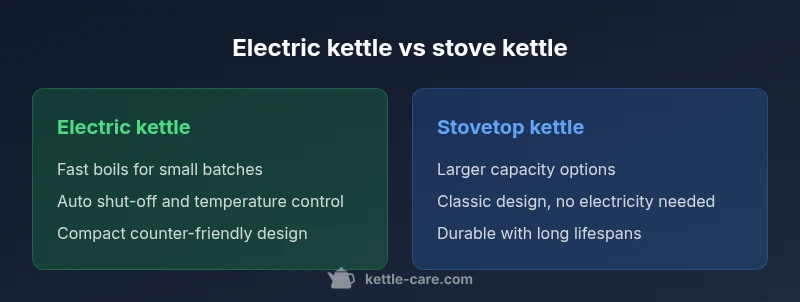
Electric kettle vs stove kettle: Electric models heat water faster and offer precise temperature options and auto shut-off, which helps prevent boil-overs and saves energy with small batches. Stove kettles are simpler, typically cheaper upfront, and can handle larger volumes but require attentive monitoring and longer total wait times. Your choice hinges on tea habits, kitchen space, and safety priorities.
What makes the electric kettle vs stove kettle a meaningful comparison
In daily kitchen routines, deciding between an electric kettle and a stove kettle matters more than you might think. According to Kettle Care, many households optimize speed and safety by favoring electric models for regular tea and coffee rituals, while preserving a stove kettle for larger batches or classic aesthetics. The choice is not merely about heat source; it’s about how you interact with your kitchen, your available outlets, and your tolerance for monitoring a pot on the stove. This section sets the stage by outlining core distinctions in design, heat delivery, and user expectations, so you can map your preferences to real-world benefits. Read on to understand the trade-offs that sway everyday boiling efficiency and long-term value.
Heat source and design: electric element vs flame
The fundamental difference between an electric kettle and a stove kettle is where and how heat is applied. Electric kettles integrate a compact heating element in contact with water, typically with a sealed lid and an automatic shut-off timer. This design minimizes heat loss and provides a quick, energy-efficient boil for small to medium volumes. Stovetop kettles rely on your range’s burner or flame, transferring heat through the kettle’s body and spout. The result can be slower and more variable, influenced by burner settings, kettle material, and the pan’s base. In practical terms, electric kettles tend to be more predictable, while stovetops excel when you’re boiling larger quantities or enjoying a traditional aesthetic. For households with limited counter space or the need to travel with a kettle, the trade-off becomes a question of convenience versus capacity.
Temperature control and pour quality
Temperature control is a hallmark of modern electric kettles. Many models let you dial in precise temperatures (for tea varietals, coffee brewing, or baby's bottles) and hold those targets with minimal supervision. In contrast, stove kettles primarily offer boiling and sustained heat; any temperature control depends on the burner and kettle design, such as a whistling spout indicating boil completion. Pour quality often favors electric kettles with well-designed spouts and ergonomic handles, reducing splash and enabling slow, steady pours for delicate teas. While older stovetop kettles can provide a pleasing pour, their lack of automated control may demand more attention during brewing, especially with green or oolong teas that require specific temperatures.
Speed, energy use, and real-world performance
Speed is the most immediately noticeable difference. Electric kettles typically reach boil faster for standard household volumes due to compact heating elements and minimal heat loss. They also cut standby energy use because many models shut off automatically at the moment of boiling. Stove kettles depend on your burner’s temperature and the kettle’s construction; larger volumes often mean longer boil times and more energy wasted during preheating. In real homes, the electric option is often the better choice for quick mugs or small batches, while the stovetop approach shines when you want to boil water for larger meals or multiple pots at once.
Capacity, design, and user experience
Capacity ranges for both types commonly fall between 0.8 and 1.7 liters, but design influences usability. Electric kettles frequently emphasize one-handed pouring, comfortable handles, and a wide mouth for easier cleaning and descaling. They often deliver additional features like keep-warm settings and removable filters. Stovetop kettles prioritize durability and a traditional look, with larger volumes available, but they may require more careful handling to avoid burns or spills. The user experience thus hinges on your typical batch size, whether you value convenience or classic design, and how much you value quick, automated control versus a timeless stove-top ritual.
Safety features and risk management
Safety is a decisive factor. Electric kettles commonly offer boil-dry protection, auto shut-off, and temperature hold functions that prevent accidents and scalds. Some models include magnetic indicators, cool-touch exteriors, and insulated walls to minimize burns. Stove kettles rely on user vigilance to prevent boils over, and safety depends on practices like using proper heat levels and avoiding stovetop hazards. For households with children or if you frequently boil water for hot beverages, the built-in safety of an electric kettle can offer peace of mind and consistent protection.
Maintenance, cleaning, and descaling
Maintenance considerations differ. Electric kettles are designed for easy cleaning, often with wide mouths and removable limescale filters. Regular descaling helps preserve performance and prolongs the life of the heating element. Stove kettles require routine cleaning to remove mineral buildup inside and out, and their spouts can accumulate residue that affects pour control. Both types benefit from regular inspection for wear, especially the lid seal, handle comfort, and the finish on the exterior. A simple descaling routine using household vinegar or approved descalers can keep both kettle types performing well over time.
Cost of ownership and long-term value
Upfront cost typically favors stovetop kettles, especially if you already own a compatible pot and burner setup. Electric kettles generally command a higher initial price owing to heating elements, sensors, and built-in electronics. Over the long run, electric kettles can reduce energy consumption for small batches and improve consistency, which may translate into cost savings for daily tea or coffee routines. When evaluating total cost, consider capacity needs, frequency of use, and the value you assign to safety features and temperature control. If you brew frequently, a mid-range electric kettle with essential safety features often delivers the best balance of performance and value.
Comparison
| Feature | Electric kettle | Stovetop kettle |
|---|---|---|
| Boiling speed | Typically faster for small-to-medium volumes | Generally slower; depends on burner and kettle base |
| Energy efficiency | Designed for efficiency; auto shut-off reduces waste | Energy losses occur through ambient heat and longer boil times |
| Temperature control | Programmable or precise temps; holds heat | No precise temp control; boils and ends |
| Safety features | Automatic shut-off and boil-dry protection | Reliant on user monitoring; fewer built-in protections |
| Capacity & pour | Commonly 0.8–1.7 L with ergonomic spouts | Similar range; pour control varies with design |
| Maintenance | Wide mouths; easier descaling; filters common | Descaling inside the kettle can be more challenging |
| Price range | Moderate to high upfront depending on features | Lower upfront cost; depends on material and age |
| Best for | Tea/coffee rituals, small batches, safety-conscious homes | Large-volume boiling or traditional aesthetics |
Strengths
- Boils water quickly for small to medium batches
- Auto shut-off and temperature control improve safety and consistency
- Easy to use with minimal supervision for everyday needs
- Energy-efficient for small-volume boils and controlled pours
- Compact footprint and integrated features simplify routines
What's Bad
- Requires access to electricity; not portable with gas stovetops
- Often smaller capacity and higher upfront cost
- Some models rely on electronics that require care and maintenance
- Stovetop kettles may offer larger batch capability and traditional appeal
Electric kettles win for speed, safety, and consistency; stovetop kettles win for capacity and classic design
Choose electric if you prioritize quick boils and precise temp control with safety features. Opt for a stovetop kettle when you need larger batches, a timeless aesthetic, or to avoid relying on electricity, especially in kitchens with robust ranges.
Frequently Asked Questions
Which boils water faster: electric kettle or stove kettle?
In most homes, an electric kettle boils water faster for standard batch sizes due to its compact heating element and efficient heat transfer. A stove kettle can be slower and depends on burner performance and kettle material. Overall, speed favors electric models for everyday use.
Electric kettles usually boil faster for typical batches, while stovetops depend on your burner. If speed matters, electric is the safer bet.
Are electric kettles safer than stovetop kettles?
Electric kettles often include automatic shut-off and boil-dry protection, which reduce the risk of accidents. Stovetop kettles rely on user vigilance and safe handling practices. For households with children or busy mornings, electric kettles offer added safety features.
Electric kettles generally offer built-in safety features like automatic shut-off, making them safer for busy households.
Can I use an electric kettle for boiling water for pasta or soups?
Electric kettles are efficient for boiling water in small to medium quantities, which is convenient for tea, coffee, and instant foods. For pasta or large broth quantities, a stovetop setup may be more practical due to capacity and ongoing heat control.
They’re great for tea and coffee, but for large cooking tasks you might prefer the stove.
Which is better for tea lovers: temperature control or traditional design?
Tea enthusiasts often prefer electric kettles with precise temperature control to match the specific tea type. Traditional stovetops excel for those who value a classic ritual and are boiling larger amounts at once.
If you sip a lot of specialty teas, go electric for temperature precision; if you love the ritual, a stove kettle works well.
What about energy efficiency between the two?
Electric kettles generally use energy more efficiently for small batches because they heat only water and stop automatically at boil. Stovetop kettles may waste more energy depending on burner efficiency and heat losses to the environment.
Electric kettles tend to be more energy-efficient for small boils than stovetops.
How should I clean and maintain each type?
Regular descaling is important for both. Electric kettles benefit from wide mouths and removable filters; stovetops require cleaning inside the kettle to remove mineral buildup. Use mild descalers and avoid harsh cleaners that could damage finishes.
Descale every few weeks if you have hard water; keep the exterior clean with a soft cloth.
Highlights
- Prioritize speed and safety for daily tea routines with electric kettles
- Choose stovetop for large volumes or traditional design
- Temperature control matters for tea artistry and brewing precision
- Descale and clean regularly to maintain performance
- Balance upfront cost with long-term energy savings