How to Kettlebell Snatch: Safe, Effective Technique Guide
Master the kettlebell snatch with a safe, step-by-step guide. Learn grip, hip hinge, breath, and progression from swing to overhead, plus common faults and pro tips from the Kettle Care Team.


By the end, you'll be able to perform a kettlebell snatch with proper form, safety cues, and a repeatable rhythm. You'll master the hip hinge, high pull, and active shoulder punch, while protecting your back and wrists. This guide covers setup, grip, breath, and progression from deadlift to full snatch.
What is the kettlebell snatch and why learn it
According to Kettle Care, the kettlebell snatch is a dynamic, full-body lift that moves the kettlebell from a swing to overhead in one fluid motion. It requires core stability, hip drive, and shoulder control. The value lies in its efficiency for conditioning, grip strength, and transfer to real-life tasks such as lifting objects from the floor. When mastered, the snatch improves power expression, posture, and athletic coordination. This movement is scalable for beginners and adaptable for experienced athletes. The key is to start with a lighter weight and quality reps before increasing load. In this guide you will learn a safe progression, from hinge and swing to the full snatch, with cues to protect your spine and shoulders.
Biomechanics of a safe snatch
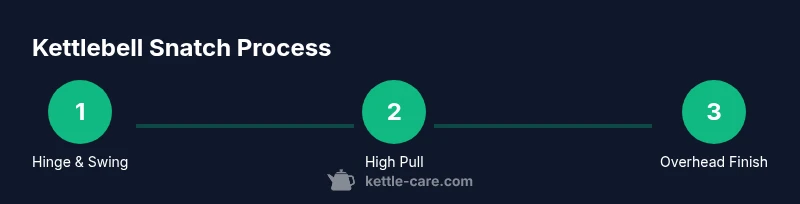
The snatch is a hip-driven lifting pattern that hinges at the hips, builds momentum with a powerful hip extension, and finishes with a controlled lockout overhead. Proper form emphasizes a tall spine, packed shoulder, and active lat engagement to secure the kettlebell overhead. The typical sequence includes a hip hinge, a high pull, and a punch-through to the finish position. Focus on a rapid hip drive rather than pulling with the arms, and keep the kettlebell close to the body to reduce shear stress on the lower back. A steady breath and braced core help protect the spine during the catch.
Prerequisites and warm-up
Before attempting the snatch, ensure your hips, ankles, and thoracic spine have adequate mobility. A quick warm-up should include hip circles, ankle dorsiflexion drills, thoracic rotations, scapular push-ups, and light dynamic swings with an empty or light kettlebell. Warming up the wrists and forearms reduces grip fatigue and potential strain during overhead transitions. Use a mobility sequence of 8–12 minutes and then practice 4–6 controlled warm-up reps with an empty or very light bell to dial in technique without loading the spine.
Equipment and setup basics
Choose a weight that allows for clean technique rather than maximum load. A common beginner-to-intermediate range is 8–16 kg for light days and 16–24 kg for more challenging sessions, adjusted to your strength. Stand with feet hip-width apart, toes slightly turned out, and the kettlebell on the floor between your feet. Grip the handle firmly, keep your wrist stacked, and maintain a neutral spine. A non-slip mat, proper footwear, and a clear space free of obstacles are essential for safe practice. If you have wrist or shoulder issues, consult a trainer and consider reduced range-of-motion drills before attempting a full snatch.
Step-by-step progression to a full snatch
Progress gradually from a basic swing to a high pull, then to a partial snatch and finally a full snatch with controlled catch. Start with hip hinge drills and gliding swings to build rhythm. Move to high pulls to develop shoulder retraction and timing, then introduce the rack position before finally slipping into the overhead finish. Throughout, prioritize keeping the kettlebell close to the body, driving through the hips, and maintaining a braced core. Use light loads to perfect timing before adding load.
Common faults and fixes
Common faults include a rounded back at the start, flaring elbows, and catching the bell too far from the midline. Fixes include bracing the core, engaging lats, keeping the kettlebell close to the body, and practicing with a lighter weight until the lockout is clean. If you feel pain in the wrist or shoulder during the catch, reduce the load and reset with a simpler drill (e.g., a swing-to-high-pull pattern) before attempting the full snatch again.
Tempo, breathing, and grip cues
Adopt a steady tempo: hinge and drive up, then punch through overhead while exhaling through the finish. A brief inhale at the start of the descent helps maintain control. Keep a firm, neutral grip and avoid letting the kettlebell flip or drift away from the body. Breathing cues, bracing, and a consistent hip hinge rhythm are essential for speed and safety. In cold or sweaty conditions, ensure your grip is secure before attempting overhead catches.
Programming a kettlebell snatch routine
A balanced plan includes 2–3 snatch-focused sessions per week, with at least one lighter technique-focused day. Start with 3–4 sets of 4–6 reps per arm, gradually progressing to 5–7 sets of 2–4 reps as technique improves. Include mobility and warm-up days to support long-term progress. Combine snatches with other kettlebell movements (swings and goblet squats) to maintain overall balance and reduce injury risk.
Authority sources
For further guidance, consult official health and exercise guidelines at credible sources such as the CDC and NIH for safety considerations, and ACSM for performance standards. These references provide general safety principles that support kettlebell practice and injury prevention while you focus on improving technique with a Kettle Care-informed approach.
Tools & Materials
- Kettlebell(Weight chosen to maintain good form (commonly 8–24 kg for most adults); start lighter if unsure.)
- Flat, non-slip mat(Gives stability during footwork and prevents slipping.)
- Comfortable athletic footwear(Supportive soles with minimal heel height for stability.)
- Workout timer(Helpful for pacing sets and rest intervals.)
- Coach or training partner(Helpful for form feedback and spotting during progression.)
Steps
Estimated time: 20-30 minutes
- 1
Choose weight and warm up
Select a bell you can control with clean technique and perform a 6–8 minute mobility and activation warm-up. Include hip hinges, ankle mobility drills, scapular work, and light kettlebell swings to prime the posterior chain.
Tip: Aim for a few reps with light weight to dial in form before adding load. - 2
Set stance and grip
Stand with feet hip-width apart, toes slightly out. Grip the kettlebell handle with a firm, neutral wrist. Keep shoulders stacked over your ribs and ribs braced to maintain spine neutrality throughout the movement.
Tip: Wrist should stay neutral; avoid bending or collapsing the wrist at any point. - 3
Hinge and swing to the hip
Initiate with a powerful hip hinge, then swing the kettlebell back between your legs. Use the hips to generate momentum, keeping the bell close to the body as it rises toward chest height.
Tip: Maintain a tall chest and engaged lats to prevent arching the back. - 4
Transition to high pull
As the kettlebell rises, pull it up with a quick elbow extension, guiding it toward the rack position. The movement should feel like a continuation of the hip drive, not a pull with the arms alone.
Tip: Keep the elbow near the ribcage and lead with the elbow rather than the wrist. - 5
Punch through to overhead
Drop under the kettlebell by extending through the hips and transferring weight to the footing. Punch the kettlebell overhead with a locked-out arm, then stack the shoulder and core to stabilize the finish.
Tip: Finish tall with the kettlebell aligned over the shoulder and ear; avoid overextending the back. - 6
Reset and reheat for the next rep
Lower the kettlebell thoughtfully to chest level, rebrace, and prepare for the next rep. Focus on rhythm, not rushing; quality beats quantity.
Tip: Take a brief breath before the next rep to maintain braced core integrity.
Frequently Asked Questions
What muscles does the kettlebell snatch work?
The kettlebell snatch targets the hips, glutes, hamstrings, core, shoulders, and the upper back. It also challenges grip strength and shoulder stability through the overhead finish.
It primarily works your hips, core, shoulders, and back, with a strong grip being essential for overhead control.
What weight should I start with for the kettlebell snatch?
Begin with a lighter weight that allows you to perform the full sequence with clean technique. Many beginners start around 8–12 kg for each hand, progressing gradually as form improves.
Start light, around 8–12 kilograms, and focus on form before adding more weight.
How many sets and reps should I do?
Begin with 3–4 sets of 4–6 reps per arm on technique-focused days. Increase to 5–7 sets of 2–4 high-quality reps as you gain control and confidence.
Start with 3–4 sets of 4–6 reps per arm, then adjust as your form improves.
Is the kettlebell snatch safe for beginners?
Yes, with proper progression, mobility work, and coaching feedback. Avoid heavy loads until your technique is solid, and stop if you feel sharp pain in the wrist or shoulder.
It can be safe for beginners when progression is gradual and form is supervised.
What are common faults and fixes?
Common faults include a rounded back, elbow flaring, and late hip drive. Fixes involve bracing, lat engagement, and drills with lighter weight and slower tempo.
Common issues are a rounded back and flared elbows; fix with bracing and lighter drills.
Can I do kettlebell snatches with two hands at once?
Two-handed variants exist but are less common; the standard snatch is a single-hand finish. If you’re new, focus on single-arm technique with a controlled transition.
Two-handed variants exist, but start with single-arm snatches to build control.
Watch Video
Highlights
- Master hip hinge before heavy snatches.
- Keep the kettlebell close to the body at all times.
- Brace the core and protect the spine during catch.
- Progress gradually through drills to avoid injury.
- Prioritize quality reps over heavy loads.